
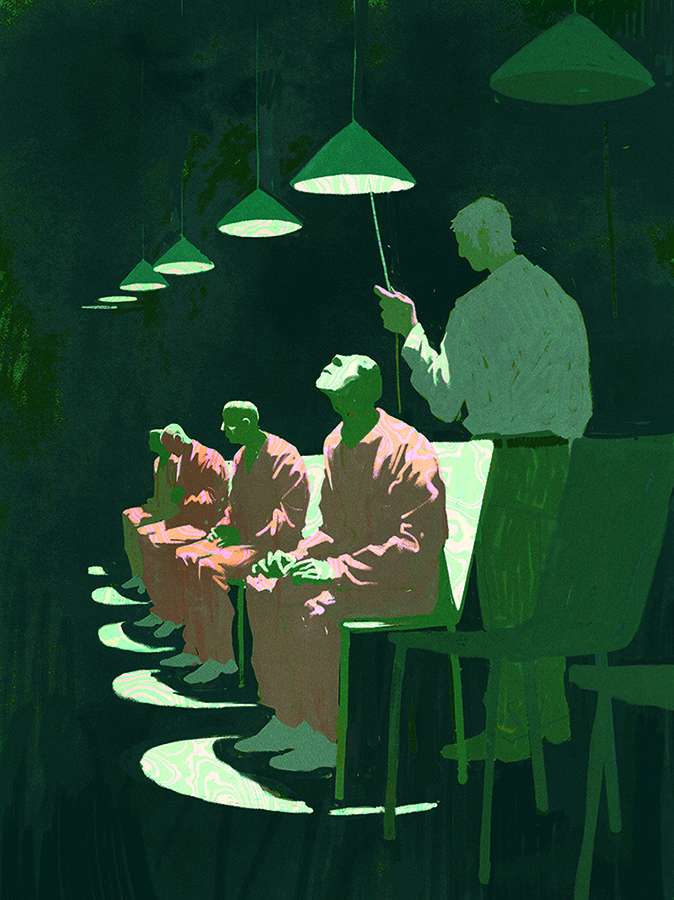
It was a mild spring evening in March 2025, just after 6pm, when Jessie Hoffman shuffled the few steps from his holding cell into the death chamber at Camp F. He had spent his entire adult life at Louisiana State Penitentiary, where I too have been imprisoned for more than three decades following my conviction for second-degree murder in 1990. It is the largest maximum-security prison in the US and is more commonly known as Angola, taking its name from the former plantation on which it was built, which itself was named after the African nation from where large numbers of slaves were exported in the colonial era.
Hoffman, a black man from New Orleans, was originally sentenced to death by lethal injection on 11 September 1998 for the murder of Mary “Molly” Elliot two years earlier. The 28-year-old wife and mother was kidnapped from the city’s Sheraton Hotel car park, where Hoffman, then 18, worked as a valet, near the offices of her advertising company. Hoffman forced her at gunpoint to drive to a nearby ATM and withdraw $200. He then took her to a remote location, raped her and shot her in the head. He dumped her body beside the Middle Pearl River, where it was discovered the following morning by a duck hunter.
Hoffman could never explain why he had done it. Despite being raised by abusive parents, he had been a high school athlete and a “good kid”, his coaches said. In prison, he became an unassuming Christian-turned-Buddhist who projected a sense of calm. He taught literacy classes to fellow prisoners and led Bible studies for followers of his former faith. He wrote lengthy letters to his son and other family members. He enjoyed basketball and was good at it, but rarely joined in the rough-housing that sometimes accompanied the games in prison. He was far from the “worst of the worst” that politicians often invoke when discussing death row inmates. Outside volunteers who taught self-help and religious programmes on death row knew him as helpful and engaging. He seemed a world away from the teenager who had committed the murder.
In his final moments, Hoffman may have wondered how he had been chosen as the first person to be involuntarily executed in Louisiana in more than 20 years. Had he won – or lost – a lottery? Louisiana’s legal system had functioned without forcibly putting anyone to death since a “volunteer” execution in 2010. (Gerald Bordelon waived his appeals, saying he wanted to die for his crime and that he would commit a similar act again if given the opportunity.) Now the informal moratorium on executions was over, and Louisiana was about to crank its state killing machinery back into life. How had this happened?

Opponents of the death penalty in the US have been encouraged by its declining incidence over the past 25 years – fewer capital trials, fewer death sentences and fewer executions. From a peak of 98 executions in 1999, the average annual total from 2015 to 2024 was just under 22. Like war, one asks: what is it good for? The answer appears to be politicians, especially in Southern US states dominated by right-wing politics. Eleven states snuffed out the lives of 47 people last year – the highest number since 2009 and 22 more than the previous year. The youngest was 35; the oldest, 79. They were among the 1,683 people, including 18 women, who have been put to death in legal executions in the US since 1977. (This era of capital punishment began with a 1976 Supreme Court decision that set new standards for imposing the death penalty.) Of those executed last year, most died by lethal injection, though three were executed by firing squad, and five were gassed to death.
On 30 September 2026, attempts to execute a Tennessee death row inmate, Christa Pike, failed. She had been sentenced to execution in 1996 for the murder of 19-year-old Colleen Slemmer. Two syringes of pentobarbital were administered to the 50-year-old, after which point she lost consciousness, but her heartbeat remained, as she audibly snored.
Sentencing someone to death does not mean they are taken directly from the courtroom to the scaffold, as they were in the days of the French Revolution. The average length of time spent on death row before execution in the US is more than 20 years. The appellate process, through state and federal courts, is multilayered and complex, and it is unclear how long public enthusiasm for the death penalty will last. It is county-level prosecutors rather than state officials who encourage the use of capital punishment in America’s legal system, and they are elected by local voters. There is no Crown Prosecution Service or Home Office equivalent to oversee the process at a higher level of government.
Of the almost 10,000 death sentences imposed by courts over the past 50 years, fewer than one in five have been carried out. Thirty-two of the 50 states have not executed anyone for at least a decade. Twenty-three states have abolished the death penalty, while four others have halted executions through executive action. This latter group includes California, which still maintains a death row population of 580 – the largest in the Western Hemisphere – despite not having carried out an execution for more than 20 years. Several other states retain death penalty statutes but have not carried out executions because of political indecision or because their protocols authorise only lethal injection as the method of execution. Since the early 2010s drug manufacturers, many of which are based in Europe, have restricted access for their medicines to be used to kill people. Nevertheless, lethal injections of either a single drug or a multi-drug cocktail remain the most common method of execution (authorities have navigated around restrictions by using stored or bootleg drugs). Death penalty states have hurried to make alternatives available if necessary. In Pike’s case, it is suspected that she did not received sufficient amounts of pentobarbital to cause apnoea and cardiovascular failure. According to Joel Zivot, a professor at Emory University School of Medicine, she may now have a brain injury due to her delayed resuscitation. On 6 October, Pike’s lawyer said she was “speaking limitedly” after regaining consciousness. Her legal team have filed an emergency motion which could lay the groundwork for a future lawsuit against the state over how her failed execution was carried out.
All of the states that carried out executions last year voted for Donald Trump in the 2024 presidential election, making it difficult to ignore the connection between the sudden upsurge in executions and the conservative wave that swept him back into office. Trump has long been a vocal supporter of capital punishment, with his advocacy dating back at least to 1989, when he took out a full-page advertisement in the New York Times calling for the restoration of the death penalty in New York following the arrest of five young men of colour who became known as the Central Park Five. They had been accused of beating and raping a female jogger. Trump’s ad argued that the death penalty was necessary to protect “innocent people” from these “muggers and murderers”. The men were later exonerated after another man confessed and DNA evidence linked him to the crime. As recently as 2024, Trump repeated incorrect claims about the group; they sued for defamation.

known as Angola, in September 2025. Photo by Tia Dufour /DHS/American Photo Archive/Alamy
The beginning of the end of Jessie Hoffman’s life can be dated to January 2024 and attributed to a man named Jeff M Landry. This former rural deputy sheriff entered the Louisiana Governor’s Mansion in January 2024 on the shoulders of the skimpiest voter turnout in decades. Armed with a Republican super-majority in the Louisiana House and Senate legislatures, and the state’s Supreme Court, he immediately set about reversing the more moderate criminal justice policies of his Democratic predecessor. As a staunch supporter of Trump – and of the president’s proposal to acquire Greenland, which led to Landry being named a special envoy to the territory while still serving as governor of Louisiana – Landry had cultivated his own combative political reputation during his eight years as state attorney general. He sued President Joe Biden over expanded oil-drilling restrictions in the Gulf of Mexico, supported constraints on transgender healthcare, opposed pandemic vaccine mandates and rejected the results of the 2020 presidential election. In short, everywhere that Trump went, Landry was sure to follow.
And if the Louisiana electorate greeted his transfer of power with a yawn, roughly 25,000 state prisoners – more than 4,000 of whom were serving life without parole (including me) – watched with trepidation. Landry was barely in office before he summoned lawmakers. He set out to drag Louisiana’s criminal justice system back into the Dark Ages. Penalties for drug possession were increased. Opportunities for post-conviction appeals were reduced. The age at which children can be charged as adults for non-violent crimes was lowered from 18 to 17. He mobilised Louisiana National Guard troops to assist Trump’s federal agents patrolling the southern border with Mexico. He declared a state of emergency, arguing that Louisiana did not have enough police officers. He pushed through a new law allowing anyone aged 18 or over – except convicted felons – to carry concealed handguns without a licence or firearms training, even if they had a documented but manageable mental illness or substance abuse issue. He granted police broad protection from liability, and if a complainant had a criminal record, their claim could effectively be dismissed.
Landry’s next move sucked the air out of the penitentiary. He declared he would immediately begin carrying out executions of the men (and one woman) on Louisiana’s death row. New laws added nitrogen hypoxia, a gas administered with a mask, and electrocution – once considered inhumane due to frequent, gruesome botches and visible physical torture – as authorised methods of execution. Correctional services officials were given authority to choose which method to use. The sources of the drugs and equipment, as well as the identities of those who participate in executions, would remain secret. Landry stood alongside crime victims wearing a wide yellow tie in the state Capitol gallery as cameras rolled and lawmakers below approved the reintroduction of state-sanctioned killing. All of this occurred within two months of his taking office. This is what “tough on crime” looks like.
Following the governor’s announcement, judges in St Tammany and DeSoto parishes signed death warrants, with nitrogen hypoxia executions scheduled on consecutive days in March 2025. DeSoto’s district attorney, Charles Adams, obtained a warrant for Christopher Sepulvado, who had been convicted of the 1992 scalding murder of his six-year-old stepson, Wesley Allen Mercer.
Wheelchair-bound and aged 81, Sepulvado was the oldest prisoner on Louisiana’s death row and had been placed in palliative hospice care at the penitentiary. His execution was scheduled for 17 March 2025. A warrant was also issued for the execution of Jessie Hoffman. He would die the day after Sepulvado.
Before the state could get to the business of executing prisoners, there were some lingering legal matters to clean up. In 2012, attorneys for condemned prisoners, including Sepulvado and Hoffman, sued in federal court, claiming that the state’s lethal injection protocol was unconstitutional. They argued that the state’s lack of transparency regarding drugs and procedures violated their due process, and constituted cruel and unusual punishment. The litigation stalled for years as Louisiana struggled to obtain the drugs needed for lethal injection, then its only authorised execution method. In 2022, Judge Shelly Dick dismissed the case without prejudice after the then state attorney general, Jeff Landry, argued it was moot because the state lacked the means to carry out executions.
On 21 February 2025, Judge Dick reopened the lawsuit after Louisiana adopted a viable execution protocol, ruling that the case once again presented a live legal controversy. Her decision threatened to delay the state’s push to carry out executions and drew sharp criticism from Republicans. Landry called the judge, an appointee of the former president Barack Obama, a “liberal activist” who favoured prisoners over victims.
During the melee over rulings and protocols, Sepulvado’s physical condition worsened. He suffered from a lung condition and gangrene in one of his legs, which led to sepsis. He was assigned to a single-occupancy cinderblock room at the prison’s treatment centre and placed on hospice vigil. On 22 February 2025, incarcerated hospice volunteers – forbidden by the treatment centre to sit bedside as with other dying patients – took turns waiting outside the heavy steel door until Sepulvado drew his last breath. Three days later, a three-judge panel threw out the district court’s ruling and effectively buried the 2012 lawsuit.
When someone is executed using nitrogen hypoxia, the last thing they may see is a full-face silicon mask with a Plexiglas screen descending over them. Thick cushioning presses against the face, creating a virtually airtight seal. When the warden gives the signal, the executioner turns on the nitrogen, allowing it to flow for 15 minutes, or for five minutes after the prisoner’s heart-rate flatlines, whichever is longer. Because nitrogen may leak into the surrounding area, oxygen monitors are installed inside both the execution chamber and the witness room.
Nitrogen hypoxia as an execution method was initially advanced in 2014 by a small team at East Central University, Oklahoma. Alabama was the first state to use the method, and eyewitness accounts described violent movements of the body beneath the restraints, including struggling “to the point that the entire gurney [was] moving up and down”; vigorous convulsions and shaking lasting four minutes; repeated gasping while conscious; minutes of apparent struggle for life; heaving and spitting; and two minutes of shaking and trembling “followed by about six minutes of periodic gulping breaths before becoming still”. On 25 January 2024, when the 58-year-old convicted murderer Kenneth Eugene Smith was executed using nitrogen hypoxia, he “convulsed in seizure-like spasms”, the Associated Press reported, “for at least two minutes of the 22-minute execution”. In his final statement, Smith said: “Tonight Alabama causes humanity to take a step backwards.”
With Sepulvado gone, the governor’s office turned to its next target: Jessie Hoffman. Nitrogen hypoxia was selected as the method by which he would die. Hoffman challenged the decision, arguing that the procedure violated the Eighth Amendment’s protection against “cruel and unusual punishments”. He proposed two alternative methods of execution: a firing squad or a five-drug cocktail.
At a federal hearing, both sides presented expert testimony. Hoffman’s expert, the anaesthesiologist Philip Bickler, testified that nitrogen hypoxia would not cause physical pain but would trigger an overwhelming instinct to breathe, producing intense fear and psychological suffering. The state’s expert, Joseph Antognini, agreed that oxygen deprivation causes severe emotional distress, though he maintained that unconsciousness would occur quickly. Judge Dick found that the evidence demonstrated a substantial risk of severe psychological pain and issued a preliminary injunction blocking Hoffman’s execution, pending a full trial.
Louisiana immediately appealed, and the US Court of Appeals reversed Judge Dick’s ruling. Judge James Ho held that the Eighth Amendment does not require executions to be free from psychological terror and that Hoffman had failed to show nitrogen hypoxia imposed greater suffering than the alternatives he proposed. The court concluded that accepting Dick’s reasoning would effectively render all capital punishment unconstitutional because every execution carries some degree of fear. After the injunction was rejected, the Louisiana Supreme Court and the US Supreme Court both declined to intervene. The execution was back on.
That evening, I joined a fellow prisoner outside our dormitory after work. While we waited for the officer to unlock the door, I told him that Hoffman’s execution was going ahead. “Really?” he replied. “Damn. That means we’ll be locked down on Tuesday. I’ve got stuff to do in the hobby shop.”
I was not surprised by his reaction. In the days leading up to Louisiana’s first execution in 15 years, I found varying levels of interest among my fellow prisoners. Their concern or indifference was not determined by race, philosophical sophistication and spiritual inclination. Many of the older prisoners reflected on previous executions; many of the younger men were oblivious to capital punishment in the Bayou State.
Those with even a peripheral connection to the men on death row felt the anxiety, and monitored the television for breaking news that a reprieve had been granted. These were the men related by blood or friendship to someone who had been executed, or those who worked on the death row tiers, or re-sentenced prisoners who had once sat on the row themselves.
Jessie Hoffman was 46 when he was executed by nitrogen hypoxia. He declined a last meal. He declined to make a final statement. According to reporter John Simerman’s account, the gas was turned on at 6.21pm. Hoffman then shook, twitched, clenched and jerked before he lay still. He was pronounced dead at 6.50pm. Hoffman was the 29th prisoner to be executed in Louisiana since 1983, the first since 2010, and the first to die by nitrogen hypoxia. His was the seventh execution in the US in 2025.
Jeff Landry did not attend the execution. The Louisiana attorney general, Liz Murrill, was present at the penitentiary but chose not to witness it. No one from the victim’s family attended. Members of Hoffman’s family were not allowed to attend. Four witness chairs remained empty. Afterwards, the warden said he was proud of his staff who ushered a human being to eternity in accordance with the law. The secretary of corrections characterised the execution as “flawless”.
Dalton Prejean Jr, who is serving time for manslaughter, found Hoffman’s execution particularly painful. When he was ten years old, in 1990, his father died in the penitentiary’s electric chair. “The day it all went down, it was almost like reliving the moments leading up to my father’s execution,” Prejean told me. “At ten o’clock the news reporter announced that Hoffman was dead. My heart skipped. I couldn’t believe they had actually killed somebody. Was what he did so bad that he just couldn’t be allowed to go on living? Wasn’t there anything about him that was redeemable?”
Twice a week, the inmate counsel substitute Gary Boudreaux makes rounds on the five death row tiers. He knows each of the surviving men housed there. “There was no tension on the row because the guys believed the execution wouldn’t happen,” Boudreaux said. “It had been so long, and they have good lawyers. They just didn’t think executions would come back.”
A week after the execution, Boudreaux returned to the row. The atmosphere was “totally different”. The men now knew that Governor Landry “is serious about executing people, and the state will execute people. There’s no doubt in their minds about that any more.”
Fred Kirkpatrick is a seminary graduate and a Catholic peer minister for death row. From 1983 until his sentence was overturned in 1994, he was condemned to die himself. During his 11 years on the row, 20 men were escorted in chains from their cells, strapped in to the heavy oak chair and electrocuted to death in the name of the state. Kirkpatrick knew them all. The way they died haunts him.
I asked him to describe the greatest fear, apart from the physical act of dying, among people facing execution. “Every man I’ve ever known who walked off the tier towards the chair was more concerned about the people he was leaving behind than about himself,” he said. “Jessie was concerned about his family. He had a son. He had a new wife. He was at peace with whatever was in store for him, but he was worried about his loved ones.”
Following Hoffman’s execution, several district attorneys and Attorney General Murrill attempted to obtain death warrants for other prisoners but failed each time. All of Louisiana’s condemned prisoners, it turned out, still had active post-conviction petitions before the courts. Only Sepulvado and Hoffman had been vulnerable.
Other states continue grinding down the execution process. On 28 July, Florida, which killed 19 of the 47 people put to death in the US in 2025, executed two men on the same day. James Duckett, a former police officer, was executed for the rape and murder of 11-year-old Teresa Mae McAbee in 1987. Dominick Occhicone was executed at the age of 80 for the 1986 murder of his ex-girlfriend’s parents. Both men had spent almost 40 years on death row. Christa Pike sat on death row for 30 years before her botched execution.
Public support for the death penalty has fallen sharply in recent decades – half of Americans believe it is unfairly applied. But national polls over the past 25 years have consistently shown that 80 per cent or more of Republican voters support the death penalty. There have been 29 executions in the US so far in 2026 – with 16 in Florida alone.
If Trump is the inciter, urging the broader and more frequent use of the death penalty as a way of cleansing America of violent criminals, he has plenty of acolytes to carry his fire. Like Landry, Republican governors, legislators, prosecutors and judges enact and enforce statutes that expand their capital punishment options and speed up the process.
No European countries outside the former Soviet bloc have used the death penalty in the past few decades. Most American states have also found they can get along perfectly well without it. It is not worth the trouble and expense when a natural life sentence is readily available. But in several states, the death penalty is one of the ideological planks upon which political careers are constructed. The Supreme Court intervenes, but only occasionally. Choose to kill or not to kill – let the politicians and courts in each state decide.
The day before Jessie Hoffman died, the sister-in-law of his victim Kate Murphy submitted a letter to the Louisiana Board of Pardons requesting that Hoffman be granted clemency and that his death sentence be commuted to life without parole. “Jessie Hoffman’s story is over. Molly [Elliot] Murphy’s story is over. But it doesn’t change the feeling that justice was not done in this case,” she wrote. “We move away from emotional reactions over time, and we’re able to see things more clearly. And when you see things more clearly, you realise that finishing violence with more violence is not the answer.”
Burk Foster contributed research for this article
[Further reading: Born in chains]
Content from our partners



Related



This article appears in the 07 Oct 2026 issue of the New Statesman, The Suspicious Relationship
Join the debate
Subscribe here to comment