
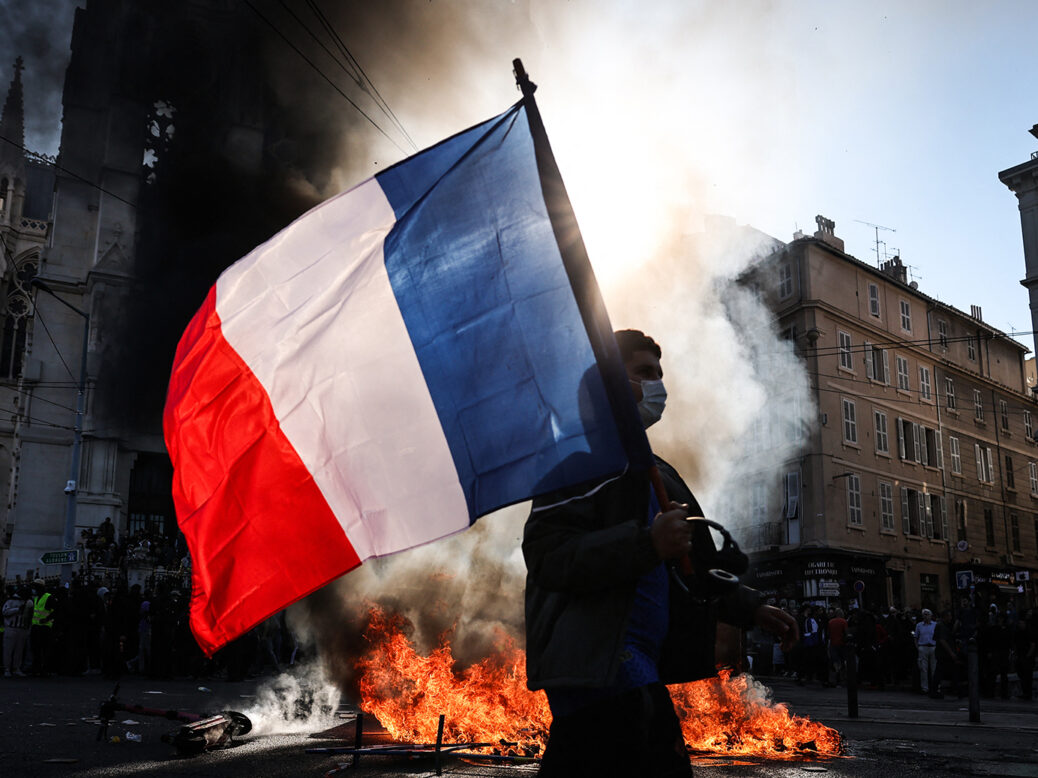
Those at the sharp end of law enforcement are known for their dark humour, and police patrolling the streets of Paris during France’s mass anti-government demonstrations are no exception. “Our job is to chase and catch, and that does not make us very popular,” one tells me, tapping his telescopic baton on a prominent sticker on his reinforced plastic shield. It displays large white letters on a red background: ACAB, standing for “All Cops Are Bastards”.
The acronym was first created in England in the early 20th century, and became associated with militant strikers and anarchists. They often had ACAB tattooed across their knuckles, and – later – so did plenty of other anti-establishment types, from football hooligans to prison inmates. Vandals – including plenty in France – now regularly spray paint it.
That a police officer is now displaying the cult ACAB legend with pride while on duty says everything about France’s paramilitary forces. They are among the most ruthless in Europe, and unashamed of their reputation. More than that, many recruits are hoping the current nationwide insurrection will empower their favoured party, the National Rally (RN).
Polls regularly suggest that some 60 per cent of serving officers and military personnel back Marine Le Pen, the de facto RN leader, to become head of state. It’s likely that figure is higher within the 25,000 professional riot-control officers, who are broadly divided into the Mobile Gendarmerie, a military force, and the CRS, who are police. They are considered unduly confrontational, and as likely to provoke trouble as to prevent it.

The CRS, created at the end of the Second World War by General Charles de Gaulle, earned its reputation for brutality during high-profile disturbances, famously the May 1968 student riots which threatened to depose De Gaulle when he was president. The sight of his cohorts smothering streets with tear gas and baton-charging unruly French citizens shocked some onlookers, but it also appealed to the country’s social conservatives. De Gaulle survived, and so did the Fifth Republic.
Emmanuel Macron will be gone next May after serving the maximum two terms as president, but his time has been characterised by enormous support for the police. No fewer than 238 new gendarmerie brigades have been created under Macron, for example. Despite this, uprisings have been an abiding feature of the Macron years – starting with the gilets jaunes, who brought mayhem in their distinctive bright yellow vests from 2018. Their initial demand was cheaper fuel and, following their very first riots, Macron capitulated, and scrapped environmental taxes on petrol and diesel.
That the vests – mainly rural working-class people struggling with the rising cost of living – are now back on the streets, and contributing to abject chaos, is another example of how soft Macron has appeared to be on law and order, his detractors argue. It is one of the reasons the polls show the RN is most likely to deliver his replacement. In Le Pen’s words: “France must not become accustomed to images of the country being battered, abused and ransacked.”
It alludes to perceived aliens being the worst rioters. Le Pen brings immigration into every issue, even when evidence linking it to problems such as civil disorder is sparse. The majority of the current rioters are indisputably French citizens, many of them very traditional ones, as shown by the gilets jaunes.
Le Pen was last year found guilty of embezzling millions from the European parliament along with senior RN colleagues. She will be forced to serve a sentence on an electronic tag if her final appeal against the sentence fails. But financial impropriety is not considered as serious as violent crime. Villain or not, Le Pen is perceived as being tough on those who maim and destroy.
There is no doubt the paramilitaries – like Le Pen – play up to their image as guardians of an old-world France in which foreign influences are scorned and mocked. An officer who is a RN member is one of four under investigation in Carcassonne for making racist remarks about black Africans. During one of many investigations into protesters being attacked by police, lawyer Mohamed Jaite said “racist and sexist insults” were very common.
The paramilitary brandishing the ACAB shield was wearing a black balaclava. He was in a unit patrolling a section of the Rue de Rivoli, the two-mile-long road that links Bastille and Concorde, two of the most famous squares in Paris. The Hôtel de Ville – Paris City Hall – is on it, as is the Louvre Museum, so it is particularly sensitive.
When I talked to him and his squad, they were taking a break from chasing down suspected looters or arsonists, often holding them on the ground after arrest with their faces pushed into the pavement. More than 2,000 shops across France were broken into on the weekend of 17 and 18 October, while others were set on fire, along with national monuments and other civic buildings – most dramatically the 19th-century Limoges town hall. So such heavy-handedness was understandable.
But I witnessed plenty of extreme police behaviour that was not justified, including at least five officers beating a single unarmed man continually with their batons. They kicked him on the ground as he attempted – unsuccessfully – to retrieve one of his shoes. Unsavoury, certainly, but such images will go down well in a country where plenty think it a good thing that all cops are bastards, and that Marine Le Pen will be best placed to make them even nastier.
[Further reading: Andy Burnham now has a blueprint to rejoin the EU]
Content from our partners



Related
This article appears in the 21 Oct 2026 issue of the New Statesman, Sally Rooney is a writer, not a terrorist
Join the debate
Subscribe here to comment