
It’s a curious thing, what you remember: those brief flashes from childhood that somehow lodge themselves in the brain. Recently I have been thinking about the books that have stayed with me throughout my life in this way – the ones I remember even if I have not read them in decades. As I do so, I keep coming back to the image of my parents’ bookshelves at home and the volumes I can still see in my mind’s eye: where they sat on the shelves, what they looked like, how they felt to pick up.
I remember Sebastian Faulks’s Birdsong, large and imposing, my mum’s favourite; and Bill Bryson’s Notes from a Small Island, light and fun, the book that made my dad roar with laughter. And then there was one more serious tome sat in a corner: Bernard Crick’s In Defence of Politics, a dark, formidable-looking thing – the marble bust of a Roman statesman staring back at me from the cover.
I cannot recall whether I read all of Crick’s Defence, but its thesis has stuck with me. Politics, Crick argued, is not a dirty thing, nor some kind of unfortunate reality we must grudgingly accept. Rather, it is a noble pursuit: the only civilised method of resolving conflict in a free society. Those parts of it that are decried for being unscrupulous or underhanded – the backroom deals and shoddy compromises – are actually to be welcomed.
In one sense, it is possible to view the recent back-and-forth over Home Secretary Shabana Mahmood’s immigration reforms in this rather Crickian way: the messy result of bargaining within the wider Labour Party in which the left and right make their voices heard. Keir Starmer had pushed the party too hard to the right without enough support to do so. The left pushed back, and the result is what we see before us.

This process is how politics is supposed to work. That, of course, does not mean the end result of this tussle – the actual policy – is wise. But it reflects the current balance of power in Westminster, which itself is the result of a general election.
It was for this reason, I think, that for much of my adult life I had assumed that the messy nature of politics was little more than the by-product of the messy pursuit of power. I no longer see it this way. Politics is, in fact, a continuous, never-ending contest of ideas, influence, organisation and leadership. Those who win elections can still “lose” the longer battles of history, while the losers of one poll or another can find ways to dramatically influence the national debate in ways that are often barely perceptible – sometimes for good and often for bad, depending on your point of view.
One obvious example of this is the way the Eurosceptic right in Britain won the referendum in 2016 – and then the general election to “get Brexit done” in 2019 – having suffered electoral defeat after defeat throughout the previous four decades. Imagine telling those close to Tony Blair in 1997 that Britain’s future would not be the open, liberal, European world they believed was the “future”, but would, in fact, be one of austerity, conservative populism and withdrawal from the European Union.
Equally, the victors of 2016 may find themselves cursing the fate of history, should Britain reapply for EU membership under Andy Burnham or one of his successors. History is not pre-ordained, but the result of events, circumstance, personality – and politics.
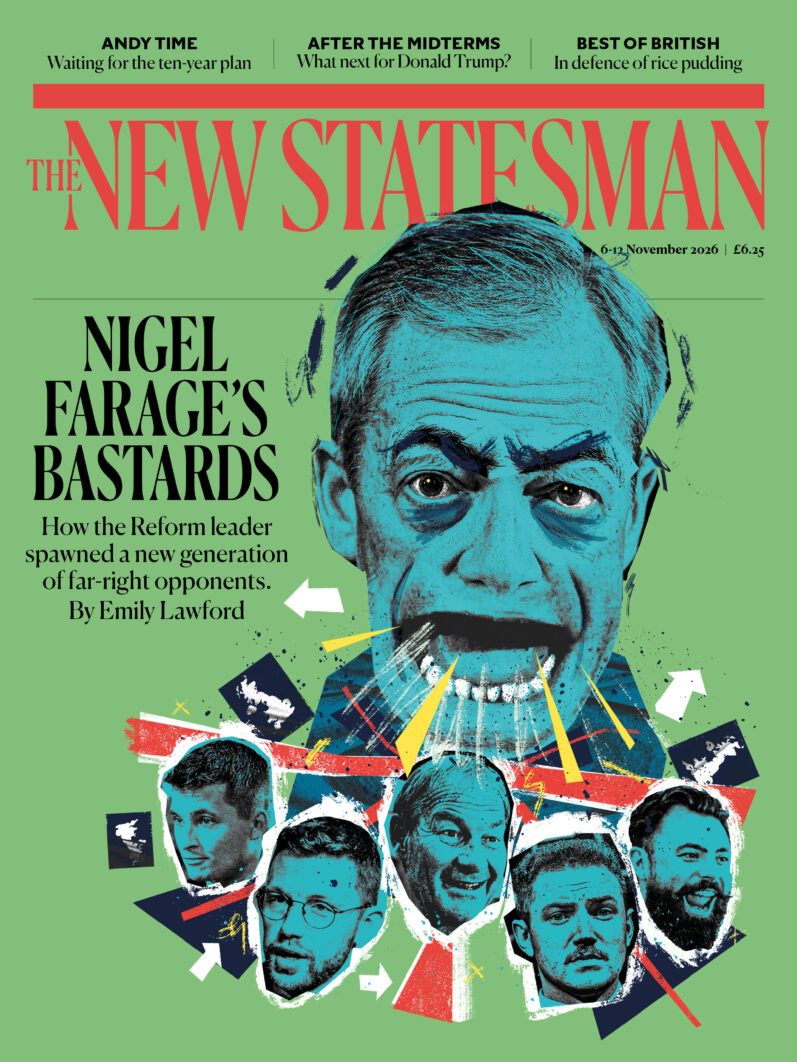
It is for all of these reasons that we should take this week’s Cover Story on the influence of the new, new right as seriously as it deserves to be taken. In it, our reporter Emily Lawford reveals the effect on British politics of a group of fringe radicals who have congregated around the figure of Rupert Lowe, the one-time Reform UK MP who is now the leader of the even more radical force on the right of British politics, Restore Britain.
Politics is the only way to govern a free society. But it is also a constant battle for influence and control, in which those on the fringes of our national life can, over time, find their way into the mainstream even if they are a long way from commanding a majority at the ballot box.
[Further reading: The midterms are Maga’s “doomsday”]
Content from our partners



Related
This article appears in the 05 Nov 2026 issue of the New Statesman, Nigel Farage's bastards
Join the debate
Subscribe here to comment