
Last week’s open letter in support of Sally Rooney, calling for the Terrorism Act to be amended to protect free expression, generated an extraordinary response. Not all of it has been positive, of course. While many readers wrote in to endorse the letter, others argued – reasonably and often forcefully – that it was Rooney who was to blame for the situation, not the government. She has chosen, of her own volition, to self-censor by going out of her way to breach a law that, irrespective of its merits, should be followed because it is the result of a democratic process. One reader, Peter O’Halloran, from Cavan, Ireland, was among many who got in touch to make this point: “While taking a moral stance is, of course, to be admired, surely the law is the law?”
This was the argument of the Home Secretary, Shabana Mahmood, in the House of Commons on 26 October when the independent MP Shockat Adam read out the opening lines of our letter. Mahmood, clearly annoyed by Adam’s question, replied that there was “a world of difference between selling books and enjoying the fruits of your labour, and saying you will use that money to fund a proscribed organisation”. This, indeed, is the reason Rooney’s publisher, Faber, made the decision to withdraw her books: Rooney had pledged to donate the royalties directly to Palestine Action, a proscribed organisation. Yet we did not argue the law should be breached, but that it should be altered. The government should change course, we argued, “amending the legislation which has led us to this point of repressive absurdity”. We stand by this.
In the wider media, there was much criticism of Rooney and those who signed our letter, yet even among some of their harshest critics there was a degree of consensus around this point: the law is clearly not fit for purpose. In the Atlantic, my former colleague George Packer argued that Palestine Action, which was proscribed by Yvette Cooper last year, has often acted in “vile” ways, but that does not mean its members are terrorists. “To lump Palestine Action with the Islamic State and al-Qaeda makes the word terrorism almost meaningless,” he argued. Furthermore, he wrote, the amendments to the Terrorism Act that mean that anyone who “expresses an opinion or belief that is supportive of a proscribed organisation” can be arrested are even more absurd. Indeed so.
In the Times, Janice Turner took a similar line of argument. Though hostile to our letter and to Rooney, she was also clear in her contempt for the government’s decision to proscribe Palestine Action. “Let us hope next month the Supreme Court finds that it was disproportionate to proscribe Palestine Action and the government escapes the corner into which it has stupidly painted itself,” she wrote. Again, we agree.

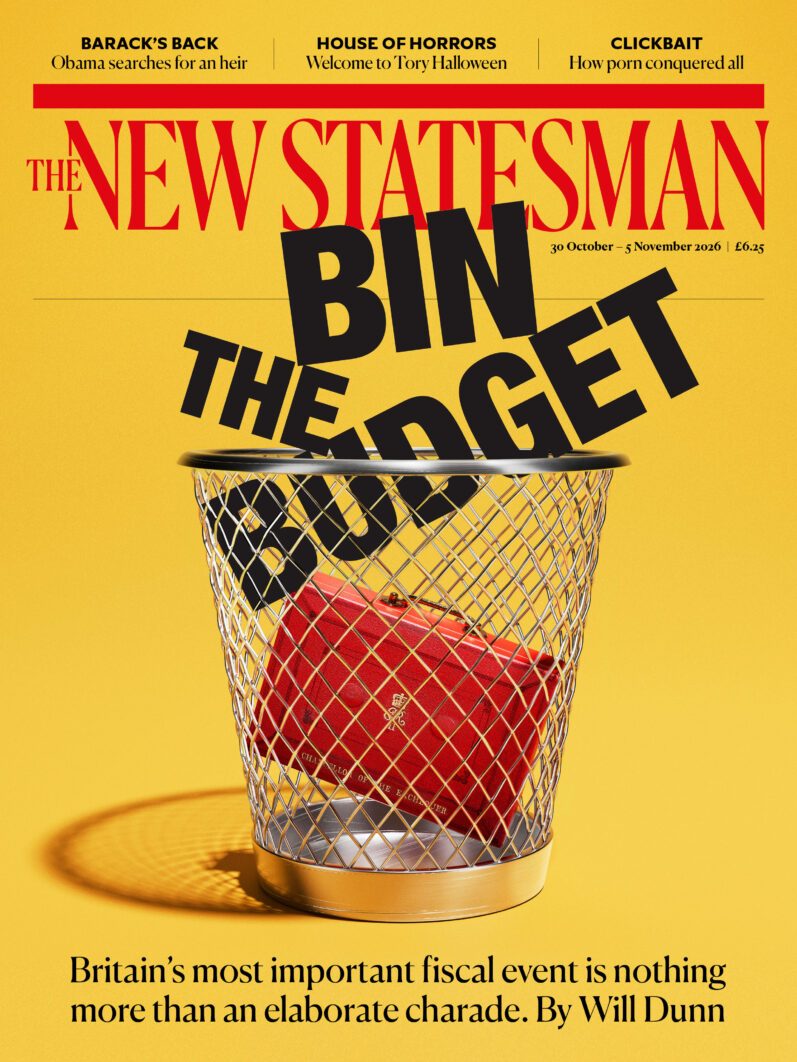
One of the joys of editing the New Statesman is the platform it offers to provoke conversation: to make arguments, promote ideas, challenge the status quo – whether that is the institutions that rule the country, the laws that govern us, or the way of doing things that we often do not even think about. Our Cover Story this week is a case in point, challenging the very existence of an annual Budget – that revered annual charade that sets the course for the next 12 months in a display of political theatre inherited from the 18th century. Why do we run our country this way, Will Dunn asks. Other countries do not. Why don’t we just scrap the whole process? As ever, we would love to hear your responses to this idea – positive or negative.
The journalist and campaigner Anthony Barnett once told my predecessor, Jason Cowley, that “every magazine needs a project”. The project of this magazine as I see it is to conserve its original, capital-R Radical spirit, a tradition older than left or right, adopting what the first editorial of this magazine described in April 1913 as “a critical standpoint” to the world around us. More than that, though, every good magazine should be a continual conversation between its writers and readers; a challenging back and forth, dealing with “all current political, social, religious and intellectual questions… bound by no ties of party, class, or creed”, as our first Leader put it. When I read those lines, I find myself nodding along, as if I was appearing in one of those grim American political adverts: “I endorse this message.” The response to our open letter last week has been brilliant. Over the following weeks I plan to introduce more ways for us to keep the conversation going. In the meantime, please keep those letters rolling in!
[Further reading: Abolish the Budget]
Content from our partners


Related

This article appears in the 28 Oct 2026 issue of the New Statesman, Bin the Budget
Join the debate
Subscribe here to comment“The response to our open letter last week has been brilliant. Over the following weeks I plan to introduce more ways for us to keep the conversation going. In the meantime, please keep those letters rolling in!”
Clickbait journalism?