
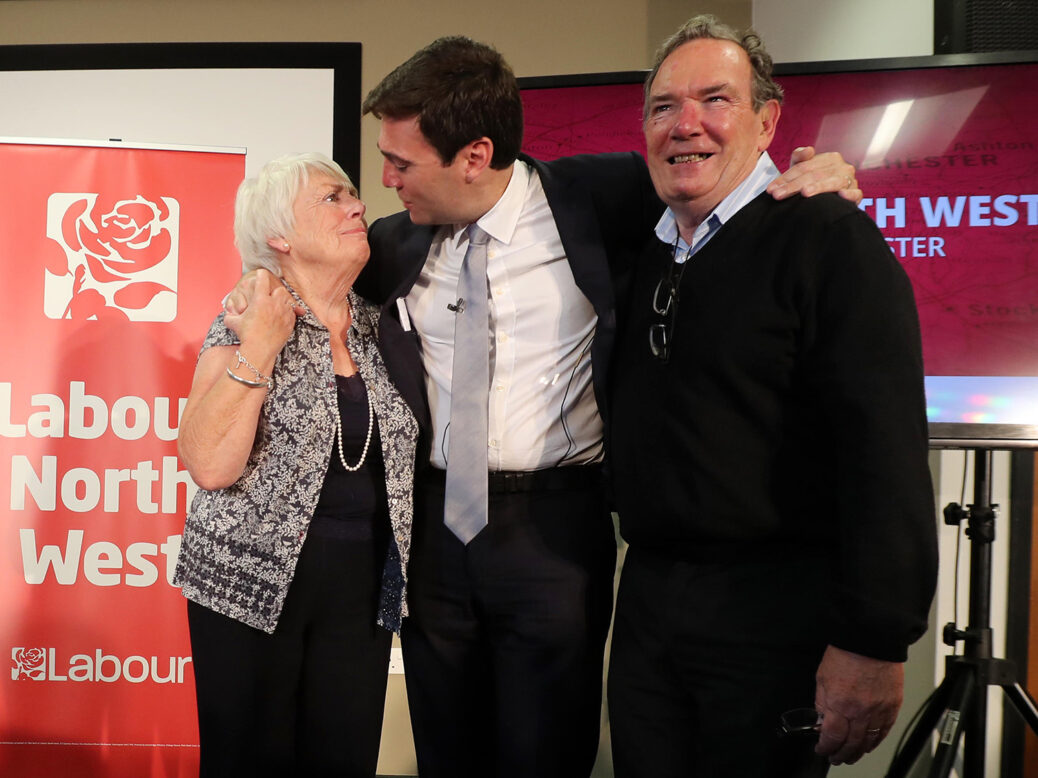
It was early Monday afternoon when I heard the news about Andy Burnham’s father. I was on the way to meet my own father when the news flashed up that Roy Burnham had passed away after struggling with Alzheimer’s – a disease many of us are now acutely aware of.
I still remember vividly my grandad’s descent into dementia – the gradual loss of comprehension, the withdrawal, and those sudden flashes of life. My nan tells the story of the day, sometime towards the end of his life, when, sitting in his armchair, having been silent all day, the light suddenly switched on, and he said, softly, as if he had never gone anywhere: “Sweet, I love you.”
There’s a clip of the Prime Minister reflecting on a similar moment in an interview with Elizabeth Day on her podcast How to Fail from a few weeks ago. Asked whether his father had known he had become PM, Burnham told the story of how his dad had been brought in front of a television at his care home just as he began walking up Downing Street. “Look Roy, look, look,” the nurses had said. And for a moment, he knew.
It was with such melancholy thoughts that, one night earlier this week, I headed over to a friend’s house after work for my “dads’ book club” (as we call it). Rather aptly, the books that had been chosen for discussion were JL Carr’s A Month in the Country (beautiful) and Leo Tolstoy’s The Death of Ivan Ilyich (remarkable).

Carr’s novel is perhaps the most nostalgic book I have ever read (just about pipping Lampedusa’s The Leopard and Roth’s The Bust of the Emperor) if only because it is set in the kind of northern village where I grew up. Carr’s reflections on the happiest summer of his life, spent restoring a lost medieval church painting, caused him to consider the fleeting reality of life and that perennial question of whether moments of content – individual or national – can be conserved. “No, I suppose not,” he writes. “People move away, grow older, die, and the bright belief that there will be another marvellous thing around each corner fades. It is now or never; we must snatch at happiness as it flies.” Such a gorgeous thought: like Roald Dahl’s BFG, catching dreams as they are born, we must grab life’s moments of joy and protect them.
If anything, though, The Death of Ivan Ilyich was even more mesmerising, telling the story of a Russian judge who seemingly has it all, only to fall ill and slowly become consumed by self-recrimination at the shallowness of his bourgeois life. I absorbed it all, trance-like, in one go. And so had the rest of the dads. There we were – a bunch of “middle-aged, mid-career, mid-spread men” as one put it – feeling utterly seen by a late-19th century Russian aristocrat who seemed to understand the absurdity of modernity. It became the highest-scoring book we have so far read. (Yes, we give each book a mark and record them in a table shared on WhatsApp.)
I had listened to Tolstoy’s novella on a long walk to work one morning as a part of a challenge I have joined to walk 100km in September to raise money for the baby-loss charity Sands after my sister lost her baby girl at 36 weeks earlier in the summer. Death, it seems, is in the air. I speculated during the book club discussion that this was part of getting older. I had read somewhere that this was the real reason many people become more conservative as they get older – not because they suddenly have to pay more taxes and resent doing so (though no doubt this must be part of it) but because of, as Roger Scruton once put it, “the consciousness of death, without which the world cannot be loved for what it is”. Is this true?
Already considering such ideas, I went to work the next day only to discover the writer and one-time arts editor of the New Statesman, Frances Stonor Saunders, had died. Her breakthrough work, Who Paid the Piper?, had exposed how the CIA had used cultural power – from books to magazines and even concerts – as a weapon in the Cold War.
Her work inspired Patrick Radden Keefe, a staff writer at the New Yorker, to investigate whether the hit 1990s power ballad, “Wind of Change”, was actually written by the CIA. With strange serendipity, the next book we are reading at the dad’s escape is Radden Keefe’s London Falling: A Mysterious Death in a Gilded City and a Family’s Search for Truth. The mystery of death – and the search for truth. As descriptions of life itself, you could do a lot worse.
[Further reading: Will AI kill us all?]
Content from our partners



Related

This article appears in the 16 Sep 2026 issue of the New Statesman, Will AI kill us all?
Join the debate
Subscribe here to comment