
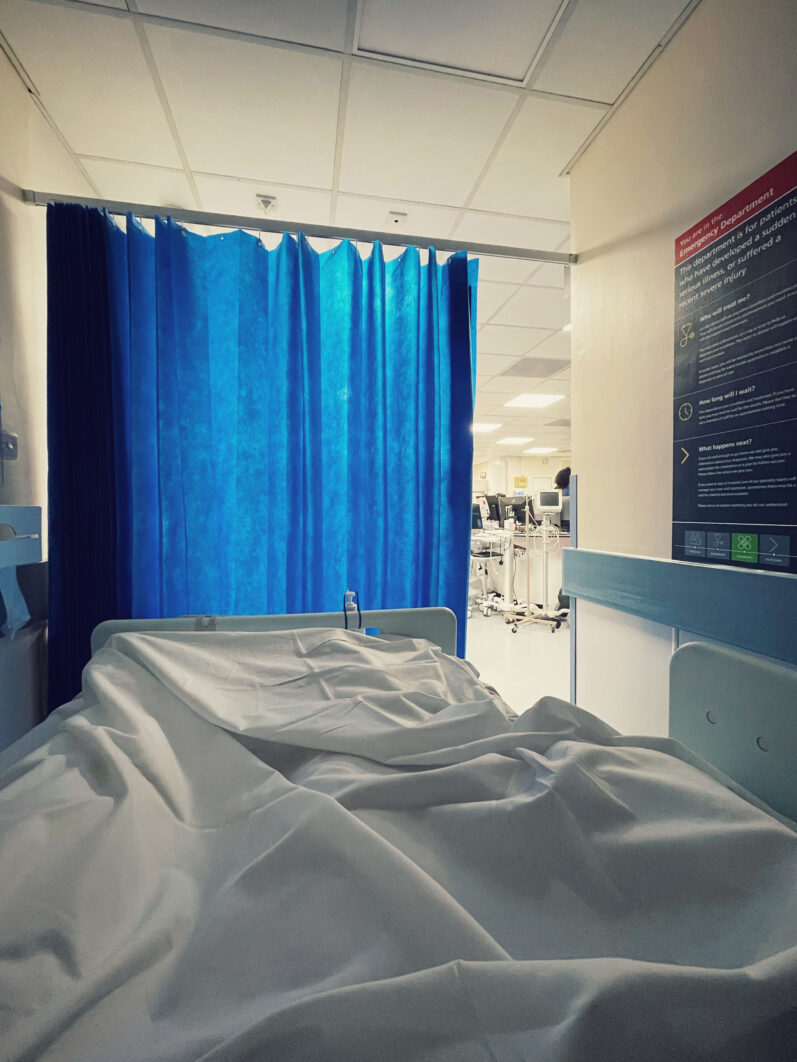
Back in London. My mother, at the age of 99, has fallen down again and is in the hospital, and I have to look after the cat. My editor does not like it when I talk about cats, so I shall keep my mentions of her to a bare minimum, even though she is adorable. Less adorable is the Whittington Hospital, although it does its best. I have come to know the Whittington fairly well over the last few years, now my mother has decided that falling over is the way forward.
On the third floor is a fine view of London, dominated by the Shard. The lifts at the Whittington are famously slow; one could, if one had the talent, draw a pleasing sketch of the city while waiting around. I have no sketchpad and, alas, no talent, so all I can do is stare out of the window and contemplate mortality.
My mother, in a ward with three other ancient women, is more confused than she usually is after a fall. She does not realise she is in a hospital. I have a wearisome conversation with her – well, not so much a conversation as a tiresome back-and-forth during which nothing I say computes for more than a second.
At first, there is something mildly comic about this, because I have not yet grasped the scale of her dementia. The lady in the bed opposite smiles, and I smile back at her with a “what can you do, eh?” shrug.

My mother and I make no progress. This becomes frustrating, although I know it is wrong to be frustrated. But stress and the sight of the wreck she has become have rattled me. “Am I going to die?” she asks at one point. Being a bit deaf, she speaks very loudly, and I have to speak loudly in reply.
“Everyone’s going to die,” I say, which wipes the smile off the face of the lady opposite. The other two ladies are lying back, eyes closed and mouths agape. I realise that my remark needs some qualification. “But not now, of course,” I say. “You’re in the best place you could be – in a hospital.”
“Where am I?” she asks, and then becomes adamant that she be returned home. This, I need hardly point out, is so far out of the question that it’s almost pointless to reply, but I do so anyway. “You can’t go home,” I say. “You’re not well enough.”
“I want to go home,” she wails. This is a woman who had been a star on Broadway, had played Natasha in a live broadcast by NBC of Prokofiev’s War and Peace, had been courted, successfully, by Yul Brynner, at the time regarded as the sexiest man on the planet, and whose marriage to my father was on the front page of the Evening Standard: now a gibbering Struldbrugg.
Actually, that is unfair. The Struldbruggs, for those who haven’t read Gulliver’s Travels, were immortal humans, the very big snag being that they still aged; the immortality did not confer eternal youth. After the age of 80, writes Swift, they are “not only opinionative, peevish, covetous, morose, vain, talkative; but incapable of friendship, and dead to all natural affection, which never descended below their grandchildren”. I had seen my mother only two weeks before, cooking a birthday lunch for my brother in the family home. There she was full of natural affection, as her four grandchildren, three of them with their delightful partners, sat around her in the garden. She seemed a bit out of it but was otherwise capable of holding a conversation, though there were occasional signs of cognitive decline.
“Do you not see them?” she asked, pointing at the desiccated flowerbed. “All those schoolgirls, walking past, with purple dresses.”
“There’s no one there,” said my brother. “I think your brain is making things up in order to fill in the gaps of your vision.” (She is now suffering from macular degeneration, and later, my brother told me that when he visited her a week or so before, she was unable to read the cards that they were playing and had to give up their traditional game of Casino after two hands.) Naturally, this explanation went right over her head, and she continued to describe the schoolgirls.
And now everything is much worse. During my visit to her yesterday, she imagined at various times that she was in John Lewis, that she had been appointed managing director of some unspecified business (“and I don’t even have any experience”), and that my brother, who was with me, had to be very careful of the crystal decanter by the side of her bed. There was no decanter.
On the Saturday before that I’d been reading in bed when suddenly, without warning, the left arm of my glasses snapped. I had no spares with me. I’d thought of packing them but for some reason didn’t. The next day, after my visit to the hospital, I met my friend K— and her pint-sized daughter, L—, at the Flask for a late lunch. Together, for it is not a job that can be done by a single pair of hands, we wrapped Sellotape round the broken arm and it kind of worked. If only people were as easy to mend.
[Further reading: Why the triple lock is here to stay]
Content from our partners



Related



This article appears in the 10 Sep 2026 issue of the New Statesman, The World According To Ed
Join the debate
Subscribe here to comment