
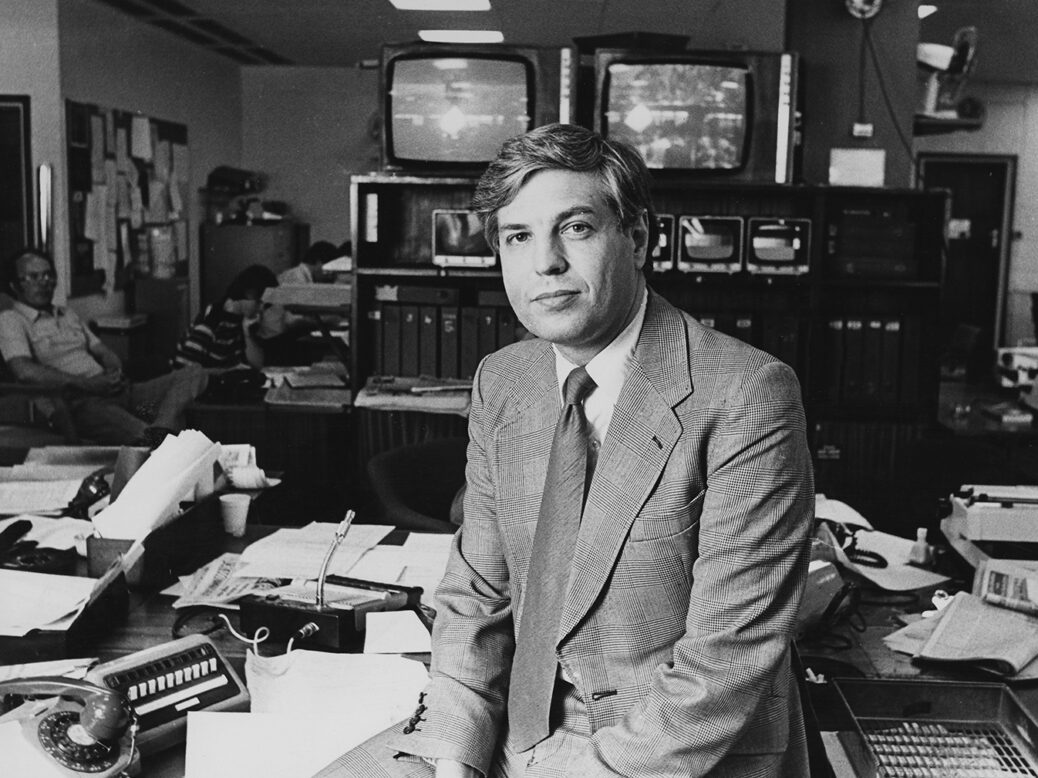
There have been times, in places such as Iraq and Afghanistan and Lebanon, when I’d have been happy to know I’d still be alive and working in an hour’s time, let alone decades later. I’m now celebrating the 60th anniversary of when I first pushed through the doors of Broadcasting House and confided to the commissionaire I’d come to work in the radio newsroom. I was 22 and newly graduated. It would have been inconceivable to that callow, self-doubting, ignorant chap that in 2026 – unthinkably far into the future – he’d still be pushing those doors open. The BBC has often been a difficult employer, and I’ve been a difficult employee; but it’s kept me on. In 2020, it even gave me my own programme on foreign affairs: Unspun World on BBC Two. I labour on it like an 82-year-old grandad on his allotment. Though much is taken, a certain amount abides…
Extraordinary people
I’m halfway through a theatre tour of the country. Having spent my career staring into a camera lens, it’s a pleasure to meet and talk to people. When I go on about seeing things such as the massacres in Sabra and Shatila, Tiananmen Square, the Halabja gassing, the Rwanda genocide or the execution of Saddam Hussein, someone always kindly enquires about the effect all this has had on me. Well, broadcasting is a sort of therapy; talking honestly about such things helps me cope with them. But there’s something more. Even at the worst moments, I’ve found there are always some people who behave extraordinarily well. In Rwanda, I interviewed a Hutu woman who hid her Tutsi neighbour for days, knowing this could end in the nastiest death imaginable. During the civil war in Iraq, many Sunnis risked their lives for their Shia friends, and vice versa. I don’t think I’ve ever covered a terrible story without finding someone who’d acted courageously. Medieval theologians called such people “the saving remnant”. No matter how awful the circumstances, they restore our faith in humanity.
My next documentary
You’d think you could squeeze everything about your career into an hour-long documentary. Sadly not: most of the big stories of my life were chopped out of the recent BBC Two programme about my 60 years for time’s sake. Next, I’d like to make a documentary about absent friends – people I’ve known who’ve been killed or banged up around the world: Imran Khan in Pakistan, Aung San Suu Kyi in Myanmar, Jimmy Lai in Hong Kong, even Bo Xilai – no democrat and not much of a hero – who challenged and failed to beat Xi Jinping to the Chinese leadership. “You’ll never know how insecure a government feels when it knows it hasn’t been elected,” Bo once told me. China’s security ministry sent a team posing as Hong Kong journalists to interview me about my career; it was only when they kept asking about Bo that I twigged. In Russia, Vladimir Putin silences everyone he doesn’t like. Various friends there have been poisoned (Anatoly Sobchak, Alexei Navalny) or shot (Galina Starovoitova, Anna Politkovskaya, Boris Nemtsov). In Gaza, the wonderful, luminous Shireen Abu Akleh was deliberately shot by the IDF. All of them belong to the saving remnant. Honour to them.
Boosting the next generation
I live in Oxford, and was always a wannabe academic. Recently, I came up with a plan for establishing a series of scholarships for young journalists from countries where the practice of honest, unbiased journalism is dangerous, either because of gangsterism (as in Mexico or Nigeria) or because of government threat (as in Hong Kong, Russia or Egypt). The idea would be to bring them to Oxford for the summer and reinforce the notions of honesty and balance; teach them how to deal with potential threats practically; and keep a watchful eye on them after they’ve gone home. I’ve seen how, in countries from Peru and Romania to South Africa, a few good journalists can transform a society. Everyone I speak to loves the idea, but it’ll need cash. Any ideas?

A source of national pride
The BBC always seems to be under the cosh. You might think that having half a billion viewers, listeners and readers around the world and being one of the most trusted news organisations on the planet would be a source of national pride. Well, check out any edition of the Telegraph or the Mail and see. Now its future is in greater doubt than ever before. If the government’s idea of replacing the licence fee with a new television tax doesn’t work, we’ve had it. The BBC is one of the most successful endeavours in British history; how absolutely absurd that it should be in any danger at all.
John Simpson is the BBC’s world affairs editor. Unspun World is on BBC Two at 11pm on Wednesdays
[Further reading: The class politics of going screen-free in school]
Content from our partners



Related

This article appears in the 21 Oct 2026 issue of the New Statesman, Sally Rooney is a writer, not a terrorist
Join the debate
Subscribe here to comment