
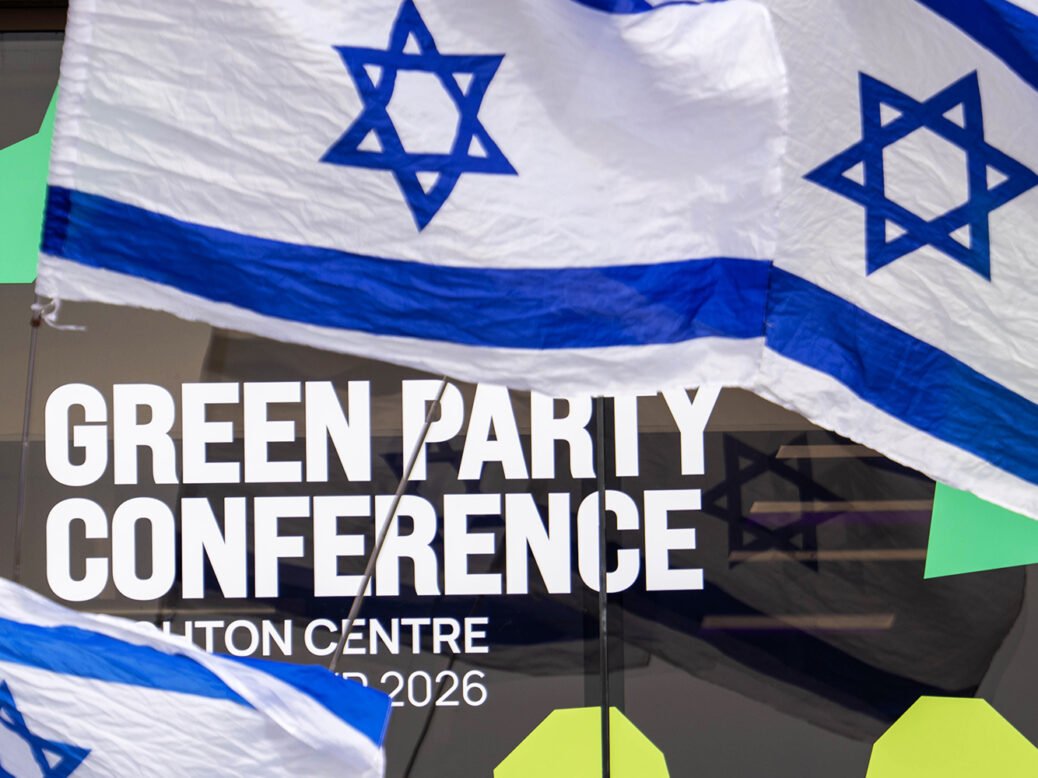
Unless you’ve been living under a rock (and there have been times in the past fortnight when that has seemed a not unattractive prospect), you’ll know about the “Zionism is racism” motion that was passed at the Green Party conference in Brighton. The fallout from it has dominated my week, with passions high on all sides. Those of us who spoke against the motion were clear: the policies and approach of this Israeli government are racist, its horrific actions in Gaza constitute genocide, and a campaign of Boycott, Divestment and Sanctions is essential. But supporting a motion that effectively denies Israel the right to exist crossed a very significant red line. In the weeks ahead, the party needs to come together, to work to show everyone, especially Jewish people, that our party is safe for them; and to make our party’s internal processes more representative and effective. The party’s membership has grown threefold in the past year alone. Our party democracy needs to evolve to meet that.
And the task couldn’t be more urgent. The country needs a strong Green Party. At a time of accelerating climate breakdown and nature collapse, with a crippling cost-of-living crisis and deepening inequality, the Green Party’s bold ideas have never been more necessary. From leaving fossil fuels in the ground to full public ownership of water companies and an emergency brake on rent increases, we are offering solutions that this government won’t go near unless Green pressure forces them to.
England, our England
The focus on that motion has understandably overshadowed everything else that happened at the conference. But one fringe I particularly enjoyed was “Our England: Greens, Nature and the Battle Against the Far Right”, where I spoke alongside John Denham, a former Labour minister and now professor at the Centre for English Identity and Politics at Southampton University. We agreed that, with a few honourable exceptions, the left has been wholly negligent in setting out what an inclusive and progressive patriotism might look like – so we can hardly be surprised if a regressive, inward-looking narrative fills the vacuum.
This could scarcely be more dangerous – because if progressives don’t try to define an inclusive sense of English identity, then we leave it to racists and the far right to determine who does and doesn’t belong. Unsurprisingly, I rarely agree with Kemi Badenoch – but I was cheering her on during the part of her Conservative conference speech when she tore into Suella Braverman’s suggestion that English identity is exclusive to white people. Next year marks the 1,100th anniversary of England. I hope we can use that moment to tell more compelling stories of a nation that has always been plural, and to start a long-overdue debate about the democratic reform that’s essential if we’re to shape an England that is finally at ease with itself.

Autumn journal
Becoming immersed in the natural world is always a welcome respite from political storms – and right now the birds are on the move on my favourite walk by the Cuckmere River, East Sussex. The Canada geese have joined the herons and egrets on the salt marshes, and it’s been a delight to hear the return of the curlews’ call and to watch the extravagantly plumed lapwings probing for food. I love this time of year, with its extremes of high and low tide in the estuary, and the intensifying colours of autumn.
Instructions for living
The shorter days are also an excuse to curl up in the late afternoon with a book. And that’s a particular treat when the book in question is The Medicine Tree by the writer, illustrator and land justice campaigner Nick Hayes. We’ve worked together on the Right to Roam campaign, which he co-founded, and I’ve always been inspired by his deep sense of kinship with the land, his vision of the importance of place in creating identity and belonging and the sheer kaleidoscopic scope of his frames of reference. I’ve just been reading the passage where he quotes from the ancient Lakota teachings, Instructions for Living – and, as I put the book down, I reflect that in today’s fractured and polarising world, we could do a lot worse than follow its insights about the interconnectedness of all things:
“All of creation is related
And the hurt of one is the hurt of all
And the honour of one is the honour of all
And whatever we do affects everything in the universe.”
[Further reading: The Green Party has urgent work to do]
Content from our partners



Related
This article appears in the 14 Oct 2026 issue of the New Statesman, Fool Britannia
Join the debate
Subscribe here to commentI can’t help feeling that a part of the upset caused by the Greens’ debate on Zionism is the way language evolves over time. Since Israel is a self-proclaimed zionist state, it is inevitable that the word’s meaning has now evolved in people’s understanding to include an almost exclusive political content. That has only been enhanced or aggravated by the behaviour of the current Israeli government.
Other examples of the way words have changed their meaning include the monopolisation of the word ‘gay’ by the homosexual community, and monopolisation of ‘antisemitic’ by Israel instead of the more specific ‘anti-jewish’ – ignoring the other 69 or so peoples who also speak semitic langauges (including the Maltese).
One of the most recent drifts in meaning has resulted in ‘their’ and ‘they’ now becoming, in effect, singular pronouns. Many are the sentences, spoken and written, which begin in a clearly ‘singular’ fashion and conclude with ‘their’ instead of ‘his’ or ‘hers’. This magazine is no exception. Presumably this is ‘woke’ related, whatever that means.
I think thete is lomgstanding use of they/their to refer to one individual but of either gender