
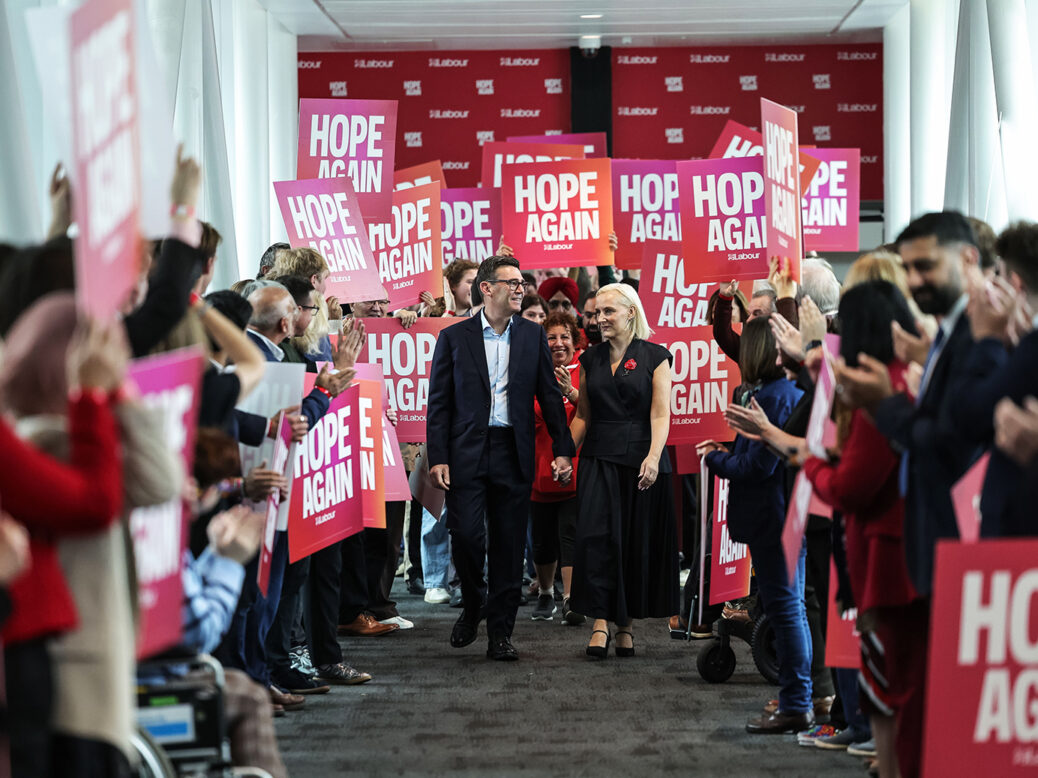
Twelve hours into my first Labour conference, and I have the curious sensation of having gone back in time a few decades, to my first day of secondary school. The conference centre is alienatingly huge, and I wear holes in the carpet trying to find my way between rooms with names like “2C” and “11B”, up and down escalators, round and round corridors. Everyone else seems somehow bigger than me, and they not only know where they are going, but also all know each other. My bag is too heavy. I am at all times either lost or late, and often both.
I swiftly discover that, like school, conference trades on exclusivity – who knows who, who has the invite to which party. The hot invites – other than the New Statesman ones, of course – seem to be Sky and the Mirror. I have neither. I make a brief appearance at the Tony Blair Institute do, at which low lighting and a DJ have been employed in an attempt to turn a meeting room into a club. The only face I recognise among the crowd of boys in ill-fitting suits is Michael Gove’s.
The big speeches are also, I learn, ticketed – the conference accreditation lanyard only gets you so far – and so I am forced to watch John Healey’s on my phone, sitting on the floor in a corridor, eating a sad tuna sandwich. What kind of festival is this, where you need a different, invite-only pass for the headliners?
Burnham season
There is a lot of talk about the “vibes” and the “energy” – which, it’s widely agreed, are good – but I don’t hear much on actual policy, save whispers of ending the triple lock and rejoining Europe. This time last year, I’m told, the mood was rather different: depending on their loyalties, MPs and members were either gripped by despondency about the impending demise of the Starmer premiership, or smug that Andy Burnham had overreached by making his pitch for the leadership too soon. This year’s conference is by comparison an unusually buoyant one – unusual too, a friend jokes, because it is the first in a long time at which Burnham is not trying to become leader of the Labour Party.

Exit through the gift shop
I begin to wonder if conference is less the first day of Year 7, more fresher’s week. In maze-like rows of stands, Labour declares itself “for” or “friends of” everything from women to Hinduism, republicanism to walking and cycling. I emerge with a clutch of branded pens and am just a business card away from having to save someone’s number in my phone as “Liz, bus stop”.
One company has erected a facsimile of No 10 Downing Street, complete with a cardboard cut-out of a hot podium guy (but, curiously, not the hot podium guy), and grey-faced delegates pose for photographs in front of it. The gift shop is doing a good line in merch marking the anniversary of Harold Wilson’s 1966 landslide, including a vinyl compilation, Wilson’s Greatest Hits, featuring such tracks as “Abolished Capital Punishment” and “Abortion Act”. Try putting that one on for a spin on Saturday morning with your coffee and your copy of the New Statesman.
Seeing the light
Seeking refuge, I leave the secure zone and head into Liverpool proper, making for the Anglican cathedral. It is my first time in the city, and I am surprised to find handsome rows of Georgian terraces (John Wood, the elder of Bath, also designed Liverpool’s town hall) and great imperial Victorian and Edwardian architecture that would look quite at home in Whitehall.
The cathedral is cavernous, the biggest in Britain, and mercifully empty. Perhaps the most famous of its many artworks is the Tracey Emin neon, which declares “I felt you and I knew you loved me” across the nave. In the late-afternoon sun, the stained glass windows above send a kaleidoscope across the grey-brown brickwork. But the artwork I find most arresting is by the late Gary Bunt; it depicts a man and his dog, walking in the hills and there stumbling upon Christ on the cross – an everyday encounter. Here, at last, I feel at home.
A masterful idea
Back in London, I head to Shoreditch to see the biennial exhibition for Make Your Own Masters, a brilliant alternative education programme founded by my sister-in-law, Stacie. Finding herself priced out of an MA, Stacie created her own, asking designers she admired to set her briefs and to mentor her. She emerged 18 months later, without a formal degree, but with the portfolio and contacts she needed to get a job in the arts. Eight years on, she has guided many others through the same process. Viewing the latest graduates’ work, from textiles to sculpture to ceramics, I am inspired by the originality and grit of the students, and depressed that the state of arts funding is such that a programme like MYOM is necessary in the first place.
[Further reading: In Liverpool, the Labour Party hopes for hope]
Content from our partners



Related


This article appears in the 01 Oct 2026 issue of the New Statesman, Sunshine and Rain
Join the debate
Subscribe here to comment