
Saxony-Anhalt’s small towns can be jewel boxes of medieval history and many have the drowsy feeling of eastern Germany outside the cities. In Naumburg, I head to the airy cathedral, which features a portrait of the noblewoman Uta von Ballenstedt, famed for her aloof beauty and flowing garb. The Nazis presented her as womanhood idealised, and her dashing, “villain chic” upturned collar is said to have inspired the evil queen in Disney’s 1937 Snow White.
Nearby, Merseburg’s grandest Romanesque church has a Ladegast organ with 5,687 pipes and perfect tone – the Porsche of 19th-century organs. I return after three decades to see a 1,000-year-old manuscript of the “Merseburg spells”, old High German incantations. One should heal a lame horse’s foot, another springs battle prisoners from captivity, if incanted correctly.
Eastern promises
On the way, I visit a friend I met when we were students in the former GDR, first in the Thuringian town of Ilmenau and later when we were both in East Berlin at the Humboldt. For me, these years were the start of a lifetime of scribbling about the oddities of East Germany, covering its demise as a reporter after the fall of the Wall in 1989.
My friend’s 90-year-old mother tells me she is voting for the left-populist Sahra Wagenknecht Alliance in the Saxony-Anhalt state elections “because I don’t want war with Russia”. That fear among a generation who remember the war and the Red Army’s advance across Germany leads to a high degree of pliancy to Vladimir Putin’s aims today. It is a tub-thumping theme of the far-right AfD party, which claims that German money is being wasted in a futile war to help “corrupt” Ukraine.

Ostalgie ain’t what it used to be
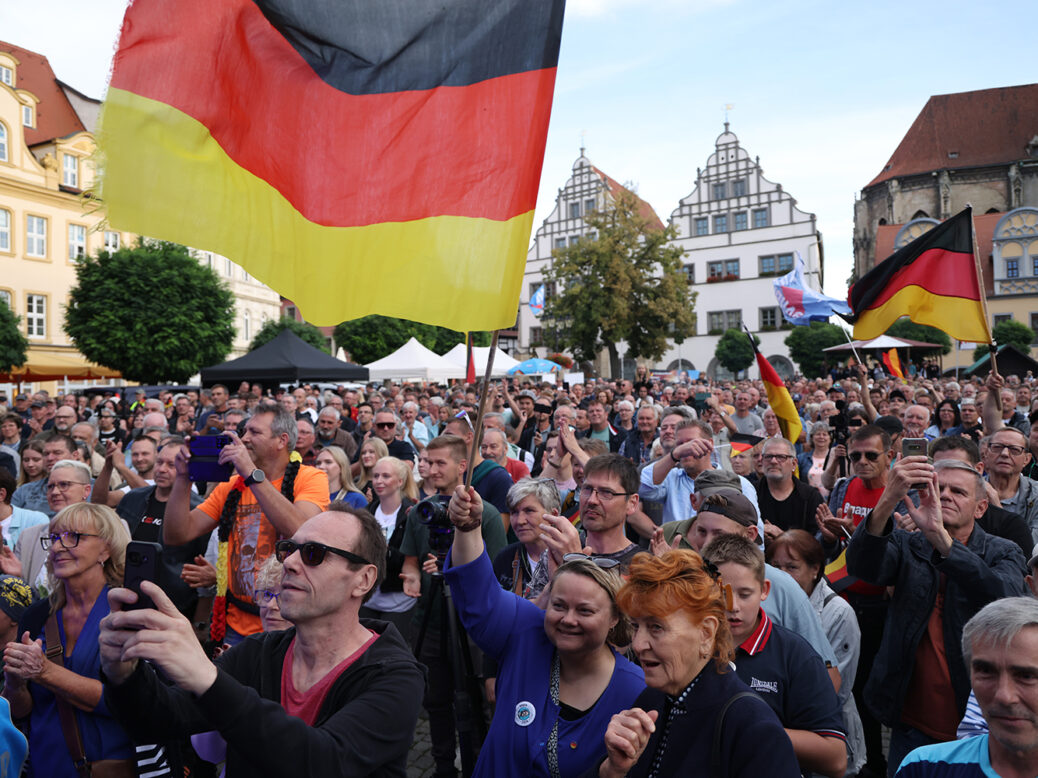
As things turned out, Wagenknecht’s Ostalgie Alliance – forever nostalgic for East German life – cleared the 5 per cent threshold required to enter the state parliament in Magdeburg. We will see if it tacitly shores up the AfD, which was led to victory by Ulrich Siegmund. The incumbent Christian Democrats ended up with less than half the AfD’s vote, though Siegmund’s party still fell short of the absolute majority that would give him the administrative keys to the state.
Watching his geezer-charm with crowds is a masterclass in connection – a skill Germany’s embattled chancellor, Friedrich Merz, sorely lacks. “Man, you work out,” I hear “Ulli” flatter a supporter, flexing with him for a photo. He signs copies of a magazine cover dubbing him “the most dangerous man in Germany” – slights and critiques turned to advantage – and talks fondly of “Ostdeutschland” and a “new 1989 spirit of awakening”.
This mood is catchy after the miserablism of centrist parties who warn of the AfD and talk of eastern Germany as though it is no more than a regrettable headache to resolve.
Silenced in Maga-deburg
Alas, my season in the Siegmund sun ends as one of his praetorian guards clocks that I am a journalist. When I say it’s a public square and stay put, he drags me by the upper arm to a waiting police car, tells an apathetic officer I am an “uncooperative woman”, and uses his bodyweight to push me over a kerb. Behind the smiles there is aggression: the mainstream media are on the long list of enemies Siegmund calls out from the stage. It’s all very Maga from Magdeburg.
Resistance of the elders
The only demographic that did not overwhelmingly go for the AfD was the eldest voters. Do older folk in Saxony recall the reality of East German shortages and the repression of life in a one-party state? Or have they memories of the first decade after unification, when the joys of a free vote were exciting, roads got upgraded, air pollution diminished and the arrival of the Deutsche mark made everyone a bit richer, and – for a while – conjoined? Only in more left-leaning northern states of the old East does the AfD encounter much resistance. As minor as Saxony-Anhalt is on the German political map, it will remain potent, and its successes fuel its confidence in the West too.
Remembering the gut life
To cool the agitated soul, Naumburg’s cafés serve local Softeis, the German ice cream, with soft swirls and cocoa powder. A farming acquaintance tells me it tasted so good because of a glut of milk overproduction in GDR “and smaller cows”. Ostalgie is always best about the small things.
Anne McElvoy is executive editor at Politico, co-host of the Politics at Sam and Anne’s podcast and author of The Saddled Cow: East Germany’s Life and Legacy (Faber & Faber)
[Further reading: The violence in Portsmouth and the rise of vigilante Britain]
Content from our partners


Related


This article appears in the 10 Sep 2026 issue of the New Statesman, The World According To Ed
Join the debate
Subscribe here to comment