
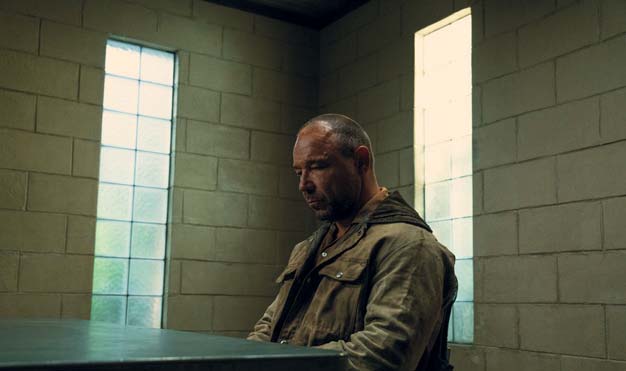
In the cold, blank grey of a high-security cell, Jurek Walter (Stephen Graham) sits preternaturally still, legs crossed, hands in his lap, whispering into the sink beside him. His voice emerges from the pipes into another cell, entreating its resident to suicide: “There’s only one way to stop the pain,” he coaxes. Eventually his victim runs, full tilt, into the opposite wall, caving in his own head. It’s an opening that seems almost to shout: “You’re going to want to watch this!” Unfortunately, Nocturne oversells itself.
We return in the next scene to Riverside Psychiatric Hospital, but in the intervening six months the show’s menace and drive have leached away. Nurse Karl (Rory Culkin), with his gullible wide blue eyes, has a way with psychos and madmen. In a heavy-handed bit of characterisation, we are shown in quick succession how he helps patients no one else can reach; he treats them like human beings when no one else does, as though he can cure them with kindness. He is soon called into his boss’s office: he’s only worked at Riverside for a few weeks, but she feels someone with his “compassion and dedication” is ready to take on more. He is to work in the restricted housing unit. Most of its patients stay temporarily, while they “calm down”, she says. It has only one “permanent resident”.
Down into the basement they go, greeted by the screaming din. There, Karl is immediately dispatched, without preamble or protocol, to give Walter his meds. “Whatever you do” – some last words of warning – “don’t tell him anything about yourself.” And so Karl inches his way down the corridor, alone, towards the cell belonging to the institution’s most psychopathic and most prized resident. All this passes in the first ten minutes, as if on fast-forward. No time is left for tension or dread to build; the series creator John Hlavin really just wanted to get the set-up over with.
If the opening gambit of Nocturne sounds familiar, that’s because it’s already been done, and with greater mastery, by Jonathan Demme (and Thomas Harris before him) in The Silence of the Lambs. Hannibal Lecter, Baltimore State Hospital for the Criminally Insane’s most feared and macabrely revered possession, also induces a fellow inmate to suicide by talking to him through the walls. Like Walter, he too is preternaturally still, with a reptilian, almost unblinking stare. He too learns a great deal about his interlocutors simply by watching and observing tiny details, Sherlock-style. And he too is sent a raw trainee, warned not to give away anything of themselves, and there for purposes of which they are not fully aware.

I am very sorry to say this, because I believe Graham to be one of the most talented actors working today, but here, at least, he is no Anthony Hopkins. We have little reason, other than his musclebound physique and unnervingly high-pitched giggle, to fear Walter because we are shown nothing of his crimes, given little real evidence of what he is capable of.
Elsewhere, Nocturne offers more recycled tropes, more rushed development. Karl is persuaded by Walter to pass on a message to his “lawyer”. Soon after, a ragged and dirty teenage boy stumbles out in front of a truck; this is Michael Frost, who has been missing since he was abducted aged 14 along with his sister, Felicia, three years previously. Michael’s return brings grizzled, grieving detective Jonah (Liev Schreiber) out of retirement. He always suspected Walter of the crime and he’s never quite let it go – as evidenced, of course, by the wall of newspaper clippings, photographs and scribbled notes, unveiled from behind a curtain in his garage. He is, of course, dogged and maverick, and the case unfolds before him easily: a pine needle here, a footprint there. None of it feels hard-won or, indeed, particularly difficult to solve – it all happens too fast.
Then there’s Saga (Zazie Beetz), the daughter of Jonah’s late police partner and his quasi-daughter, who is sent into Riverside undercover to find out what Walter knows. This strand, finally, has the potential to be interesting: how long can you pretend to be insane, keep company with maniacs, without losing your grip on reality?
Apple has already made a compulsive and chilling drama in which a complex hero (Taron Egerton) goes undercover to befriend and ultimately betray a killer. It’s called Black Bird. Watch that instead.
Nocturne
Apple TV
[Further reading: It Gets Worse couldn’t be better]
Content from our partners



Related


This article appears in the 05 Nov 2026 issue of the New Statesman, Nigel Farage's bastards
Join the debate
Subscribe here to comment