
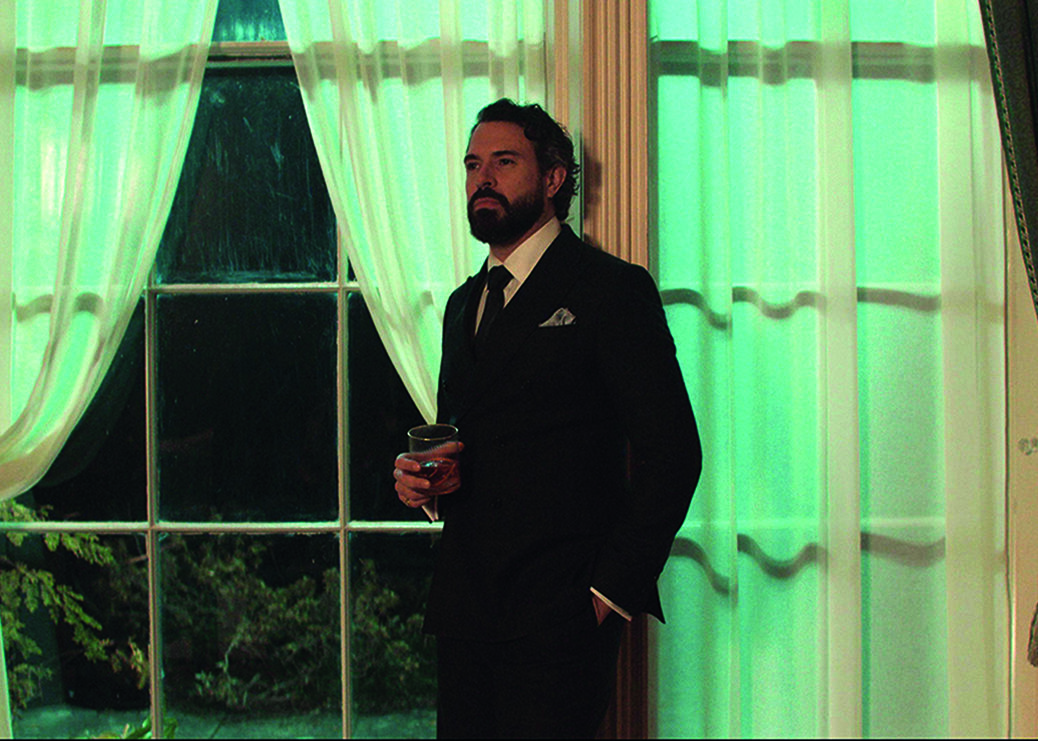
The seigneurial paterfamilias, the wayward sister, the working-class guest and the floppy, closeted heir to the estate. At one point in The Party, one of the characters lists the stereotypes who form its personae. (The wayward sister, Phoebe, is given the job of laying out this tableau, a further reproduction of the expository functions previously performed by Waugh’s Cordelia Flyte, Hollinghurst’s Cat Fedden and, I suppose, Fennell’s Venetia Catton.) And if we know the motions and meanings of The Party, it is no great pain to watch, reanimated, a solid, good-bad contribution to the posh-people-gone-nuts-or-nasty genre that forms so much Anglo-shlock.
The opening montage lays it on thick: the bloodied dress shirt, the police cell, the handgun raised and fired. Something terrible has happened at a country-house party, and we’re going to find out what. We quickly get the sense that something even worse than murder – a breach of social niceties – is at stake too, when we see Martin Gilmour and his wife, Lucy (Luke Evans and Sarah Solemani), checking in to a B&B before the event. They have not been offered accommodation at the house, even though Martin is godfather to one of the hosting couple’s children.
It’s a neat way of establishing the pair’s class relationship to the hosts, which is further complicated into a patron-client exchange. Martin is a journalist, and the party’s host, Lord Ben Fitzmaurice (Tom Cullen) is a Conservative politician, one who, we learn, keeps Martin flush with scoops and stories. What was anticipated as a social event soon turns professional: when Martin and Lucy turn on their B&B room’s tiny television, they see that the Conservative Party leader (played by an actress who could have resembled Kemi Badenoch slightly less) has resigned.
The story proceeds by the fits and starts of flashback, the party inching along, while the backstory of Martin and Lord Ben is filled out in pieces. Again, we’re on familiar tracks here, and pass swiftly through familiar stations. Martin: the scholarship boy at the public school, fouled on the rugby field on his first day. Lord Ben: his saviour and patron and – we sense in the longing gazes exchanged in corridor and quadrangle – the object of more secret desires. Soon, his lordship has invited Martin to Denby Hall for the holidays and we meet the paterfamilias, his lady and the wayward sister.

If these characters weren’t already articulated for us, we’d recognise them easily enough. This is a world in which posh girls wear oversized rugby shirts, posh boys knot cricket jumpers around their necks and posh dads wear blazers with metal buttons. And we’d recognise their habits: the clan takes Martin shooting, where a family friend, the ratty Jarvis (Sam Troughton), snipes at Martin, “What’s it like to be a shadow?” referring to his dogged relationship with Ben. This results in the nickname “Little Shadow” or “LS”, by which the family humiliatingly come to know Martin.
In perhaps too-perfect symmetry, by the time of the party, Jarvis is also a Tory MP and is Ben’s main rival for the Conservative leadership following the resignation of their leader. In the tussle, we not only hear the skeletons in the closets begin to rattle, but we also see who stashed the bones. Phoebe is missing from the party, and we gradually learn that this is down to a car accident after a boozy society night at her university, one that also involved Martin and Ben, and which tethers them together for life.
It would be telling to reveal how the story advances from here, though I will say that there should be a more definitive way of establishing who was driving the car when they crash or receive speeding tickets. The suspense and thrills of this series are no less genuine for being predictable. They are, though, let down by one unfortunate failure. The actor playing the young Martin does a fine turn, innocent and vulnerable, but Luke Evans’s older iteration is oddly played, a sickly, croaky, almost cadaverous performance, which conveys how Martin has been drained of life by his dependency but not why he would be a lively enough monkey for the Fitzmaurices to keep around.
But that is the demand of the story, and on a grander frame the demand of the genre – a genre that has now sprouted, if not a new branch, then a fresh twig.
The Party
ITVX
[Further reading: Inside the Green Party’s identity crisis]
Content from our partners



Related
This article appears in the 14 Oct 2026 issue of the New Statesman, Fool Britannia
Join the debate
Subscribe here to comment