
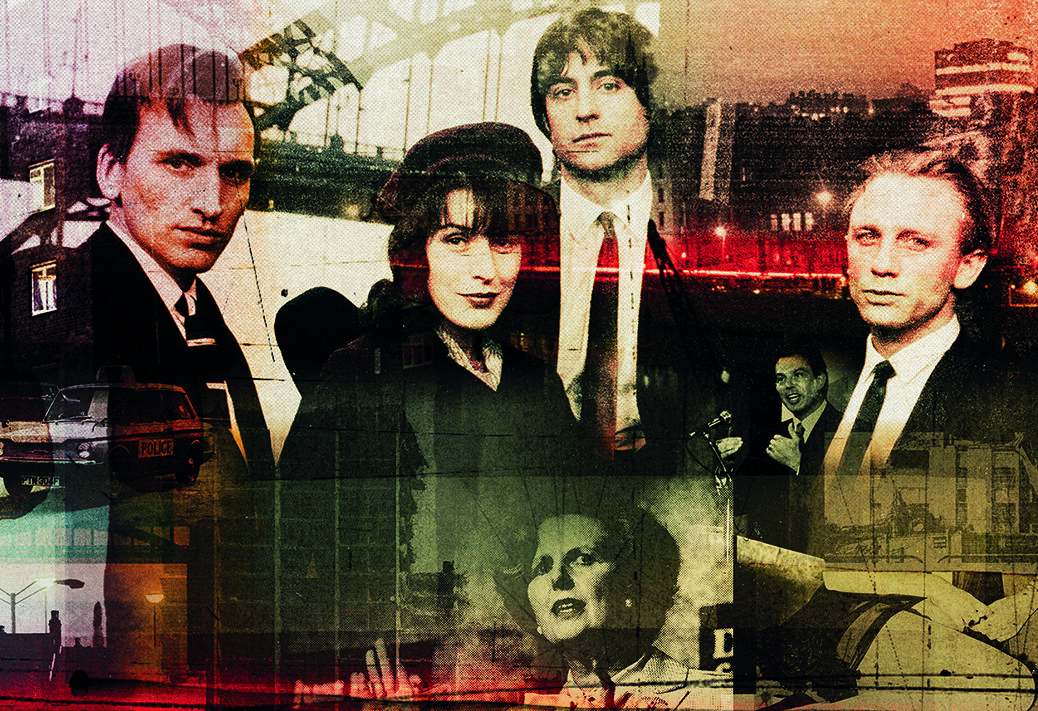
Newcastle’s Live Theatre sits down a side street from the law courts and the River Tyne, close to where four relatively unknown actors posed for the promo photo of Our Friends in the North, one of the most ambitious pieces of British television programming of the 1990s. Their names were Christopher Eccleston, Gina McKee, Mark Strong and Daniel Craig.
At rehearsals for a theatre adaptation timed for the series’s 30th anniversary this year, a clash between police and striking miners in a north-east pit village is being blocked out. The precise way the actors will chant at strike-breakers is being discussed.
“Do you think we should have three scabs?” says Jack McNamara, Live’s artistic director.
“Once, twice, three scabs a lady,” answers Chris Connel, one of the actors.

When the writer, Peter Flannery, was patched in to the first read-through two weeks ago via video link, McNamara joked that everyone would remember him looming over them as they worked. Loom is the correct verb for Flannery’s 1996 show and its legacy.
Beginning in 1964, the story follows four working-class friends against the seemingly unpromising backdrop of social housing policy and party politics in Newcastle, then spiders out to touch on Westminster, the Soho porn underworld and corruption in the Met Police. Every new foray contributes to an interlinked story that covers the whole of society over 30 years. Each of the nine episodes is long enough to be a feature film. The depth of Flannery’s writing, its grand thematic scope and rich central characters – performances which made stars – foreshadowed prestige TV. The viewing figures were unheard of for a BBC Two drama of the time.
Geordie (Daniel Craig) is an optimist who wants to start a beat band, falls in with gangsters and becomes homeless; Tosker (Mark Strong) wants to be a club singer and becomes a self-made businessman, slum landlord and philanderer (“like a dog with two dicks”, as his own mother describes him); Nicky (Christopher Eccleston) is a left-wing idealist who runs unsuccessfully for parliament and becomes disillusioned; Mary (Gina McKee) drops out of university due to pregnancy, weathers mistreatment by both Tosker and Nicky, and becomes a Labour MP in time for Tony Blair’s rise.
Before Flannery agreed to adapt his ten-and-a-half hour series into a stage play, he had turned down BBC requests to reprise the characters’ lives years later. He didn’t want to pick up with them at 90, “sitting in a home, smelling of piss and marzipan”, the 75-year-old writer tells me. He was amenable to an adaptation happening, but was unsure of the extent to which he wished to be involved. McNamara, a theatre director who had previously adapted for stage Lars von Trier’s comedy film The Boss of It All (2006) by typing out the original screenplay – gave Flannery a “dummy version” sketched from two episodes by the same method. Seeing the unwieldy drama cut up this way unlocked something for Flannery. He wrested back ownership of the script.
In fact, even before Our Friends was on TV, it had already once been a play, which took a version of the characters up to 1979. This was the year Flannery, aged 27, became writer-in-residence with the Royal Shakespeare Company. At the time, Terry Hands, the RSC’s co-artistic director, was staging Shakespeare’s history plays. “They chronicled the highs and lows of British society, all piling on to each other,” Flannery tells me over Zoom from his Oxfordshire home. “I didn’t want to write about kings and queens, but I wanted to write about everything in society, high and low.”
At this time, he was becoming increasingly aware that his working-class parents from Jarrow on South Tyneside were entirely suspicious of politics. “They felt the political people they knew were corrupt and the ones who ran their lives from London were corrupt. When you’d talk about politicians, they’d just laugh.”
Flannery had his idea. He cold-called T Dan Smith, the 1960s city council leader dubbed “Mr Newcastle”. Smith had just got out of prison for corruption and accepting bribes while facilitating an urban redevelopment that left the north-east full of instantly crumbling system-built tower blocks. But the alleged recluse was more than happy to assist in Flannery’s research for a play, “possibly about corruption in British public life”. Smith responded with a now well-thumbed quote, that “there’s a play here of Shakespearean proportions”, envisaging himself as a tragic hero. Then in a move that Flannery could have written, Smith tried to put his hand in the young writer’s pocket, expecting to be paid for his reminiscences about trying to build the “Venice of the North”. Lawyers got involved.
Our Friends in the North was staged in 1982, but, Flannery says, “had nothing like the heart of what the TV show became”. Nicola Shindler worked on Our Friends as her first job as a production assistant. She has since shaped British television from the turn of the millennium onwards, producing Hillsborough, Queer as Folk, the David Tennant launchpad Casanova, Happy Valley, Last Tango in Halifax, It’s a Sin and more. Eleven Baftas later, she tells me Our Friends is the “most epic” programme she’s ever worked on.
Period pieces are exponentially more expensive and difficult to film. This, effectively, had nine periods. The sets for a single episode, Shindler says, could have been used to shoot an entire series. Episode one got scrapped, entirely rewritten and reshot halfway into the run. Flannery tells me he had to write a scene to salvage a particularly expensive shot of Daniel Craig walking past some colliery houses that were demolished for the purpose.
“That’s what Peter’s really good at,” Shindler tells me. “Making everything as difficult as possible while trying to make it as good as possible. He never wanted to compromise on his ambition just for the sake of people slogging away. And it was right.”
“I think Our Friends in the North is the greatest TV show ever written,” Danny Brocklehurst tells me. “The breadth of its ambition; the way it sweeps through 30 years of British politics and social changes; the acting. The writing is superb. It’s a remarkable piece of television on every level. The only downside is, as a television writer, I doubt I will ever do anything as good.”
Brocklehurst wrote the award-winning first three seasons of Shameless and created Sky One’s most successful comedy, Brassic. Like Flannery, the Mancunian writer has influenced the way working-class British lives and the north are broadcast.
“What Flannery did brilliantly was write characters who I recognise from my background with the same respect and the same importance as any character. Because to them, their lives matter just as much as the life of an MP.” When he worked with Paul Abbott on the first series of Shameless, their mantra was: “Always remember these people love each other. They don’t see themselves as poor. All they’re trying to do is get through their life in the best way they can, look after their families and have a good time.”
Nicola Shindler has found that Our Friends had a similar effect on many of her writers. “Seeing four working-class characters, their families and friends on screen, and their lives being considered as important as Shakespeare, has made such a difference to their writing.” Just as Flannery’s storytelling and sense of political urgency has, she tells me, left an impression on everything she has produced since, whether it’s The Blame, currently running on ITV, or Russell T Davies’s Tip Toe.
Watching Our Friends today, I am struck by the ways in which it seems to presage The Wire’s sequential sprawl from street-level crime and policing to city politics and dirty money. Or the way characters in The Sopranos or Mad Men, rather than undergoing satisfying dramatic arcs of growth and breakthrough, seem about to change only – so frustratingly – to resist change. Or the way whole episodes could be discreetly structured by theme.
Charlie Pattinson produced Our Friends at the BBC. He tells me that within television circles, it shifted the way people started to develop programmes. “Every time there’s a hit, the conversation becomes: where’s the next Game of Thrones? Back then everyone was saying, where’s the next Our Friends in the North?”
Its mode of storytelling became what people wanted to develop. “It was one of the absolute first of those programmes that ushered in what people now refer to as the golden age of television,” Pattinson says. “Those novelistic serials by great writers, of which there are only seven or eight examples.”
When I asked Flannery whether he saw his influence in the television of today, he admitted he didn’t watch all that much. “But I’d love to know if David Simon had seen Our Friends before he created The Wire.”
He laughed when I said I’d already reached out to Simon asking the same thing. (I got no reply.)
This is a co-production. Our Friends in the North: The Thatcher Years will be staged not at the Live Theatre, but at Newcastle’s much grander, 1,800-seat, 19th-century Theatre Royal. In its rehearsal space, the cast firm up the miners’ strike scene I had witnessed a week earlier.
The actor Trevor Fox, who was in the series too, advises on the reality of police confrontations; the “apprehension” felt when they knew something was going to kick off. In the show, Fox played the local policeman Harry in this very scene. Offscreen he was affiliated with Militant Tendency: the hard-left group with which Nicky Hutchinson, Christopher Eccleston’s character, is involved.
Now he plays Nicky’s father, Felix. And the two acts of the play, one set in 1979, the other in 1984, neatly tell the story of Nicky’s ideological disillusionment and relationship with his father; who had, in his turn, become politically disillusioned when the party leadership distanced itself from the Jarrow Marchers in 1936.
“I tried to warn you, son,” Felix says in the new play. “I tried to tell you about the Labour Party.”
When I speak to Christopher Eccleston, now a household name – within a decade of Our Friends, he was the Doctor in Doctor Who – he remembers exactly where he was sitting in his London flat when he read a scene that has Felix being attacked by a man and his Rottweiler. “I thought: this is going to be one of the greatest moments of British television,” Eccleston says. “The decline of the working-class sense of self, and sense of dignity, was captured there by Peter Flannery: this lion of the left, Felix, being savaged by the dog of a man who’d been thrown on the scrap heap under Thatcher. I remember crying, reading that. And also an enormous surge of pride that I was going to be involved in it.”
He still seems to feel this. As Eccleston talks, he instinctively quotes entire lines from the original script in the Geordie accent he used. He is briefly, almost imperceptibly, overcome with emotion at points.
“I was deep in a typical working-class experience of a deeply middle-class industry,” he says. “I was consumed by impostor syndrome. So all I could see was how I failed with the accent, how I failed with the performance. I was still skint. I was still living in bedsits. I was looking for my next job. Can I get another job? Can I get a script as good as that?”
It was only with time that he saw the impact he had on younger people, who tell him Nicky Hutchinson made them want to act. “They jump on Nicky’s burning idealism. I get moved talking about it. He wants to change the world. And I still feel that. Every so often something like Our Friends in the North comes along and it changes the landscape. And I still believe. I still hope to be part of something like that. But if not, I’ll always have Newcastle. We’ll always have the Tyne Bridge.”
Our Friends in the North was Peter Flannery’s first large playwriting commission, and he’s still writing some version of it 48 years later. It has, almost accidentally, sprawled into a life’s work. “It’s got a kind of symmetry,” he tells me, “because I think this will probably be the last thing I’ll write.”
The show itself is constructed out of symmetries and repeats. So it’s not surprising that, politically, we are still living out the things Flannery is still writing. A big theme is not just the disillusionment of working-class, left-wing voters with Westminster, but also a party’s inability to enact change once it has compromised to get into office.
“You know my opinion,” says Felix in 1964. “Doesn’t matter who wins the elections. Nothing changes.” As for the region, he was speaking from an era when Labour had “[run] the north-east since 1919” and been unable to conjure up the change it promised. Labour hasn’t had this certainty for a decade.
Does Flannery think Andy Burnham, with his No 10 North, will fare any better in enacting change?
“I suspect he’ll make some progress around the edges,” he says. “And then, like every other Labour man on the left I’ve seen in my lifetime, he’ll get mangled in the machine. That’s what I think will happen. But I hope it won’t. I don’t know why I hope, after watching this just happen time and time again.”
Unexpectedly, it is T Dan Smith who Flannery turns to for the show’s final note of hope. “Tomorrow’s too late,” Flannery once heard Mr Newcastle say, and these are the last words of Nicky’s mother, Florrie, to her son, in a letter suggesting he can still change his fortunes – as long as he acts now. “Dan said that over and over about political change,” Flannery tells me. “He was sort of saying, ‘Move fast and break things. Crack on – do it now. Do it while they’re not watching.’ And I think Burnham should say things like ‘Tomorrow’s too late’. If I was writing his speeches, he would.”
Our Friends in the North: The Thatcher Years is at Newcastle Theatre Royal until 24 October
[Further reading: The ghost of Hannah Arendt in the Banality of Evil]
Content from our partners



Related
This article appears in the 14 Oct 2026 issue of the New Statesman, Fool Britannia
Join the debate
Subscribe here to comment