
When I was younger, I thought America was one massive city. It came to me on E4 in sitcoms with hundreds of episodes; it was brownstones and bars and diners. And it was not until I visited the country that I realised that most of America is a wilderness of forests and plains that puts our “countryside”, with its chequerboard of steady browns and greens, to timid, miniature shame.
That wilderness has its own literary tradition, which – speaking for myself here – does not always survive the Atlantic crossing. I think here of Walt Whitman and Henry David Thoreau and William Faulkner and John Steinbeck, writers of a decidedly non-comic if not anti-comic prose, who deal in elements and landscapes and prophesy, and see special providence in compass points and dustbowls. They’re the kind of writers who make Joseph Smith look totally unremarkable for trying to write his own sequel to the Bible; Steinbeck’s books always read to me substantially like Exodus fan-fiction.
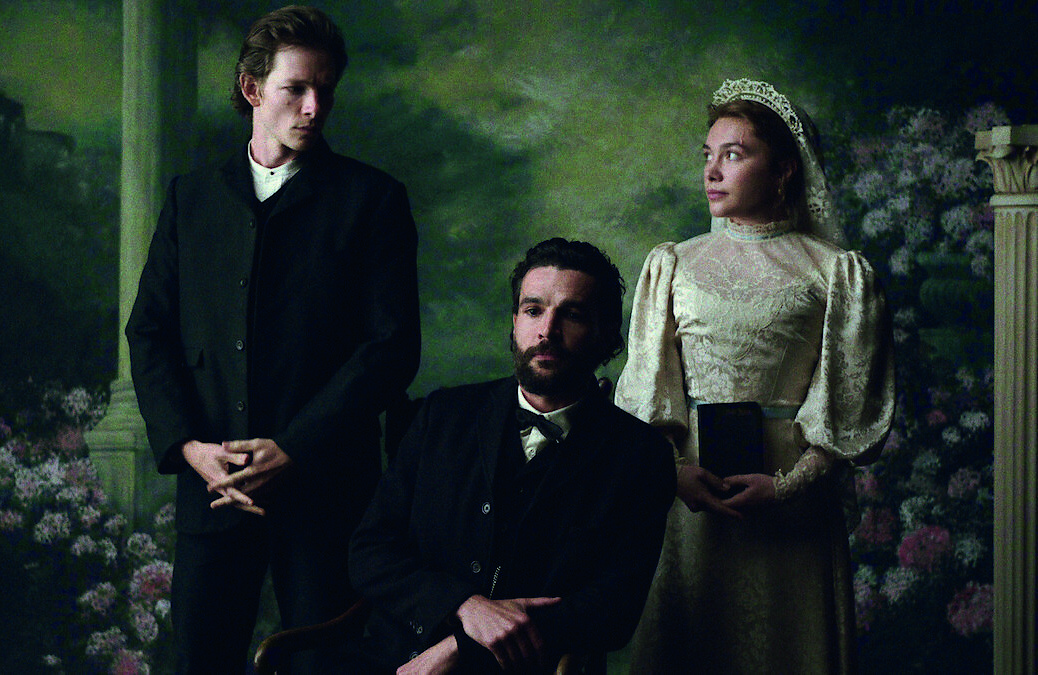
Thus prejudiced, I started East of Eden, Netflix’s new adaptation of Steinbeck’s novel. And I was immediately in exactly that wild America, more specifically somewhere that looked like a reproduction of Andrew Wyeth’s 1948 painting Christina’s World. But the world in East of Eden is even darker than Christina’s, because the tight-laced bodice that was crawling towards the homestead was battered and bloody. When it arrived at the doorstep, it was met by two broody, high-cheekboned brothers who, with some trepidation, carried the wounded woman inside.
The first two episodes of the series are spent explaining how these characters got themselves in this position. The cheekbones belong to Adam and Charles Trask (Christopher Abbott and Mike Faist), half-brothers and sons of Cyrus (you half expect an uncle called Shem, or a grandfather called Methuselah). We’re in Connecticut in 1874, and Cyrus is the kind of father who gets his sons to practise marching on the spot, and thrashes them when they fumble musket training, filling the evenings with stories of bringing General Lee to heel at Gettysburg.

But it’s the brothers we’re really interested in. And for some reason Cyrus loves Adam “better” than Charles. (Another thing about Steinbeck: his characters don’t seem to make decisions for themselves but are moved by the will of their creator.) Anyway, it’s Adam that he pushes into the army, while Charles stays at home on the farm, and this paternal preference gives us some truly Gallagherian displays of brotherly love-hate, including a scuffle, that becomes a hug, that becomes a fight in which Charles beats Adam bloody.
Adam does his time in the army, and murders his requisite “injuns”, but when his father pushes him to work in government in Washington, he refuses, becoming the kind of American vagrant who sits by campfires listening to guitar music. And when he finally returns to the family farm, his father is dead, and the brothers are left to make a tender, mildly erotic reunion in which they wash each other and cut each other’s hair.
All very Old Testament then, and only more so when we turn to the story of the woman they’ve taken in, Cathy (Florence Pugh). She (this is another character who has very little choice over their fate) is the pretty and strange daughter of a cold mother and a harsh father, who is preyed upon by men early in life and quickly learns to manipulate them back. She murders her parents in a house fire and “trains” as a prostitute, later becoming the mistress of Massachusetts’s leading procurer (it feels odd to call a man in a bowler hat a “pimp”). It’s at his hands she is beaten, in a rage of jealousy, and finds her way to the brothers’ doorstep.
East of Eden is epic, if epic means slow. It takes until the end of the second episode before our characters even contemplate, let alone begin, their journey to California, where the bulk of Steinbeck’s novel is set. And while the series has beauty, its characters suffer from Steinbeck’s sense of narrative propulsion, in which they are forces more than people. “I believe there are monsters born in the world to human parents,” Cathy’s narration runs at one point, as if that explains everything. But if this story has the violent grandiosity of the natural world, the wild America that Steinbeck seems to feel so well, for me it loses something of the human world in the process.
[Further reading: Celebrity Traitors has tamed our national id]
Content from our partners



Related
This article appears in the 07 Oct 2026 issue of the New Statesman, The Suspicious Relationship
Join the debate
Subscribe here to comment