
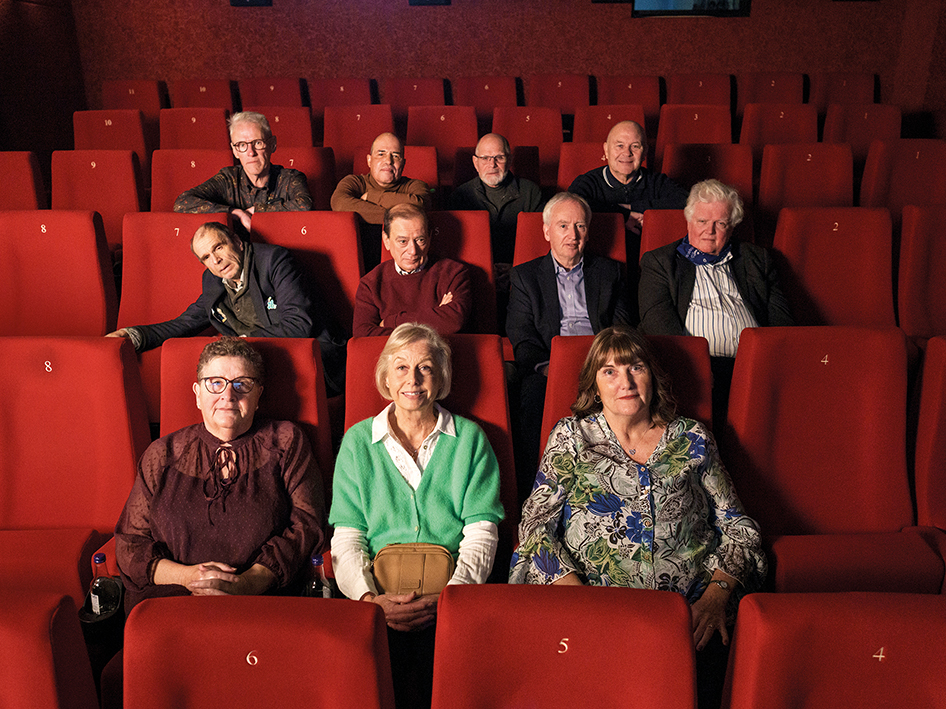
The wise travelling vagrant, the adulterous East End cockney bounder and the prize posh shit – can the mess of life truly produce such clear, predictable, Thackerayan archetypes? Or do we project them on to real people, squinting the three-dimensional down to two? This was the question that I found myself asking after watching 70 Up, the final instalment of the celebrated television chronicle of everyday British life.
The original series, Seven Up!, covered the lives of 14 seven-year-olds in 1964, long before “reality TV”. It was a novelty to film normal life, and to what I now think of as my shame, I had never seen the programme before. I was grateful therefore that 70 Up, which is being marketed as the last in the series, has a retrospective, summative quality, scrapbooking through the previous films – each made seven years apart – and forming a series of microbiographies, with the whole sequence then forming a masterpiece of microhistory.
You can see ageing at these intervals – what changes but also what doesn’t change. Faces sag, guts swell and all the rest. But certain things appear to be fixed. For better or for worse, the “T” of eyes, nose and mouth stays roughly static, even as the face around it shifts, the same smile smirking under different features. Under the stylish direction of Asif Kapadia – the director of the documentary films Amy and Senna – the faces of the participants appear out of chronological order and in different periods of their lives, but you’re never at a loss to know who you’re watching.
Kapadia has taken over direction from the late Michael Apted, who had worked on the series from 1964 until two years before his death in 2021. When Seven Up! was conceived it was intended to run until the millennium, to demonstrate the depressing hypothesis that insuperable class divisions are the main determinant of a British seven-year-old’s life. The more depressing conclusion is that the hypothesis has largely been proved correct. Take John Brisby KC, a quadrangle-to-quadrangle figure who, at the age of seven, said he was destined for Westminster and Cambridge, and meant it too. Or take Suzy Lusk, who briefly threw her life of comfort and horses aside to drop out of school and move to Paris, but who then, like a spacecraft correcting its orbit, gravitated back to the mean, marrying a baronet and settling in a country pile.

But even if very few of the participants have managed to break out of their class gulleys, some have managed to take incredibly winding paths through life’s ranges. In 1964 Neil Hughes was a schoolboy with choppy hair and ambitions to go to university; in 1977 he was living in a squat and working on building sites; in 1984 he was homeless; in 1991 he was living in the Shetland Islands on social security benefit. His interviews from all of these periods demonstrate a remarkable stoicism and intelligence and lack of self-pity. But then a further metamorphosis: in the 1990s he became a Liberal Democrat councillor in Hackney; in the 2000s he became a lay preacher in Cumbria; and now he lives in crumbling maison in France. Even if he hasn’t exactly managed to overcome life’s expectations, he has managed to confound them.
Not so his peers – or so the documentary would seem to have you believe. The participants are alive to this tension, ultimately an aesthetic one, about how rounded humanity can ever be mediated on screen, or even on the page. Charlie, who has stopped collaborating with the series, is heard towards the end of this episode accusing Apted of trying to “cast” them. And we see one outburst from working-class Jackie from one of the earlier series, aimed at Apted behind the camera, accusing him of asking her questions he would never ask the other participants. And Apted’s questioning can be surprisingly aggressive: he often asks the group whether they’re content with the lives they’ve led, pushing them on whether they could have done things differently or better. Their answers are surprising too, but warming.
What seems to have mattered the most for all of them is not life’s class trajectory but its context – family and love. It might not be the radical conclusion those 1960s filmmakers were looking for, but it’s the one their successors have found.
70 Up
ITV One
[Further reading: The Grand Tour is spinning its wheels]
Content from our partners



Related

This article appears in the 16 Sep 2026 issue of the New Statesman, Will AI kill us all?
Join the debate
Subscribe here to comment