
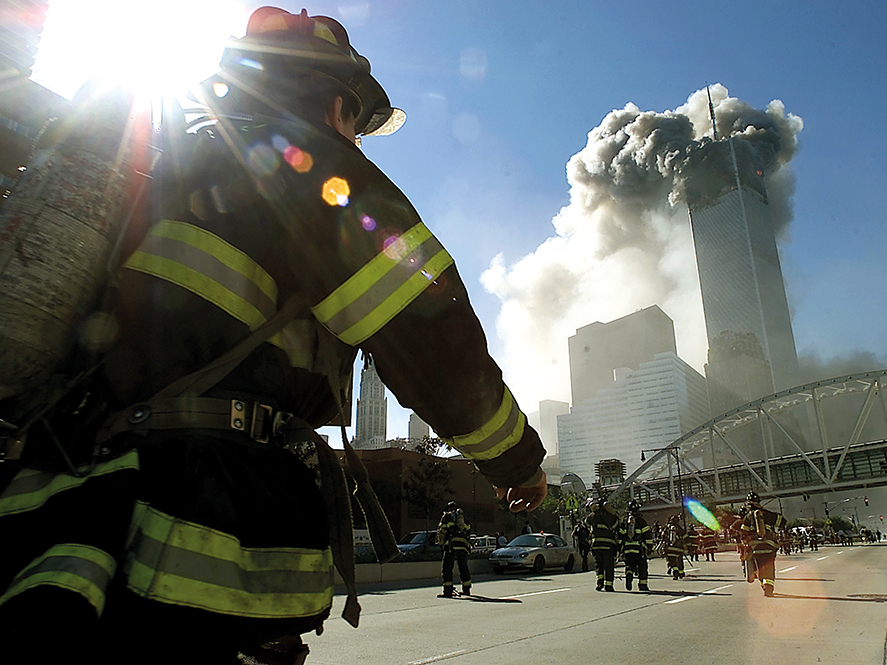
I don’t remember 9/11, which made me feel especially qualified to watch Netflix’s Turning Point: Generation 9/11. I’ve spent enough time around millennial rememberers, people who try to stun you with their “where were you” stories (school stopped, parents panicked, televisions wheeled into classrooms). But this isn’t about them. Because we’re a canonical 25 years on now, and so this is a documentary about the people who don’t remember, and how an event that you don’t remember can change your country, determine your life, and even determine your death.
The day itself does not resist retelling. It is perhaps ghoulish to say, but the spectacular, film-like quality that Osama bin Laden clearly plotted by attacking such a cinematic monument has endured. In the moments between the first plane and the second, there is still that eerie vacuum of false suspense, as newsreaders blink over what they are gingerly calling an “accident”. “You see in that moment between 8.46am and 9.03am how innocent America actually is,” says one of the historians interviewed for the programme. But not for long, as the South Tower is struck, and begins to burn and crumble. It will probably always be hard to hold back tears when the voicemails from the jets are replayed.
Once the day of 9/11 is over, history begins, and the documentary accelerates snappily but stylishly through the American 21st century. On 18 September, the US legislatures passed the “Authorisation for Use of Military Force”, a document that also effectively justified the war in Afghanistan. But the war came home too – the programme argues that the strengthened Department of Homeland Security is what gave us Immigration and Customs Enforcement (Ice), and the militarisation of American society that persists to this day.
This documentary defines its 9/11 generation in two senses: alongside tracking the more structural, climatic changes in American society, it follows the individuals whose lives were transformed by the event, those who grieved, fought and died because of it.

The characters are well selected. There’s An Nguyen, whose family story describes a historic arc: his father fled South Vietnam to the US in the 1970s and lived “the American Dream”, eventually working as an engineer in the Pentagon, only to die in the building on 9/11. There’s Obaidullah Durani, an Afghan who joined the Afghan Air Force alongside the Americans to help defeat the Taliban and is now a refugee in the US, while his wife is trapped on the other side of the world.
And there’s Michael Snoak, an impeccably American boy-soldier from South Carolina who doesn’t remember 9/11 either but joined the marines because of it (“On YouTube I saw videos of the war”). In all of the interviews with the boys who became soldiers, I was struck by their very American religiosity – when they talk crusadingly of how they had to “go forth” into battle, you can hear not just a 9/11 generation, but also a generation reared on pastors and psalms, in brazen and naive phrases that ring oddly to British ears. Snoak will end up at Generation 9/11’s final stand: passing Afghan babies to load them on to jets in Kabul airport in 2021. And after that experience you can hear his young faith quaver as he asks if the wars that stemmed from 9/11 have been worth it.
One of Snoak’s fellow marines, a soldier called Wyatt, names his daughter after two of their comrades who died in the evacuation: she is Page Sovi, after Daegan Page and Max Soviak. It’s a sobering symbol: will the following generation inherit the traumas of 9/11, or learn from them?
I sometimes wondered if Turning Point: Generation 9/11 overstated the 2001 attack’s role in reshaping the American sensibility – the United States had demonstrated its inflexibility and aggression in foreign affairs fairly well during the Cold War. And, as this documentary notes at its close, that is the iciest irony of 9/11. Bin Laden wanted to provoke the American empire into thrashing its own destruction. Twenty-five years on, he is dead, but it seems ever more likely that he got what he wanted.
Turning Point: Generation 9/11
Netflix
[Further reading: The anomalous delight of More Or Less]
Content from our partners



Related


This article appears in the 10 Sep 2026 issue of the New Statesman, The World According To Ed
Join the debate
Subscribe here to comment