
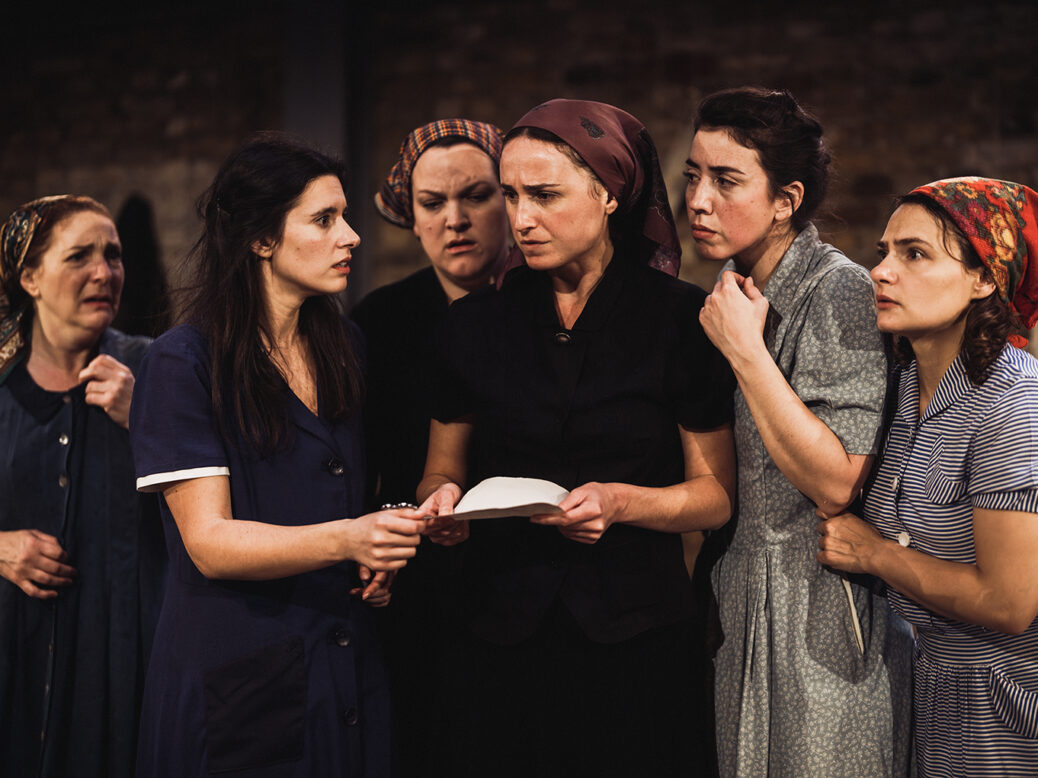
It is a bold writer indeed who decides to tell a recently uncovered story about the Holocaust via the medium of experimental theatre. Julia Pascal’s journey began when her cousin told her how his aunt and grandmother had been imprisoned in Gurs, an internment camp on the French-Spanish border, just before the Nazis took France. Pascal had never heard of Gurs – unlike Auschwitz, Belsen and Treblinka, its name has not become a grim synecdoche for the mass extermination of Jews and other so-called “undesirables”. Yet thousands of German Jewish refugees were held there, rounded up in May 1940 by French authorities terrified of the coming invasion. And one of them was the political theorist Hannah Arendt who wrote about her experiences there.
The outcome of this revelation is The Banality of Evil: Hannah Arendt, France, 1940, written and directed by Pascal and showing at the studio basement of the Arcola Theatre. The story of Arendt (Mai Weisz) and her fellow prisoners, including artist Charlotte Salomon (Anna Eckhard) and the socialist schoolgirl loosely based on Pascal’s relative Eva Daube (Ariella Barnett), is told over 90 minutes of cabaret-like physical theatre with a six-woman cast. There are monologues that break the fourth wall, multi-lingual impersonations, dreamlike interpretative dance sequences, and acapella multi-part interludes that blend jazz and folk music with the harmonies of Jewish prayers. Humour and horror are intertwined, morality examined and reinterpreted, deliverance and despair held up as one another’s mirrors.
Together, the women embody the refugee experience, stateless and unwanted by every nation they have tried to flee to. Arendt, who prior to Gurs helped Jewish children escape Germany to Palestine, is a belated convert to Zionism out of pragmatism rather than ideology: how can a race of outcasts ever be safe without a homeland of their own? Others put their faith in the socialist cause or lie to themselves that assimilation can save them. Their distress and determination echo the desperation of today’s refugees, who take impossible risks in the hope of a better life, or any life at all. Yet Pascal has said another London theatre initially expressed interest in the show then changed its mind, with hints that now, in this fevered geopolitical climate, was not the right time for a play about the plight of Jews.
All in all, this experimental production could do with more time in the workshop. The performances are compelling – particularly that of Weisz, whose facial acting is exquisite, and the haunting vocals of ensemble member Anja Fahlenkamp. And for such heavy subject matter, it manages to avoid descending into total bleakness. But it fails to properly articulate a message, beyond the basic takeaway that the Holocaust saw Jews and other refugees stripped of their humanity and rejected by the world. The philosophy of Hannah Arendt, for whom the play is named, makes the occasional fleeting appearance but otherwise it is unclear what she is doing there, what this titan of 20th century political thought is trying to say. I can see why Julia Pascal felt compelled to tell this story. Less clear is whether, in its current form, it can have the resonance its protagonists deserve.

The Banality of Evil: Hannah Arendt, France, 1940
The Arcola, London E8
Until 7 November
[Further reading: Who’s afraid of a perfect revival?]
Content from our partners



Related

This article appears in the 21 Oct 2026 issue of the New Statesman, Sally Rooney is a writer, not a terrorist
Join the debate
Subscribe here to comment