
The question one should always ask when a beloved film is reimagined as a musical is: why? What is it about the musical medium that will take this story to another level? What’s being added here?
In the case of Thelma & Louise, a new adaptation directed by Trip Cullman at the Young Vic of the legendary 1991 film, the answer is some nice songs and a bit of line-dancing. It’s fun. It’s slick. It has heart-warming moments and the cast – especially the leads, Amy Lennox as the trampled housewife Thelma and Rachel Tucker as her spiky friend Louise – are great. It just fails to justify its existence.
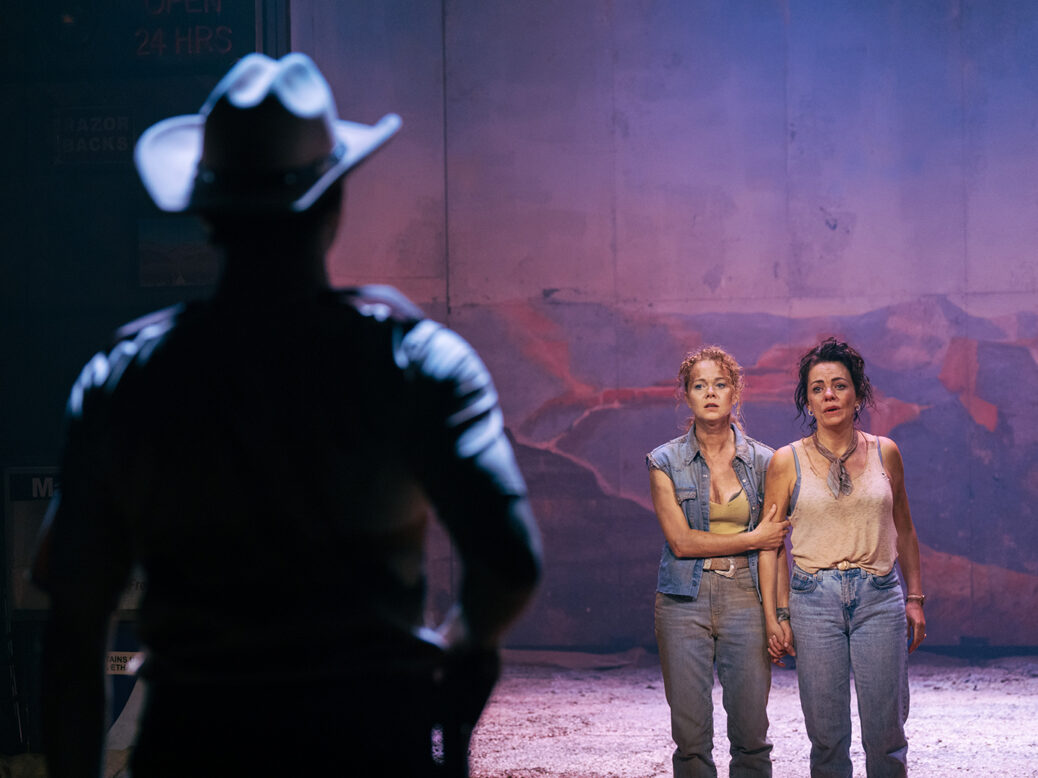
The plot broadly follows that of the film’s feminist arc: a girls’ road-trip that goes horribly wrong when Thelma is nearly raped and Louise shoots her attacker in the parking lot of a seedy roadside bar. What started as an escape from the shackles of domestic life becomes an epic car-chase as the pair head for Mexico to begin a new life of freedom. Scenographers Christine Jones and Brett J. Banakis have done a stellar job with a set that resembles every middle-of-nowhere America motel and diner, while zipping red and white lights evoke the speeding anonymity of the highway. But while the iconic green Ford Thunderbird that is both the protagonists’ getaway car and their doom (as it helps identify them to the cops) features briefly at the start, it is otherwise absent. The final scene, where – spoiler – the duo choose to drive off a cliff into the Grand Canyon rather than surrender themselves, becomes a metatheatrical sequence of lighting that is mostly left to the audience’s imagination. It’s fine, really, but given the cinematic resonance of that scene over the past 35, it’s something of an anticlimax.
In between, there are songs – country-style, written by Neko Case and accompanied by musicians cleverly squirreled away on platforms on the sides of the stage – that give us snippets of all the ways these women have been pushed into this dire situation by the men in their life and are only now starting to discover themselves. Some are genuinely beautiful, like when Thelma experiences a sexual awakening courtesy of a seductive hitchhiker who turns out to be an armed robber and then steals their cash, or Louise’s poignant remembering of her own experience of being raped. Some are okay. And some are just very forgettable. The pacing is off (always a risk when translating from screen to stage), and while the dance numbers are entertaining, overall the show lacks energy.

Intriguingly, it is Callie Khouri – award-winning writer of the original screenplay – who is partly responsible for this revival. She wrote the book for the show, and is quoted in the programme saying: “It was such a different way of viewing the story. It would have to be a completely new interpretation, a new iteration”. But other than a few bits of extra backstory, particularly involving the detective who comes to understand the pair as he chases them down, this isn’t a new interpretation. It hasn’t been updated for a 2026 audience, it’s just been reheated and set to a jangling country beat. The original themes of malicious patriarchy might feel scarily relevant again in a world where America is defiantly going backwards on women’s rights, but the response to that is not to make new musical. If you want to revisit the radicalism and magic of Thelma & Louise, just watch the film.
[Further reading: The wide chasm of Electra/Persona]
Content from our partners



Related
This article appears in the 24 Sep 2026 issue of the New Statesman, A Sense of Power
Join the debate
Subscribe here to comment