
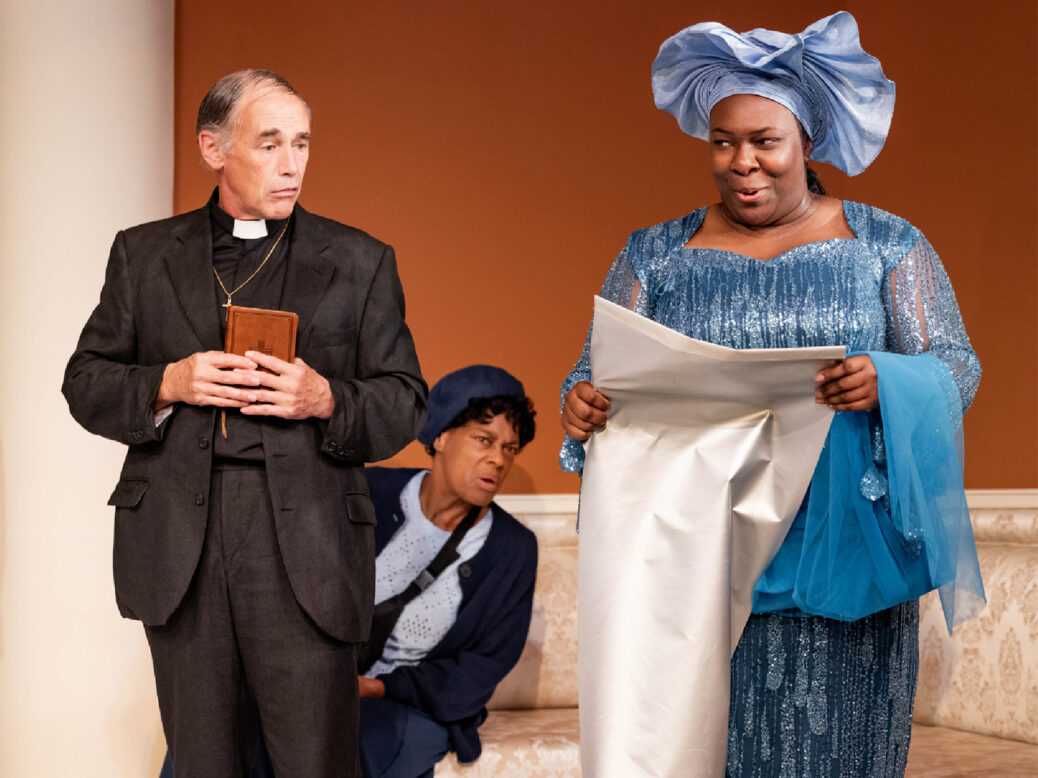
Love and religion: natural bedfellows? It’s a perennially evocative question, in which emotion and dogma converge, which has long been a source of beauty and conflict. This goes some way to explaining why Molière’s Tartuffe, a farce about hypocrisy, gullibility and false piety, has endured since its first staging in 1664 – despite Louis XIV banning it. In recent decades it has been frequently reworked: Martin Clunes starred in Tartuffe in 2002; the playwright John Donnelly reimagined it in 2019; and last year Matthew Broderick led a Broadway adaptation.
The latest revival, Tartuffe (Remixed), is by Darren Raymond, who deftly recontextualises the story within a Jamaican-Nigerian family, the Afolabi-Williamses, gathered at the patriarch Oga’s mansion before his daughter Adanna’s wedding. On the arrival of Pastor Blake (the spectacular Mark Rylance, who delightfully embodies this slimy buffoon of a protagonist – buck-toothed, slick-haired and cartoonishly animated), Oga mistakes religious authority for divine power. Soon, he insists Adanna marry this charismatic clown of God. Beneath its comic surface, the play examines serious themes: colonialism, misogyny and the stymying of individuality by strict, established family structures.
Performed in rhyming couplets throughout, the dialogue mirrors the poetic language of Yoruban proverbs and Jamaican patois, while also being embedded in more traditional, archaic syntax. The script is as wise (“He wields scripture like a sword”) as it is comic, though some of the references – biblical allusions and the nuance of accents – eluded me. But judging by audience reactions, the play resonated: a woman cackled when it was suggested the cutlery be blessed, and teeth were kissed when Oga’s wife, Elmire, was accused of seducing Pastor Blake. That members of the Nigerian and Jamaican diaspora could recognise themselves in this 17th-century drama testifies to the way a classic can successfully be reconfigured with different, culturally distinct personalities.
[Further reading: The wide chasm of Electra/Persona]

Content from our partners


Related

This article appears in the 16 Sep 2026 issue of the New Statesman, Will AI kill us all?
Join the debate
Subscribe here to comment