
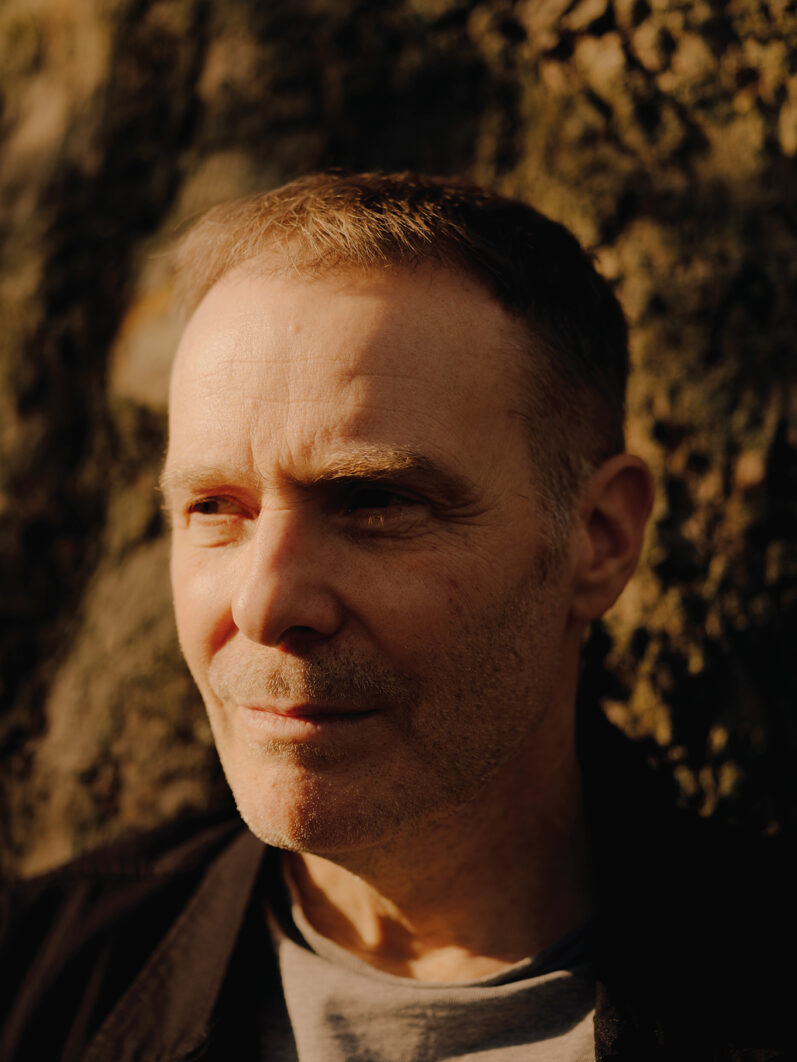
A few years ago, on a wet summer day, I took a stroll through my Berlin neighbourhood to see the apartment where, more than a century earlier, Felice Bauer, an employee of a large office supply manufacturer, received hundreds of letters from her budding-writer boyfriend in Prague, Franz Kafka. I was looking for Bauer’s mailbox; I wanted to describe it for a piece I was writing. Imagine my surprise when the door on the ground floor opened and out walked the novelist Tom McCarthy.
Maybe I shouldn’t have been surprised. After all, it’s fitting that the writer once dubbed “a Kafka of the Google age” lives in a place quite literally touched by his words. The two-time Booker nominee moved to the German capital after Brexit, with his Swedish wife, the visual artist, Eva Stenram, and their two daughters. (McCarthy now also has Swedish citizenship.)
Around the time Berlin emerged from its interminable lockdown, he and Stenram collaborated, as part of curator Joanna Warsza’s outdoor exhibition “Die Balkone”, on an art installation inspired by their house. Passers-by were invited to write down a dream on a postcard and place it, with an address, into a box affixed to the front of the building. The postcards were then shuffled upstairs, cut in half, reassembled, and assigned new addressees. Each participant later received someone else’s dream in the post. The two called this a “Formerly Epigraphically Licensed Intra-Consciousness Exchange”, aka FELICE.
From his debut Remainder (2005), a novel in the experimental tradition of the nouveau roman that was rejected by every publisher in the UK until it was published in a limited edition by a press in Paris, to his recent essay “The Threshold and the Ledger”, in which he explores a poem by the Austrian writer Ingeborg Bachmann through the works of Sophocles and David Lynch, McCarthy strikes me as the most European-minded of contemporary British novelists.

I tell McCarthy this when we meet at a café located a few doors down from his house, to talk about his new novel, The Rhyl Poster. Its protagonist, Benjamin Stanton, goes from working as a surveyor for the Royal Engineers on the hunt for non-existent WMDs in Iraq (shades of Kafka’s The Castle), to working as a référendaire in the Court of Justice of the European Union in Luxembourg (shades of The Trial). Usually, we meet up for a pint at Tomsky’s, a watering hole in Prenzlauer Berg, but we decide on somewhere quieter for the voice recording apps on our phones.
“‘English’ literature has always been driven by continental culture,” he says, as we are seated in the café’s mezzanine. He cites Montaigne’s influence on Shakespeare and George Eliot’s debt to Spinoza. The Rhyl Poster makes this debt explicit. It is a European novel – not just in the sense that it is set in many of the cities (Luxembourg City, Brussels, Strasbourg, the Hague) that play host to the institutional machinery of the EU. In the book, lawmaking becomes intimately connected with literary modernism. McCarthy elliptically names the plaintiffs in the novel’s court cases after the protagonists of Finnegans Wake and Heinrich von Kleist’s 1810 novel Michael Kohlhaas. Some of these cases are heard in the Fernando Pessoa Courtroom.
This last detail, McCarthy is quick to remind me, was not his invention. There really is a courtroom named after the Portuguese modernist poet at the Court of Justice of the European Union. Nor is the connection between law and literature “merely theoretical”, he says. Ana Bobić, the Croatian référendaire who showed McCarthy around the Court of Justice, and helped explain the “labyrinthine ins and outs” of its structures and procedures to him, is a former student of comparative literature. Reading, cross-reading, textual analysis: “This is what we do here,” Bobić told McCarthy during the time he spent in Luxembourg City doing research for The Rhyl Poster.
Tasked with writing an era-defining opinion on data protection, Stanton comes to resemble one of the oldest figures in the European literary tradition: Oedipus, a man whose analytical gifts turn him into a lawmaker, only to expose himself as a criminal. It is a task that he finds “overwhelming and impossible”, McCarthy says, and so, like a Thomas Bernhard character, he spends “his whole time prevaricating and delaying”. A relatable enough situation for most writers of fiction, legal or literary.
At a legal conference at Monte Verità , on the Swiss side of Lake Maggiore, Stanton is blackmailed into leaking court documents to a front organisation called the Centre for Juridical Collaboration, whose unnamed backers have a vested but unspecified interest in the wording of his opinion. Like the Pessoa Courtroom, Monte Verità (“Mountain of Truth”) turns out to be real. Founded by Russian anarchists in the late 19th century, it became a gathering place for occultists, health faddists, artists and intellectuals before it went defunct during the Second World War. The buildings are used today by the Swiss Technical University.
For most of us who live in Europe, the inner workings of EU institutions like the Court of Justice, with their byzantine organisation and impenetrable argot spackled on to dozens of languages, are opaque. Was it this sense of opacity, I ask McCarthy, that generated the widespread suspicion that laws and policies were really created by deep states and shadowy corporate interests? He grants that, in the novel, both the court and the front organisation were opaque, but he underlines an important distinction between them. For all their flaws, the court and the other legal institutions of the EU actually functioned as a “bulwark” against “oppressive corporate and state power”. They were, in fact, “democracy in action”.
“The central paradox is that the Court, like Europe itself, is imperfect,” he continues. He is aware of the dark side of European democracy, which is “inseparable from the Continent’s history of colonial violence”. And yet these same legal institutions remain, for McCarthy, the best way to resist the “onslaught of fascism” coming from Moscow in the East, and Washington DC and Silicon Valley in the West. To my surprise, he reaches for a Star Wars analogy. From a geopolitical perspective, it was like “being in the garbage room where the debris are holding back the walls that push in from all sides”.
Born in London in 1969, McCarthy went to Dulwich College and read English at New College, Oxford. He spent his early twenties doing odd jobs in post-communist Prague. When he returned home, he joined the art scene, founding the International Necronautical Society, a “semi-fictitious avant-garde network”, with his friend the philosopher Simon Critchley.
At 57, McCarthy has the wiry build of one of Kafka’s stick-figure drawings, but the boyish energy of someone three decades his junior. His speech seems to unzip and double back to layer in new ideas and associations. He ushers me from topic to topic with quick cycles of the wrist. From the little blue pills that Stanton is given by his handler at the Centre for Juridical Collaboration, we find ourselves talking about les petit bleus, the pneumatic postal network that flourished in Paris in the age of Proust, and then, moments later, about the German judge Daniel Paul Schreber, whose Memoirs of My Nervous Illness (1885) is frequently alluded to in The Rhyl Poster.
In this work – a key text in the history of psychology – Schreber described a cosmology of angelic rays that connected his nerves to the sun. His premises may be mad, we both agree, but if accepted, they form a metaphysical system of astonishing coherence and even beauty. “Schreber is just amazing; what a brilliant, brilliant text!” McCarthy exclaims. Then he shoots off again, like one of the rays themselves, into a history of texts written on the body, from the stigmata of medieval mystics to Queequeg’s tattoos in Moby-Dick to the torture machine in Kafka’s short story “In the Penal Colony”. “I’m just fascinated by these figures,” he tells me. Did I know “the reason a book’s spine is called a spine is because it was literally the spine of a sheep, and the pages were the skin – the vellum”?
Stanton, who has a mysterious bullet wound, is himself a “markèd” man. He owes no small part of his vaunted reputation at the Court of Justice to speech impediment and his illegible shorthand. McCarthy reminds me that Moses, too – the archetypical lawgiver – was a stutterer, and so were Dadaists like Tristan Tzara. “A new law demands a new language,” says McCarthy, and this is what connects the most ancient religious text to the most innovative avant-garde poetry. But in the Old Testament, God gives the tablets of the law to Moses “pre-printed”: Moses is just the “delivery guy, the Amazon guy”. In The Rhyl Poster, the lawgiver creates a whole new diction and notation system.
The headiness of McCarthy’s table talk is buoyed by his contagious enthusiasm. Our conversation turns to the five Ms – money, matter, mediation, machinery and metaphor – the prism through which he is currently exploring the history of the novel from Don Quixote to Gravity’s Rainbow in “The Man Behind the Curtain”, a podcast series hosted by the London Review of Books.
To take mediation as an example: Stanton has a girlfriend whose two sons play a first-person shooter video game modelled on Grand Theft Auto. McCarthy has been fascinated by digital game-worlds ever since he encountered Harun Farocki’s “Serious Games I-IV”, a series of film essays exploring the computer games developed by the US military to train soldiers and treat them for PTSD. What interests McCarthy about Grand Theft Auto is the “tensions” in its “moral environment”. “The game’s avatar is at once a supervillain and an agent of the law,” he says. The character is at once endlessly killed, impossible to kill and already dead; and thanks to the drop-down menus that allow players to customise his appearance, he has a fundamentally fluid and unstable identity.
Are video games a rival medium that would one day eclipse the novel? He brushes off the suggestion. Digital game-worlds were both an interruption and a continuation of the space of literature, “although to what extent it’s an interruption”, he muses, “I’m not so sure.” Look at Don Quixote, the first modern novel: “It’s continually interrupted, it’s about self-invention, it’s about the impossibility of a kind of smooth traversal of a narrative environment and landscape.” Quixote and Sancho Panza are always “stopping, rebooting, analysing, going back to the source code”, just like a player of Grand Theft Auto. Or, for that matter, the protagonist of The Rhyl Poster.
Underneath the sign hanging above café’s entrance, which shows a white revolver mid-fire, we said our goodbyes. When I return home to transcribe our conversation, I find the sound of our voices punctuated by the hissing, grinding and clanking of the large metal machine in the other room.
The Rhyl Poster
Tom McCarthy
Jonathan Cape, 201pp, £14
Purchasing a book may earn the NS a commission from Bookshop.org, who support independent bookshops
[Further reading: Missouri Williams: “Fiction has its own kind of truth”]
Content from our partners



Related
This article appears in the 05 Nov 2026 issue of the New Statesman, Nigel Farage's bastards
Join the debate
Subscribe here to comment