
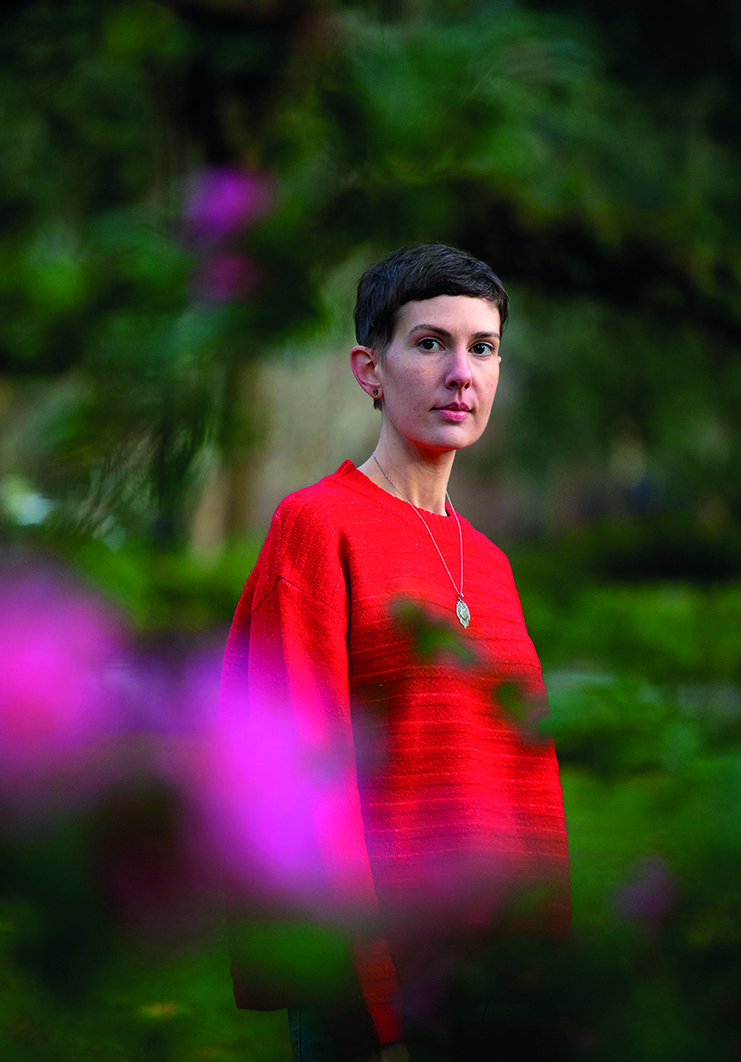
“This is the full butthole horse,” Patricia Lockwood says, pointing to a painting of a stallion’s flared behind. “He needs you to see his orifice. He’s really proud of it. It’s like, powering him on his journey.”
The Royal Horseguards in Charing Cross is Lockwood’s favourite London hotel, because of its wall-to-wall paintings of famous horses: the kind of whimsical, absurd image the poet and novelist likes. She is here to judge the Booker Prize and to tour her new poetry collection, Agate Head / Stone Soup, talking in a velveted sitting room while Whistlejacket and friends whinny above her.
This is the first poetry collection Lockwood has managed to complete in over a decade. “Poetry requires boredom,” she writes in the introduction. “But too much was happening, there was a different kind of attention being paid, and we had entered a reality where it was impossible to be bored.” Around the time of Donald Trump’s second inauguration, she and her husband got Covid and her head felt like a balloon. “I was looking at the news and I was like, none of this makes any fucking sense at all,” she tells me. She got off social media and took a metalsmithing class. She started to get the sense she could write again. “It’s almost like if you had whiskers and the air stirred your whisker, that’s how small the feeling is,” she says. Soon she was writing two or three poems in a day. “You only experience something like that once or twice, I think, in a writing life.”
Lockwood began her writing life on an internet that no longer exists. Days before she was supposed to go to university, her father told her bluntly they had no money. His fancy guitar collection gleamed upstairs. Instead of university, she wrote poetry, and moved in with Jason Kendall, a 19-year-old boy she had met on a poetry forum. Kendall bought her a cellphone, and she started a surrealist Twitter account, writing things like: “Sext: I am a living male turtleneck. You are an art teacher in winter. You put your whole head through me.”

Lockwood had a unique language, and devoted followers. When Kendall needed eye surgery, they raised $10,000 in 12 hours. She became real-life famous in 2013, when her furious, funny poem “Rape Joke” went viral (“The rape joke it wore a goatee. A goatee.”)
Lockwood is almost always funny, even in her literary criticism. (On Karl Ove Knausgaard’s latest epic, The Morning Star: “Is it any good? I have no fucking idea.”) Writers sometimes ask her how she can break the rules like that – in the London Review of Books! “I’m just like, ’cos I’m running buck wild. That is why.’” In person, she is the same: colourful, witty, crude. At the pulpit, making a congregation belly-laugh.
Lockwood’s first memoir, Priestdaddy (2017), narrates her deeply Catholic upbringing. She was born in 1982 in Fort Wayne, Indiana, and when she was young moved from parish to parish with her anxious, doting mother and pastor father – as a former Lutheran minister, he was able to become a married priest upon entering the Catholic Church. His moods could “control the weather”, she says. “If he was very up, then the rest of us were very up. If he was in the depths of despair, then we were down with him.” As a teenager, Lockwood went to anti-abortion marches and attended a youth group where kids spoke in tongues, signed virgin pledges and spoke in erotic detail about all the sex they wouldn’t be having. When she moved out of her parents’ home, her faith slipped out of her. She discovered that a priest she’d been close to at school had been a sexual predator. “I think that did kill it for me a little bit.”
Now a commodities analyst, Kendall floats in and out of the hotel room, bringing water and lattes. “You know how women marry their dads? I married my mother,” Lockwood says. “I married a treat giver and a caretaker.”
Kendall has always been Lockwood’s champion. Whenever she finished a poem, he would submit them to magazines, sometimes on the same day. “I was like, ‘Dude, I was maybe going to revise that!’” She’s called him her Leonard Woolf. “Historically, there have been women who lucked out, and found these guys who were helpmates, and it’s really, really amazing that that happened for me.” Kendall gets a thrill whenever her poems get accepted. “I was able to harness male ambition for good,” she jokes. “I can just let him treat it like a fantasy football or gambling addiction.”
In 2022, after bowel surgery went wrong and he haemorrhaged twice, Kendall nearly died. Lockwood, usually the “baby” of the relationship, is proud of how she nursed him, dressing and cleaning his wound. “I was like, all right, the adult baby is standing up.” His illness, and her own struggle with long Covid, form part of her semi-autobiographical novel Will There Ever Be Another You. A section of the book is quoted on the NHS web page about bowel surgery and aftercare. Lockwood is proud of this too.
Kendall and Lockwood’s shared medical trauma has made them a closer unit, she muses. “I probably wouldn’t initiate a divorce for anything less than something totally outrageous.” The couple live together in Savannah, Georgia, with three cats: Fenriz (“the crazy boy”), Gilly (“the beautiful cat model”) and Miette (“the little goblin from the trash”). In the evenings, the couple ride a special bicycle they own, built for two.
It sounds like an idyllic life for a poet – albeit one lived still very much online. To calm the cats, Lockwood and Kendall play a YouTube channel called Cat TV – a 24/7 live stream of chipmunks and birds and squirrels eating nuts and seeds and making general woodland sounds. Writing Agate Head with Cat TV on in the background, Lockwood felt like Wordsworth. “You’re sitting there with your poetry collection, and you look up, and there’s a little chipmunk shoving a freaking peanut sideways in his cheek, and you’re like, ‘I’m in nature. I’m a pastoral poet sitting in the woods.’”
Before she wrote the collection, she’d been studying Sylvia Plath for a London Review of Books essay and she tried to follow Plath’s technique for writing poems: “Write them straight through, from beginning to end, don’t mess with them too much.” You can hear echoes of Plath through Agate Head, as Lockwood agonises over Kendall’s near death:
If I were an electrician or
Mathematician or a collector of Fairburn
Agates, I would have been able
To draw him together swifter, sooner,
And with less of that thing called platelets.
She’s now working on two new projects: “Folk”, an urban fantasy novel about art, and “Tiny Leaf Road”, a non-fiction book about how we read now. Lockwood doesn’t think literacy is dead yet. “I’m not going to be pessimistic, because there’s all those dark romanticists out there reading their monster sex novels.” She is encouraged by watching vloggers dissect the Booker longlist, trying to guess the winner, often wildly incorrectly.
In her role as a judge, Lockwood has read more than 160 novels in the past six months, sometimes two a day. “It’s probably something I’ll look back on fondly,” she says, “but it was completely insane. It’s like those guys that go into the wilderness and eat raw fish and build their own huts. I bet they feel really good when they come back to civilisation and get a big quarter-pounder at McDonald’s.” Miette, now ten, recently had an ulcerated tooth. The other day, she bled on Lockwood’s favourite novel from the Booker list. “So she marked it literally with her blood, and I was like, ‘This has to be meaningful in some way.’”
For the prize, Lockwood has grown a “Booker tail”, a slick of brown-grey curls at the back of her neck. Carly, her “little goth emo cutie stylist”, is the person responsible. “I had no idea what she could possibly be doing, but she looked like she was thrilled with it,” she says. “She finally turns me around, and I was like, ‘Oh no!’ How do I tell her I don’t really want a tail? And I certainly don’t want a tail for the entire, like, length of our relationship. If she keeps styling my hair, she’ll keep giving me tails. I don’t think that can happen.” She eventually committed to growing it at least until the winner is announced. “I’ve come around to it, but it is funny. I’m 44, and I’m using one of my remaining years on this planet to look terrible because I have grown a tail on purpose.” A Bluesky poster told her she looked like a teenage Argentine football star. “I’m like, hell yeah, that’s me. I choose to believe that I’m pulling it off.”
Lockwood still lingers on Bluesky, although it doesn’t hit the same as Twitter used to. She left X a few years ago, after Elon Musk bought the platform and destroyed all its rules of style and humour that had made her a star. It is a foreign language now, although one that still fascinates her. She logged on the other day and was shown pro-anorexia, pro-masturbation content. “This girl was like, ‘Rub yo clih while starveeen, angel.’” The girl posted a picture of her skeletal body to drive home the point. The sentence stuck in Lockwood’s head. “It was literally: Rub your clit while starving. ‘Starveeen’ had three Es. I don’t even know how to interpret the sequence of words.”
It’s not just X. All of America has gone insane. Trump’s second term has been more brutal, Lockwood says: “it was no picnic the first time around. But we all marked the change.” She’s been at readings where people pass out whistle kits to warn for Ice raids. Perhaps Lockwood’s most political work is her 2021 autofictional novel, No One Is Talking About This, in which the narrator is addicted to the “portal” (Twitter) while her sister may die because of restrictive abortion laws. Trump is referred to only as “the dictator”: “The trouble was that they had a dictator now, which, according to some people (white), they had never had before, and according to other people (everyone else), they had only ever been having, constantly, since the beginning of the world.”
It’s an earnestness that has fallen out of fashion on the internet, where straightforward anti-Trump rage can feel dated. But how else should artists respond to American tyranny? It’s defeatist to demand that poets ignore politics. Lockwood liked Elizabeth Strout’s novel The Things We Never Say, about a high school teacher resisting Trump. “Some people were like, it’s like, it’s twee or cringe or sentimental to even mention these things,” she says. “But if we give that up we don’t have anything… You have to allow for imagination and hope, or we can’t fight it at all.”
Lockwood remains close with her parents, despite their steadfast Republicanism. It helps that her father doesn’t read anything she writes. Her mother, meanwhile, loves her audiobooks. “It’s like your daughter calls you and talks to you for 17 years straight, right? It’s the mom’s dream.” She especially likes Lockwood’s chapters about the family. What might read to us as farce to her reads true. “Even when it’s a bit different, or altered in some way, she’s like, ‘That’s exactly how I remember it.’”
Patricia Lockwood’s Agate Head / Stone Soup is published by Bloomsbury Circus
[Further reading: Patricia Lockwood’s dispatches from the brain fog]
Content from our partners



Related
This article appears in the 01 Oct 2026 issue of the New Statesman, Sunshine and Rain
Join the debate
Subscribe here to comment