
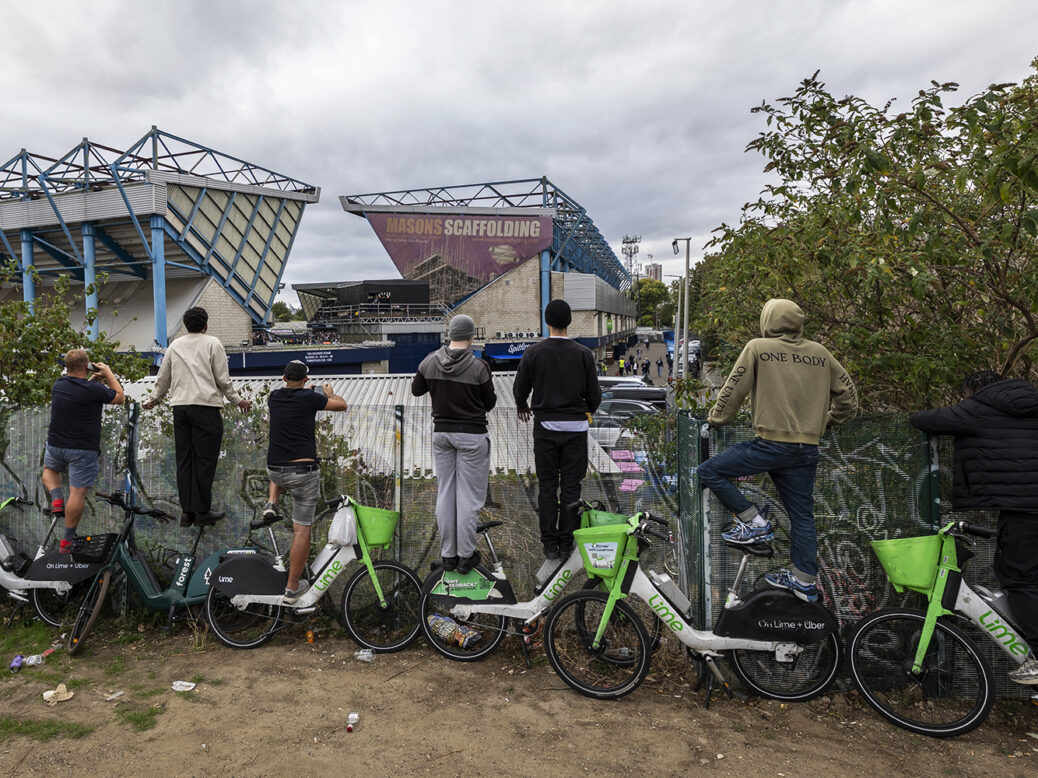
The first warning signs came 48 hours before kick-off. Pre-game tactics were published: the Metropolitan Police declared that, ahead of Millwall vs West Ham, 15-20 square kilometres of south-east London would comprise a special “dispersal” zone. Police horses and more than 400 policemen and women would be on duty in and around The Den, Millwall’s home ground. The Met made its goal clear: to “remove anyone causing disorder”. Section 35 orders granted extended permissions to seize items from agitators and ban them from the area for 48 hours; officers also had the power to escort troublemaking children to their homes.
Taking place on 19 September in English football’s second division, this was the fixture’s 100th iteration, and the first in 14 years. The policing fanfare around the two clubs, which were founded by rival dock-working firms on the Isle of Dogs, was dubbed “the ring of steel”. The “dockers derby”, as it is commonly referred, was first contested in December 1899. And though they haven’t been neighbours for over a century (Millwall moved south of the Thames in 1910), the legend of the rivalry has endured. It is the English football fixture most closely associated with bitterness, violence and hooliganism – traits that, in English football’s nadir in the Eighties and Nineties, threatened to become aspects not just of sporting culture, but of the national culture.
Around 18 hours before kick-off, it looked as though another chapter of violence would be added to the fixture’s lore. Online, videos of Millwall fans cuffed by coppers surfaced: West Ham ultras had reportedly lured them to east London with the promise of a fight. Instead, they called the police on the south Londoners. Reactions varied by persuasion. “Grassers!” Millwall fans raged. “True shithousery,” their rivals chuckled.
Despite only irregular meetings in the modern era, the violent tradition of Millwall-West Ham is borne out in both reality and fiction. The 99 fixtures prior to last weekend’s game have featured countless arrests and at least two deaths: of a Millwall fan in 1976, and a West Ham supporter a decade later. “Millwall and West Ham firms hate each other more than any other,” runs the narration from the leader of a fictionalised West Ham supporter firm in the 2005 film Green Street, “like the Israelis and the Palestinians.”

From 9am on matchday, I flitted between the usual pre-match pubs frequented by Millwall fans in Bermondsey. As I drank pints and observed the punters, it became increasingly clear that the wind-up merchants, fire-starters and protagonists that have historically defined the fixture were in short supply. The fans had dressed like their Nineties forebears – Millwall supporters turned out in Stone Island apparel, skinny jeans and well-worn trainers. But in menace, the atmosphere was lacking. Unlike in the books and films, the pre-match chat I overheard centred on team line-ups and tactics; not plans on how to smash through police barricades and do-in the heads of West Ham supporters. “Don’t get me wrong, I fucking hate West Ham,” the boyish-looking Sam told me at the bar, waiting for his Madrí. “But this game isn’t what our season – our life – hinges on.”
Outside the stadium, too, I found not columns of thugs, but neutrally dressed day-trippers, photographers and influencer-types waving miniature microphones. They were desperately hoping for something, anything, to happen. “I’m on the capturing-fans-scrapping beat today,” a freelance photographer, who had little interest in football, told me. He flicked through his photos: variations on punters and pints. The working title of the online pool of images set up by editors bore the pre-emptive heading: “Football fan clashes and unrest”. A knowing look from the photographer: “They’re going to be quite annoyed; this isn’t what they hoped for. Especially the Daily Mail.”
Despite the pre-match hype, things did not “kick-off” between the two sides until referee Paul Tierney blew his whistle to begin the first half. The match itself was more dramatic than the hysterics around it. Millwall led by two goals before West Ham drew the game level in the second half. A late red card for the away team meant they had to cling on in the final minutes. On the whistle, there was upset – but not fury. Only one Millwall fan truly lost his temper, and not towards the buoyant West Ham fans chanting “two-nil and you fucked it up”, but at the DJ’s post-game playlist, which featured grating covers of cheesy pop songs. “This is teenage-girl music… Fucking c***.”
The core of the Millwall-West Ham legend is that old rivalries die hard. But, whatever their divisions, both tribes would rather repeat the various footballing platitudes and truisms – “We hate them; they hate us”– than enforce them with violence. And, despite the lack of bloody violence on Saturday (“only” six people were arrested), that still holds true. My conversations with punters about the proverbial enemy were not short of munters and wankers, pricks and dicks, twats and fucks – the usual verbal venom. There is still fear and loathing, but little appetite for traditional mob rule.
In fact, across both fanbases, I detected something of a shared frustration: an irritation at the violence expected of both clubs and their presumed inability to stage a fiery, but fair, non-violent contest. To “by all means enjoy it, but enjoy it by being fucking disciplined here”. Nevertheless, vlogs of this relative nothingburger have thumbnails of influencers with Photoshopped black eyes and bloodied noses, and titles such as “I survived Britain’s most NOTORIOUS derby!” Why the clamour for chaos? The answer may lie in the dire prognosis many have given to the state of modern football. “Game’s gone” is now the reflexive catchphrase to bemoan the sport’s modern features and ills – Var, tiny shin-pads, ex-pros Jason Cundy and Jamie O’Hara rage-baiting callers on talkSPORT. The diluted intensity of derby games is part of this litany. It is part humorous projection, part coping mechanism. “If it’s not going to kick-off at Millwall-West Ham, will it ever again?”
This yearning for the past, however, forgets the grim reality of what football, and especially derbies, used to be like. Among the Thugs, a 1991 book by the American journalist Bill Buford, is the canonical work on the hooligan subculture. It details stadiums with sections “that look like animal pens”, and terraces that provided supporters with “only essential accommodation” – a “fence to keep them from leaving the area… a place for essential refreshment… a place to pee and shit”. “That is what the terraces offer,” Buford wrote. “Not just the crowd experience but the herd experience with more intensity than any other sport, with more intensity than any other moment in a person’s life – week after week.”
Buford kept envelopes of national and local newspaper clippings, illustrations of footballing violence. One week in May 1987 featured: a 150-person mass brawl at an amateur Sunday league game; a racist attack by Leeds fans – whose supporters chanted “Sieg heil” and performed Nazi salutes – on a Rastafarian reggae band that saw a member of the group glassed and left four others with stab wounds; and the throat-slashing of a 19-year-old fan after a match between Everton and Manchester City, which required 20 stitches to repair. Each envelope, usually accounting for a single week, typically contained 50-100 clippings, sometimes “many” more. “It was too much to take in,” Buford wrote. “This is what Saturday afternoon in England is really like.”
The nostalgic fans of today are not explicitly calling for the full-blooded return of such a devastating status quo. But selective hooliganism is impossible. The troubled terraces of that time were interwoven with the socio-economic and political shortcomings of the era. And while aspects of daily life may have yo-yoed in quality since the Eighties, a positive and under-examined aspect of modern England is how little violence there is. Homicides in England and Wales fell to a 50-year low last year, while according to an Economist analysis the urban centres and cities “historically associated with violence have achieved impressive reductions over the past decade”. To this trend, there is a major, periodic, footballing exception which evokes our hooligan past: that incidents of domestic abuse shoot up by at least a quarter when the England men’s national team plays in a major tournament. Solace, the women’s aid charity, attributes it to “heady… tribalism resulting in ‘toxic masculinity’ and aggressive behaviour triggered by alcohol consumption”.
Nicky, a half-cut Millwall fan, confessed to me at full time: “I won’t shy away from what’s happened in the past.” He sat on a ledge outside the stadium, nursing a flat pint and scratching his short and greying hair as he recalled attending the 2009 League Cup tie between West Ham and Millwall. The match was something of a last gasp for football hooliganism, and came to be known as the “Upton Park riot”. The match saw multiple pitch invasions and was temporarily suspended. One Millwall fan was stabbed and around 80 people were arrested.
Things have changed “dramatically” since then, Nicky said. The hooligans of the past, he reckoned, were acting out of a need for belonging and ritual: “Chatting to the lads, dressing smart… making an impression and fighting.” Nicky, who is 43, outlined the chasm of expectation between older generations of matchgoers and their younger counterparts. “There’s a lot of [younger] fans who’ve probably watched too much Football Factory [another film about football hooliganism] and think that’s the fucking way the world is,” he said. “That was a different age.” And the lack of tribalistic punching, stabbing or, indeed, killing at the Millwall-West Ham game this past weekend is good reason to conclude that the cultural unruliness we once became accustomed to is now gone.
But a culture of unruliness is still a culture. While the end of tenacious terraces is seen as a universal good, much else, too, has disappeared from football as it has grown from a game firmly rooted in the working classes, to the hyper-commercialised, multibillion-pound behemoth it is today. Season tickets worth thousands, ever-expensive club strips, Super Leagues, erratic kick-off times dictated by the TV subscription duopoly of Sky Sports and TNT – all of it has squeezed the everyfan, pushed away from the clubs and stadiums that historically, the literary critic Terry Eagleton suggested, “allow[ed] people an experience of solidarity in a social order sorely lacking in it”.
While we should celebrate the end of hooliganism, there is a genuine and understandable mourning for a lost game. Andy Burnham doesn’t “think it’s fair” football fans are legislated against based on a bygone era. On 24 September the Prime Minister expressed his desire for the 1985 banning of alcohol consumption in football stands to be lifted. “I think that legislation dates to an era where football was very different,” said Burnham, a proud Everton fan.
Given all this, the projection of the past on to the most recent Millwall-West Ham game was perhaps inevitable and unsurprising. Some hoped it would be the stage for a modern revival of football hooliganism; instead, it served as its testimonial. But the game undoubtedly had a taste of the “old school” about it – being a Saturday lunchtime kick-off, broadcast on terrestrial TV and played (without Var) in the rough-and-tumble second division. A clash between two old foes to inspire romantic memories not just of “match of the day”, but matches of days gone by.
[Further reading: Andy Burnham’s Scouse soul]
Content from our partners



Related

Join the debate
Subscribe here to comment