
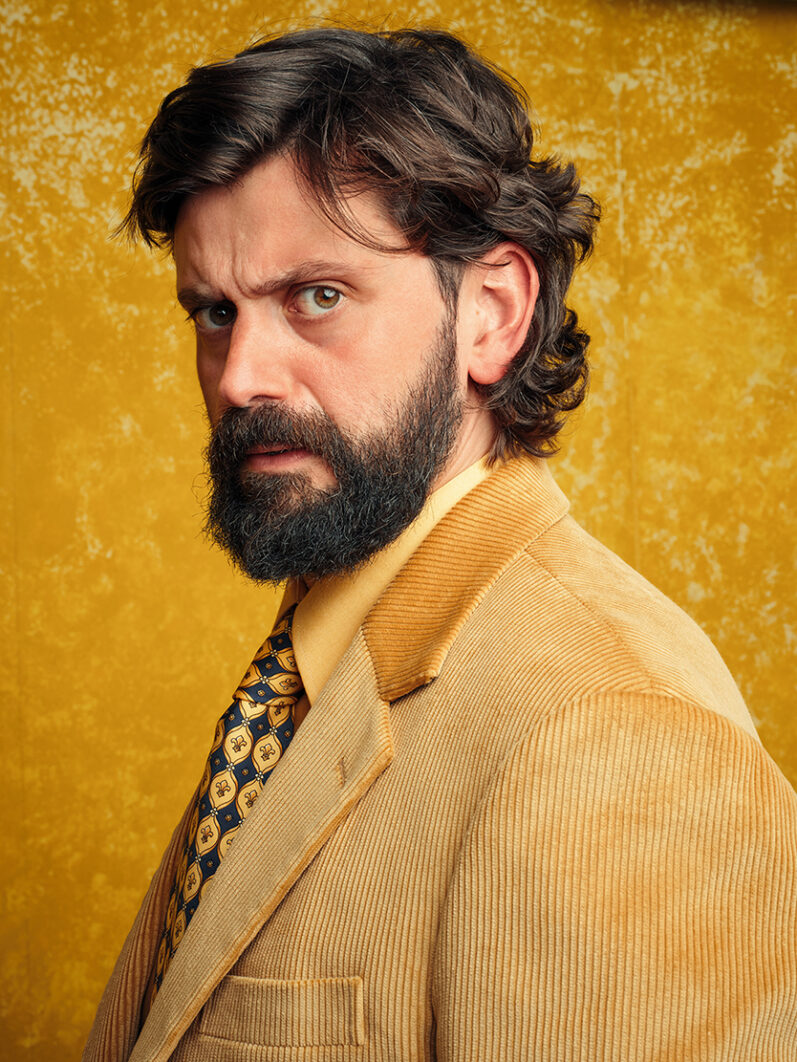
Fin Taylor is not wearing shoes. We are sitting in his South London studio, and his feet are up, his hands are behind his head, he sounds weary. The cumulative effect is as though I am talking to a hungover fresher, who just happens to be about 6’4” and 36 years old.
If you have not heard of him, ask the first 23-year-old boy you can find, and then prepare to hear him splutter, fawn, idolise, venerate. Taylor is the star of the satirical history podcast Fin vs History. One Gen-Z colleague of mine says that hardly a single conversation with his friends goes by without mention of the show. It is currently number 12 in the national podcast charts on Spotify, just behind the Rest is Football and the Newsagents.
I am nominally here to talk about his new book The History of Mankind in its Entirety (abridged) – An Unsupervised PhD by Fin Taylor (Historian). But really this is a project of disambiguation: Fin (Historian) is a character played by Fin (Comedian). Fin (Comedian) has had a semi-successful stand-up career for the best part of a decade, and a popular podcast, Fin vs the Internet since, 2022. In 2025 Fin (Comedian) put Fin (Historian) in front of the microphone and created Fin vs History. Now Fin (Historian) has written a book and Fin (Comedian) is talking me through it.
The podcast – which, like all podcasts now, is also an on-camera operation – was founded originally as a blatant “rip-off” of the Rest is History, he tells me. Rip-off, I suspect, is the wrong word – would “riff on” work better? Fin and co-host Horatio Gould lounge on a sofa in 1970s, moth-y suits (or sometimes in thematic costume: lab coats for a series on Chernobyl, naval caps for the sinking of the Belgrano) and chat their way chronologically through an episode in history. The reign of Caligula, the suffragette movement, Harold Wilson and post-war Britain. So far, so Rest is History.

The joke, however, is that neither of the pair – nor the disembodied, ambient voice of their producer Charlie – has a particularly strong grasp on the facts, or the minutiae of events. Call it impressionistic history, perhaps. A gist. Is it true that residents of Pripyat gathered on a nearby bridge to watch the Chernobyl reactor fire, only for them to all die of radiation poisoning soon after? Or is that an urban myth? Eh, Fin shrugs, who cares! Mahatma Gandhi, meanwhile, is “one of the biggest kill joys of all time” and General Jean-Andoche Junot “one of the maddest cunts alive”.
Where Tom Holland and Dominic Sandbrook have several thousand pages of published academic history between them, Fin and Horatio work to give the impression they have but glanced at the subject Wikipedia page on the way to the office. Hyperbole, a disinterest for detail, hostility to the Academe – this is the rhetorical mode of Fin vs History. But of course, such studied insouciance takes a lot more effort than that.
And Fin (Comedian) openly admits to this. He has an undergraduate degree in history from Bristol. He reads and prepares. And, surprise – Fin vs History even has researchers. Fin (Comedian) likens the craft to Les Dawson, the 1970s comic who used to play piano badly on stage to uproarious effect. In reality, Dawson was a concert pianist – “you have to be able to know how to play the piano in order to make it terrible in a funny way” as Fin puts it.
It is hard to escape the resonance: Picasso once said that it took four years to paint like Raphael, and a lifetime to paint like a child. In other words, you have to know the form to break it; to do cubism, an ability for photorealism is a prerequisite. Fin (Historian) is the magical invention of Fin (Comedian). And there it is, the first flashes I detect of a man – for all his insistence that silliness is the ultimate goal – who would like to be taken quite seriously indeed. Fin (Genius?)
Fin Taylor is from St Albans in Hertfordshire. Before Bristol, he went to Abingdon, a minor public school. It would have been easy for him to slot into the time honoured archetype of British comedy: the posh chap, the rakish and self-knowing lad, the affable school boy rogue. Jack Whitehall is their patron saint. Ed Gamble pretender to the throne. The bumbling, BBC-friendly, “who me?” routine is their lingua franca. But Taylor – blessed with the same countenance and RP – has done something apparently new with the form.
Whatever Fin vs History is – satire? Pastiche? Podcast burlesque? – one cannot readily imagine it on the BBC. The most milquetoast gags range from likening women’s suffrage to terrorism, to anatomically lewd discussion of dwarfism. In History of Mankind Fin (Historian) asks of Israel: “Are they committing genocide? Or are they making memories?” He rides the crest of the culture war, capable of sounding progressive and reactionary within a single breath: “The Dark Ages ended in the 1970s with women’s liberation (and, with girls allowed in pubs, so began a new Dark Ages for men).”
And he dedicates excessive time to jokes about autism, on and off page. Take The History of Mankind: The purpose of this book is to “punch through the autism silo” of academic history; people who take interest in pre-500 BC history “score highly on the autism spectrum”; in fact, “the older the history, the more autistic the historian”; Martin Luther “self-diagnosed with autism”; and that it is incumbent on humans today to provide “autistics of the future” with something to hyper-fixate on. “Are we German or Italian?” Britain asks itself, trying to decide the future of its state religion. Or better yet, “are we autistic or gay?” Fin (Historian) thinks. One paragraph on the Reformation contains the word five times.
“Do you ever wonder if you overdo the autism joke?” I ask. “Part of me thought there could be fewer references,” he says.
The resulting character – Fin (Historian) – allows Fin (Comedian) to make somewhat sophisticated arguments about historiography, truth, and the evolution of history from elite discipline to mass entertainment via the mechanism of toilet humour and jokes about holocaust denial. It is comedy for boys who used to joke about masturbation from the back of the maths classroom, and now have BAs from Russell Group universities.
For his comedic freedom, Taylor (Fin) has Patreon to thank. A model whereby listeners pay the talent directly for their product. It has long been the mechanism for traditionally non-woke podcasters to survive: CumTown and Chapo Trap House were early adopters of the financial arrangement, insulated from establishment cancellation by cutting out the need for establishment buy-in. Jack Whitehall would have a terribly difficult time making such light of phrenology as Fin (Historian) does, as a gentle example.
But Fin (Comedian) insists he is above the fray of the culture war. You can satirise the left and right with equal disregard for basic politeness, I put to him. “Am I supposed to see you as some kind of enlightened centrist,” I add, somewhat glibly. “No… you’re meant to believe that I’m just playing.” Hmm. “I admit that is hard for some journalists to accept,” he adds, resistant to the idea that there is a political dimension to what he is doing at all.
Okay, so if not the left, and if not the right, and if not the concept of stuffy academic history, nor the abstract idea of a culture war, then what is his book satirising? “You say it’s satirical. That’s a label you’ve given it,” he admonishes. “Maybe it’s more a comment on how history is weaponised, uh, politically. But then I say that… It’s just funny. It’s meant to just be funny” he retreats.
The History of Mankind in its Entirety may not be the best medium for Fin (Historian) – a character that benefits from Fin (Comedian)’s on-screen charisma and chemistry with co-host Horatio. Moments of comedy on the page are too laboured – Saddam Hussein’s “falafel clogged veins” and a quip that “the Gulags were great craic”, for example. It is what Martin Amis would call a joke wearing a joke badge. As an advertisement for the character, I suspect in places The History of Mankind sells his originality short.
And there are instances when the Comedian and Historian are hard to disambiguate. Fin (Historian) for example misunderstands Fukuyama’s End of History thesis. But what about Fin Taylor? It is not clear. I suspect he has misunderstood it too. Is that unfair? Is that the joke? (Just a joke, bro!) He, in the very least, has some pretty solid plausible deniability. And at the end of the book, the Historian – or is it Taylor? – writes a sincere coda on 9/11, which contains proper points and flashes of genuine writerly artfulness, sans gags. He – Historian? Comedian? Writer? Taylor? – then says something so incongruously wrong about Afghanistan you have to ask, has Taylor just let himself down in mid-earnest flow, or is Fin (Historian) just an inconsistently drawn character? Someone who is supposed to only ever be inaccurately joking, but secretly harbours considered ideas about mass terrorism in an age of mass communication?
I am not sure, and Fin (Comedian) doesn’t seem to be either. He is right and lucid on one thing at least: it takes a craftsman of superhuman precision to get away with the Fin (Historian) podcast routine. I did not find the Les Dawson comparison lofty or grandiose – there is a reason he is so beloved and it is entirely to do with skill. And so, again, I cannot help but detect that nagging desire to be taken as a man of sober, sharp intellect too. “The only standard I’m held up to is: is it funny?” he says, and I wonder if he wishes that were not entirely true.
[Further reading: Oasis gave us permission to let go]
Content from our partners



Related



Join the debate
Subscribe here to comment