
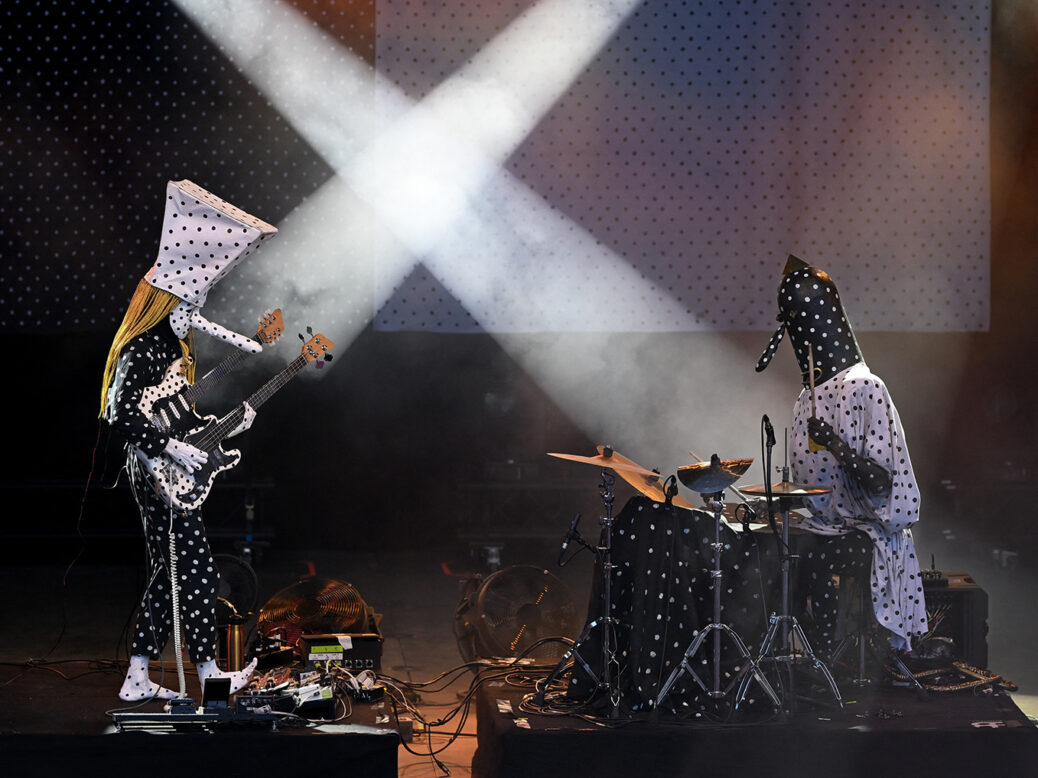
It’s great to think there is a new guitar hero on the block and even better that no one knows who he is. Angine de Poitrine are, for now, an anonymous band: two men from Quebec, with folk-style monikers (Khn de Poitrine and Klek de Poitrine), their instruments a set of drums and a Stratocaster guitar that has been welded on top of a Fender Precision bass, both models customised using a hand saw to create twice as many frets as usual, and therefore twice as many notes. There is also a loop pedal at work – an instrument in itself – operated by the long, bony foot of guitarist Khn: a foot painted with the same black and white polka dots as his bony hands and ceremonial head box.
At the Troxy in east London’s Limehouse, one night on a UK and US tour that has sold out, they begin on opposing podiums, facing each other, bobbing ritualistically from the knees and communicating by making triangle shapes with their hands. Drummer Klek’s papier mâché helmet resembles medieval torture equipment. His long proboscis is floppy, and swings while he plays, while his bandmate’s “nose” is semi-erect. The aesthetic reminds me of Renaissance Venice – that intersection of the sumptuous and the degenerate; a world of plague doctors and birds with teeth. There is something of the Renaissance in their raw fanfares too, like music played in court on thin trumpets. Though abrasive and insistent, the sound is strangely focusing: put it on while working and it won’t distract you at all. Angine de Poitrine appeared in full dress in an interview on Canadian TV earlier this year, with their manager acting as “interpreter”. But he was not translating their native French to English: when the band opened their mouths, all that came out was a kind of oral feedback – high croaks, beeps and burbles, which you also hear on stage at the Troxy, announced by lightbulbs flashing inside their headgear.
The masked player or singer has always had a considerable appeal to the public. Masked musicians can’t age, or look boring (Daft Punk). Bands can, if they want, have an infinite line-up of members, subbing and depping for one another because you never knew who was under there in the first place, as the Swedish band Goat claim to do. Masks can make music much more confrontational and scary (Slipknot, Clown Core). And in the case of Angine de Poitrine, masks can sweeten the pill, turning a cerebral, somewhat intimidating genre into something cultish and fun.
In front of the stage, a small patch of whirling fans is forming like the last of a bath going down a plug hole. As the music builds, the mosh pit spins faster and faster, and the mind expands: you think about how strange and wondrous humans are to have created music at all, and to be doing this for fun; you wonder what this scene would look like to an alien, though Klek and Khn look like aliens too. They are locked together on stage, each cymbal crash hitting a note in unison: there are large fans to keep them cool. There are expansive, eastern-flavoured tunes with drums like camels galloping.

Angine de Poitrine’s music is often described as math rock, which I think of as a term used by people who don’t like jazz, to describe music that is basically jazz. Where there is rock, it is in their raw ingredients – in riffs approaching heavy metal, and in rich, diminished chords thrown in among a twiddly-twiddly madness that recalls the yodel-tastic Focus, the great prog-rock band of the 1970s. There is rock, too, in the regularity of it all – section after musical section, learned obsessively, mapped rather than improvised, repetitive rather than free. The duo love dance music, and are big fans of Calvin Harris.
But the thing everyone’s talking about, other than the clothes, is the microtones. Thanks to the sawed guitar, Angine de Poitrine use a scale of 24 notes, rather than the usual 12 – a scale that features quarter tones (“half sharps” and “half flats”) as well as semitones, resulting in a sound we’re accustomed to hearing in Indian and Turkish music but not so much in the West. So what’s going on when you listen? You couldn’t replicate what the band play on the piano, because the piano doesn’t have the ghostly quarters; your ear hears the reassuring root notes – the Gs and Es – and it also detects the mysterious microtones. Something is “off”, but only slightly so.
The overall effect on stage at the Troxy is an elongated state of suspense. On the tracks “Yor Zarad” and “Sarniez”, Khn is essentially rolling around a key note, a fraction above, then a fraction below it. On “Mata Zyklek”, his guitar sounds interchangeable with one of those Indian wind instruments they use to charm cobras. The band maintain that what they’ve arrived at bears just as much resemblance to Miles Davis as it does to eastern tonality. Yet there are surprisingly few people playing microtonally in Western music: there is the American guitarist David Fiuczynski who, rather than adding more frets to his instrument, simply removed them, and the new British genius Maddie Ashman, who has actually created a kind of microtonal piano, but that is a tale for another time.
That the band has, as Apple Music put it, “pushed discussion of microtonal guitar tunings and 17/4 time signatures from the darkest recesses of prog message boards into mainstream music discourse” is clearly all down to their spotty clothes and dong-like noses. But this is the beauty of Angine de Poitrine, operating basses and guitars and loops and lightboxes all at once, while still finding time to squat and squeak and buzz. They are amused ambassadors for complicated sounds that we’d otherwise find it hard to relate to – part of a wider movement embracing clever music, which probably began on YouTube with Jacob Collier’s viral, microtonal cover of Stevie Wonder, featuring dozens of tracks of his own voice. Not that long ago, playing a guitar well, with lots of notes, was still seen as “wanking”. Now, we like to wonder at virtuosic instrumentalists, and watch them doing things we never could.
Yet to be anonymous is an added kind of wonder. Klek and Khn’s costumes – inspired by their love of papier mâché and the proboscis monkey – came about because they played the same venue twice in one week and had to pretend to be a different band the second time round so that people would come again. You don’t have to search long on YouTube to find clips of two pale, young Canadians – one with a Mohawk and one in shorts – playing remarkably similar music, with remarkably similar energy, four or five years ago. At one point while at the Troxy, I wondered whether Angine de Poitrine were, in fact, their own support act, as there’s nothing to stop them appearing twice. As they left the stage, I was anxious that one of the moshers might grab Khn’s long golden “hair”, which appears to be made of curtain cord, pull his headpiece off, shove a phone in the face of the man underneath and ruin the joke for everyone. But I think we all know it’s better this way.
Angine de Poitrine
The Troxy, London E1
20 October 2026
[Further reading: Geese’s alluring detachment]
Content from our partners



Related
This article appears in the 21 Oct 2026 issue of the New Statesman, Sally Rooney is a writer, not a terrorist
Join the debate
Subscribe here to comment