
In 1965, when Miss World arrived in the Tyneside town of Jarrow, she found herself roundly booed for mentioning the 1936 Jarrow March. Hired for the grand opening of Club Franchi, a self-described “palace of luxury living”, which featured a casino where coins from Roman Northumbria hung from the ceiling, Miss World’s impromptu tribute to the marchers turned the crowd against her. The town was more interested in the stars of today: the two Italian brothers who ran the club had booked Dusty Springfield to do a week’s residency. “Former hunger march town blossoms into living luxury,” as the Stage put it. The past was over.
Club Franchi’s Venetian gondolas were the pilots of an optimism that floated far into the future. By contrast, bringing up the Jarrow Crusade – now more commonly referred to as the Jarrow March – brought back memories of when politics was more uncomfortable, difficult to tidy away, and often a little embarrassing. No wonder so many people just wanted it to be forgotten. Alternately shunned and celebrated by the political left, once the marchers became famous, they were doomed to be misremembered. Despite efforts to supress coverage of the Jarrow Crusade, the marchers became a newsreel sensation, and have since become a kind of myth, used to advance (or counter) political claims.
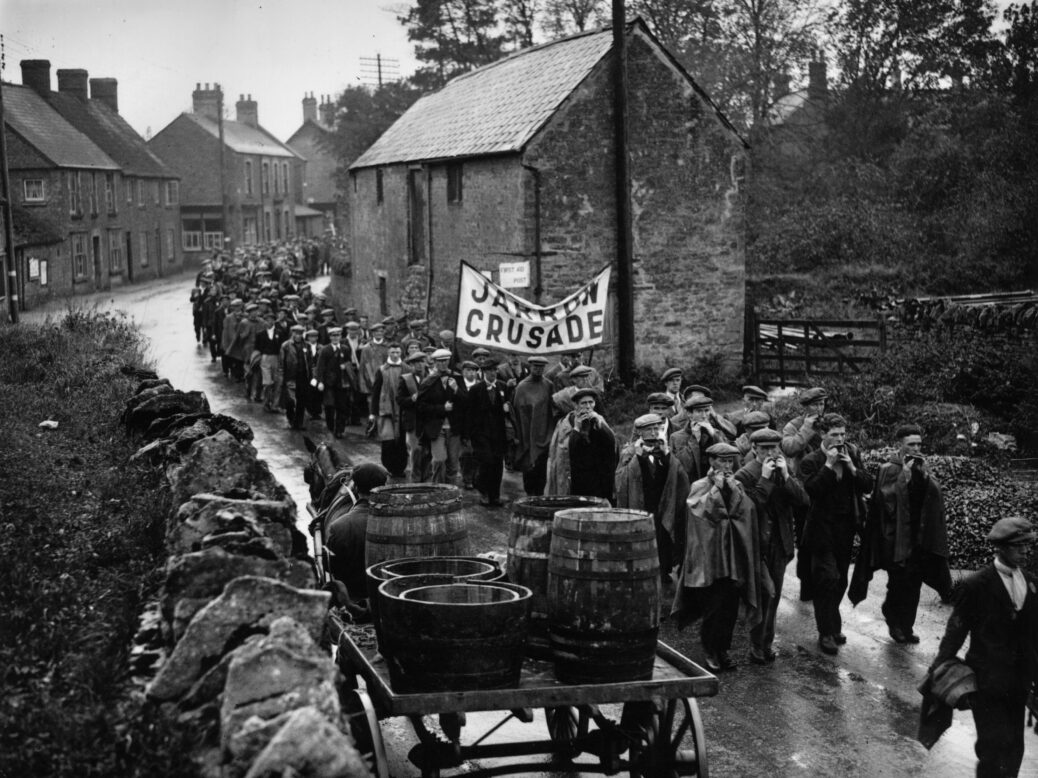
The Jarrow Crusade is now 90 years old. It began with Jarrow’s mayor, Alderman William “Billy” Thompson, and David Riley, chairman of the local council, selecting 200 fit men from 1,200 volunteers. After passing a medical, each man was given a Jarrow Crusade badge, a waterproof, two pairs of socks and new soles for their boots. With quasi-military discipline the marchers assembled at 8:45 every morning, their procession followed by a second-hand bus which carried cooking supplies, blankets and tents. The men received a donation of harmonicas and were accompanied by a dog. They set off in the sunshine on Monday 5 October and arrived in London in pouring rain on Saturday 31.
The story of 200 desperate men from Jarrow, where unemployment had reached over 75 per cent, marching for 26 days from their northeast home to Westminster, has become a textbook illustration of the slump. But for much of the five decades that followed it, there was a wilful attempt to suppress its memory. “People didn’t want to talk about it,” says the screenwriter Peter Flannery, whose grandfather was on the march. “They had returned half triumphant and half with their tail between their legs. They didn’t want to draw attention to themselves. It was a heroic failure.”
Even when the march had just been an idea, few had wanted it to actually happen. “Rationalisation” after the First World War had led to the closure of Palmer’s Shipyard, but 18 months later Britain was importing ships from Belgium made with bits of machinery salvaged from Jarrow’s shuttered factories. Pressed to intervene, then prime minister Ramsay MacDonald cautioned, “Jarrow must be its own salvation.” Jarrow’s Crusade for Jobs was the response of an archetypal one-industry town that had been abandoned even as other regions prospered.
Not only was the Crusade embarrassing for the Labour Party but they feared accusations of encouraging “the politics of the mob”. To try and head off this criticism, from its inception, the organisers of the Crusade had put enormous amounts of energy into articulating what the protest was not. Despite this caution, at their conference that autumn, Labour determined not to support them. The Labour Party, jibes a character in Flannery’s 1990s TV series Our Friends in the North, has been betraying ordinary people ever since. The Crusade exemplified the inter-generational incomprehension, the illegibility of the old to their more demanding post-war children, that provided that series with its dramatic heart. “The thing with my parents,” Flannery adds, “is that they thought their lives were unremarkable. They just underrated their own experiences.”

Instead, the memory of the Jarrow Crusade would become inextricably linked with the image of the Jarrow MP Ellen Wilkinson, later a Labour minister, but at this time an iconoclastic socialist. Wilkinson played a key role in organising and promoting the Crusade, although she did not herself complete it. She was able to circumnavigate attempts to supress press coverage by inviting friends in the media like the BBC’s Bernard Murphy to join. Radio talks were broadcast that offered the perspective of the unemployed, while the Times was persuaded to publish articles on the plight of “the distressed areas”.
Much more than anyone within the labour movement at that point, and certainly any other female politician on the left, Wilkinson was able to craft a compelling media persona for herself through the 1930s. She knew how things played, how things were reported, and how to talk over her Westminster rivals. It was a measure of this sophistication that the marchers were treated to screenings of Soviet propaganda films such as Pudovkin’s Storm Over Asia, at the same time as newsreels were choregraphed to capture footage of royal servants throwing money at the marchers as they arrived in London. The Jarrow Crusade was one of the smallest marches of the era, but you would not have known it from the media response. “It’s best to understand it as theatrics with an end goal,” says Professor Laura Beers, Wilkinson’s biographer. “[Wilkinson] was a great believer in the stunt in terms of political effect as opposed to solely in terms of her personal career advancement… Wilkinson marched with the Jarrow Marchers not to build a public presence, but because she knows she has a national presence, and she’s trying to lend that weight to the march.”
With the marchers carefully herded out of the way lest they be tempted to cause any trouble, it was left to Wilkinson to deliver their petition and provide the moment that pushed the Jarrow Crusade into political folklore. “Miss Ellen Wilkinson, highly strung socialist MP for Jarrow,” as the Daily Mail reported it, “laid her copper-coloured hair on the rails at the bank of the speaker’s highchair in the House of Commons tonight and wept.” Although Wilkinson’s tears were likely staged, their performance was completely sincere. “I’ve got an original print of Ellen Wilkinson on the march, with the marchers having a sandwich and a cup of tea, pinned on my wall in parliament,” says Emma Lewell, the Labour MP for South Shields, “and next to it is a piece from the New Statesman, I think, celebrating one of the anniversaries of the march.”
It is the fate of protests “from below” to be posthumously reconstructed. Now that there are no participants left to speak from experience, it is worth reemphasising that the Jarrow Crusade was a thankless enterprise to be bound up with. While Wilkinson is now remembered as the Minister of Education who rolled out the tripartite education system, her support for the marchers nearly sank her political career. There was no state response to speak of, and the little there was came from the private initiative of a Conservative MP for Surrey, Sir John Jarvis, who invested £1m in businesses, funded new housing and built amenities including an athletics stadium. Disappointed by the lack of support, several marchers who criticised the party’s leadership were expelled. By making themselves unavailable for work, the marchers had their unemployment assistance withdrawn.
Even from the vantage point of the immediate postwar period, the Crusade could appear a relic from a time before modern democracy. The marchers petition had read, “[We] humbly pray that His Majesty’s Government and this honourable House should realise the urgent need that work should be provided for the town.” On their trek the marchers often slept in workhouses and churchyards. It was a pilgrimage that belonged to older religious and quasi-religious traditions of the labour movement that had already begun to evaporate. As Special Branch observers noted, when they entered London, the marchers “cheered lustily” as the King passed down the Mall. Little wonder its participants were reluctant to speak about it. “My gran used to say, ‘Politics isn’t for the likes of us, Emma,’” explains Lewell, “because we always deemed it as something for people who have had an expensive education. But my gran was the most political person I’d ever met.”
It was not until the Blitz that the memory of the marchers suffering flickered briefly back into wider cultural currency as ordinary people in Clydeside, Coventry and the East End experienced their own devastations. To try and rekindle this sentiment ahead of the 1950 election, with incredible chutzpah, Labour issued a poster featuring a photograph of the marchers emblazoned with the slogan “Remember unemployment? Don’t give the Tories another chance”. Jarrow’s particular plight had become a popular myth that politicians retrospectively reshaped to magnify the tribal loyalties of the postwar settlement. No wonder that, 30 years after the event, nobody really understood what the Crusade had been about.
However, the re-emergence of stark regional inequalities during the Thatcher era brought renewed attention and comparisons to the disparities of the interwar period. With the eclipse of the postwar compact there was a rise in the historical stock of the Jarrow Crusade. Britain was (again) simultaneously booming and bust. By the time of the Crusade’s 50th anniversary, Club Franchi was derelict, and so was the optimism of the Sixties. The moral paradigms of contemporary British history often seem stuck in 1945, but the Jarrow March as we have come to know it was invented around 1986.
“[The March] is steeped in the town’s history. It’s steeped in South Tyneside history,” concludes Lewell, “because it represents the struggles that the wider northeast has had for a very long time in terms of poverty, unemployment, and a general frustration.” To mark the Crusade’s golden jubilee, in 1986, the TUC invested £80,000 in a 30-man reenactment, with the walk broken up by pop concerts that aimed at capturing “the imagination of young Britain”. Heaven 17, The Mekons and Alan Hull of Lindisfarne were among the contributors to a Jarrow Crusade album entitled Heads Held High.
Outside of the north-east, the Crusade’s lack of revolutionary spirit began to provoke less generous judgements. Prompted by the popularity of Thatcherite policies with large swathes of the working-class, and under the influence of the New Left, academic historians contrasted the larger, more numerous and politically pointed “hunger marches” of the era organised by the (Communist) National Unemployed Workers’ Movement with the highly mediatised and self-consciously “non-political” Jarrow Crusade. Although it is not news that for much of the 20th century ordinary people were more socially conservative than their liberal betters, the organisers of the Crusade had worked hand in glove with Scotland Yard’s Special Branch. The fear of communist infiltration was immense. Recruiting Conservatives and building on a bedrock of rotary clubs, charities, and assorted tin-shakers was an important counter to this.
Indeed, such is the ambiguity around the March that in 1996 the Thatcherite attack dog Sir Bernard Ingham fronted a three-part TV tribute examining its legacies. His interviews – including with Peter Flannery and the property developer Sir John Hall – strike an uneasy balance. Britain at the close of the 20th century, as Ingham saw it, is defined by a mobility that makes it possible for people to better their lot, but not (he adds) without myriad social costs. The cathedrals of the modern age were now represented by the Metro Centre, an enormous shopping mall that opened in nearby Gateshead in 1986. Meanwhile, the Olympic medallist Steve Cram – the Jarrow Arrow – had become perhaps the most famous beneficiary of Jarvis’s sporting philanthropy. While a mural of the marchers adorned the platform of Newcastle’s new light railway (The Tyne & Wear Metro) the social bonds of the marchers had been obliterated by the private motor car.
The March’s “broader significance waned for quite a while, until in ’86 it’s brought back”, argues Beers. “Because it was whitewashed at the time, it can be used in ’86 to compare a neoliberal moment to the failures of the original liberal system and to underscore why the social welfare state needed to be created and ought to be sustained. It becomes a parable.” To recall the march at the end of the century was less to remember the Jarrow Crusade than to reveal the imaginative schism that had grown up between a generation of those like Ingham, whose path from socialism to Thatcherism was predicated on an understanding that the people had been let down by the post-war state, and a new left infused with the belief that the post-war state had been let down by the British people.
If Miss World was to return to Jarrow in 2026, she would find the Arndale Centre, which housed Club Franchi, as well as a bowling alley, Pearl Assurance offices and the fine dining of Restaurant del Sol, had been demolished and replaced by an enormous Morrisons supermarket. In 2001, a statue to the Crusaders and their dog was unveiled in its wind-swept car park. Using the statue as a starting point, local tour guide and actress Amanda Hepburn, has been trying to resurrect interest in the march. “When I recount the levels of poverty that we saw in the 30s, I’ve had people in tears,” says Hepburn. “And we only really remember the men. The women’s suffering, which might have been worse, is invisible.”
However, while locations from the TV show Vera or the novels of Catherine Cookson (before they went out of fashion) proved difficult stories could make for popular tours in prosperous times, as the cost-of-living bites, the Jarrow March is proving a hard sell. Visitors from cruise ships into Newcastle ask to go up the Northumbrian coast or along Hadrian’s Wall instead. “Honestly, I don’t think Jarrow can remember what it was,” says Hepburn. “People don’t see any relation between themselves and what happened in the past.”
Tracking media coverage from a low base in the 1960s to a highpoint in the 1990s, national interest in the march is in steep decline. The Jarrow Crusade does not map easily onto the politics of 21st century Britain. It is no longer useful shorthand. Instead, politicians reach from a more recent selection of well-worn binaries – nostalgia for postwar social democracy, and fear of Seventies statist calamity. These still have political currency, but cast very little light on contemporary challenges such as the disruptive impact of digital technologies, the excessive debt that followed a prolonged period of low interest rates, extremely high levels of immigration, the fragmentation of international trade in the wake of the Global Financial Crisis, or the fallout from the War on Terror.
It remains uncomfortable and difficult to think about the Jarrow Crusade with acuity, and now that nearly a century has passed there is little incentive to try. Earlier this month Andy Burnham claimed to be “righting a historic wrong” by receiving a petition from descendants of the marchers in Downing Street. Labour’s hostile attitude to the march was expunged from the record and Stanley Baldwin was offered up as the historic villain instead. We are now firmly in “celebration” territory, and as of this moment there seems no obvious prospect of a return to shunning. Yet rebellious instincts can be inherited whether they are consciously understood or not. In May’s local government elections, the decades long rise of forerunners like Ukip resulted in the residents of the housing Sir John Jarvis built in Jarrow voting Reform by a landslide.
[Further reading: Tony, Gordon, and me]
Content from our partners



Related
Join the debate
Subscribe here to comment