
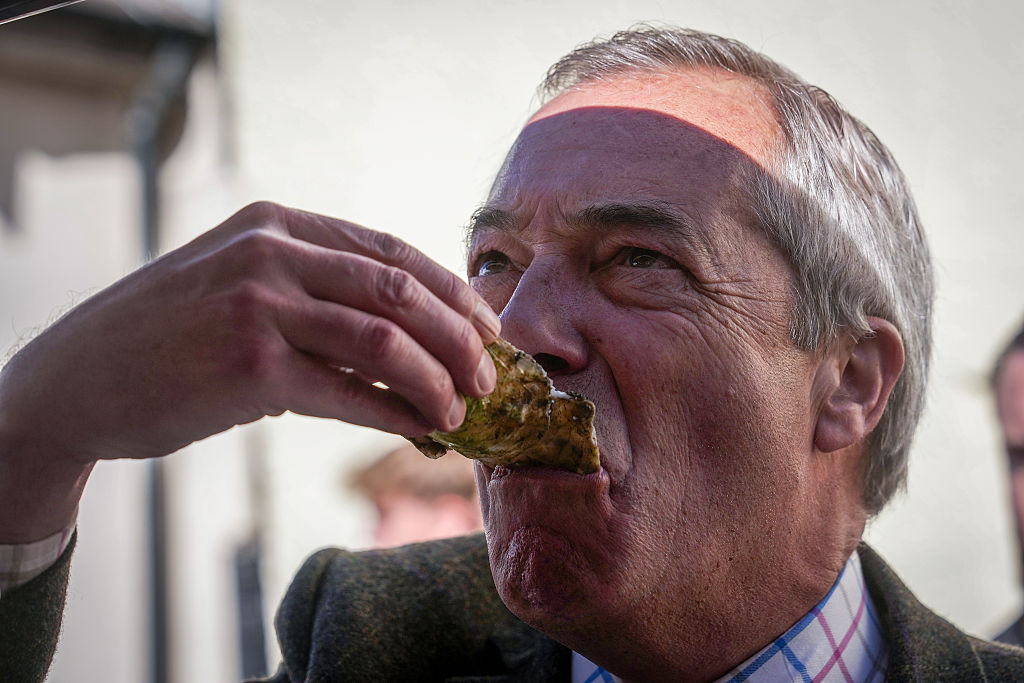
July, 2026: “Oysters please!” Nigel Farage chirped in the garden of a seafood restaurant somewhere near Clacton-on-Sea. One has to wonder how many times he’s said those exact words in his 62 years – more than a few dozen, I suspect. A man’s proximity to the British right is almost perfectly correlated to his affection for crustaceans, mollusks and flaky fish.
He should have known, then, that there were interlopers in his ranks. In Reform: Exposed by Channel 4 and Verbatim Farage is caught on hidden camera merrily cavorting with fake American donors over white wine (screw top) and oysters in the constituency. Party conference? Derailed. Scandals? Piling up. Reform? Exposed? Sure, maybe! But he should have seen it coming – with that one simple slip in the semantics.
“Shall we do four each?” the fake son responded to Farage’s request for oysters. Four?! Farage baulks. Ordering oysters in a quantity of four is as odd as asking for eggs in a group of seven – or cigarettes in anything other than 20. He should know. “Nooooo, pointless – I’ll have half a dozen” he responds. To cosplay as a Reform enthusiast – or a Reform donor willing to obscure foreign money via some very creative accounting – it is best to become au fait with the duodecimal system.
Accounting for the tradition involves some guess work. We have been eating oysters a lot longer than we have had the metric system. “Base 12” helped fishmongers divide their hauls into halves, thirds, quarters – no abacus required. There is a simple aesthetic case, too: Six, 12 and 24 look better arranged in a circle than four, eight… 16. Somewhat convincing.

Whatever the reason, when it comes to fish Reform is across the mores. It’s all that time spent in the white table clothed sea food restaurants of London’s W post codes. At Bentley’s – where the patrons assume the 1801 Act of Union is still active, it seems – you can eat oysters from County Louth, County Mayo, County Donegal and even somewhere in Wales were you so inclined. Down at Wilton’s and J Sheekey it is much the same: A platter of oysters, a dover sole (“boat price” usually), a fish pie.
The semiotics of the oyster are constantly evolving – in Rome they were a luxury, Ancient Greece? Commonplace. They were cheap street food for hokey Victorians in London – “poverty and oysters always seem to go together” as Dickens wrote in The Pickwick Papers – and made common appearances on the canvasses of the Dutch golden age. I would gesture to the feted aphrodisiac qualities, but nowhere in British party politics would that apply.
And now here we are – with oysters (in traditional quantities, please!) as the preferred lunch of the British right. A last stand against the modernising, progressive loons and their metric systems, taking this country to the dogs.
[Further reading: What is a right-wing restaurant?]
Content from our partners



Related


Join the debate
Subscribe here to comment