
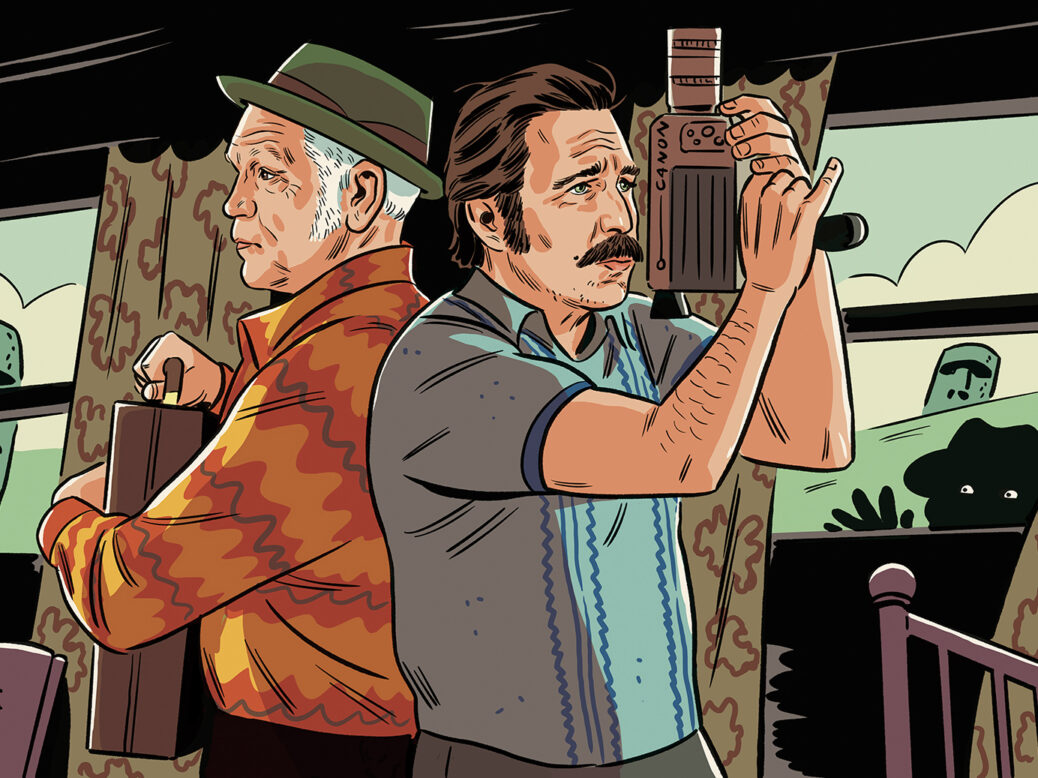
Martin McDonagh would kill for a joke. Just look at the body count in his movies. Black comedy is a lethal genre and he’s the expert. Wild Horse Nine, the Irish filmmaker’s fifth feature, combines choice elements from his first, In Bruges (two hit-men take a trip) and his last, The Banshees of Inisherin (island mayhem).
It is 1973. In Santiago, Chile, the CIA has been preparing the coup against President Salvador Allende that will result in the Pinochet dictatorship. CIA buddies Lee (Sam Rockwell) and Chris (John Malkovich) are fooling around with a home-movie camera before setting off on holiday. “I’m a big-shot in the CIA,” says Chris by way of introducing himself, “a veteran of Guatemala, 1954 – success. The Congo, 1960 – success. The Bay of Pigs, 1961 – less successful. Dallas, 1963…” Lee asks in return, “What do you regret?”
At 72, Chris, we learn, is terminally ill and losing his memory. This is to be his last trip, but he remains a great talker, very much in the McDonagh mode of exaggerated, rhythmic repetition, native to Ireland but no less vital elsewhere. At the airport, en route to Easter Island, he shoots his mouth off to a couple of appalled women (Mariana di Girolamo, Ailín Salas). We’ll encounter them again later. “We are the CIA, actually. We came down to destabilise your democracy – it’s going great! Your country’s going to get fucked.”
On the plane, Chris and Lee bicker familiarly. “I was killing people before you were even born, I’ve killed people in countries you can’t even spell,” Chris brags. Czechoslovakia, for example.

For the rest of the film we’re on Easter Island. It is only the second feature to be shot there (Rapa Nui, a 1994 historical adventure directed by Kevin Reynolds being the first, bombed). McDonagh had long wanted to make a film there after visiting years ago. For all of the talk in this film – the great talk, for McDonagh is a writer of dialogue, much more than he is either a playwright or a film director – it is the island that makes this film so eloquent.
It is beautifully and spaciously filmed at sunset and dawn, not just as backdrop but the place where Chris has come to reflect on his murderous career, and die. The pair are absurdly flippant about the “big heads”, as they call the stone Moai. Looking at an array of damaged and incomplete statues. Chris says, “I feel like at one time or another I’ve dated every single one of these girls – except the dwarf.” But the figures’ indecipherable, brooding presence remains potent nonetheless; impassive witnesses from the deep past to the mortal story being played out before them.
Easter Island is also populated by herds of wild horses – Chris loves these, and thinks he probably could have killed a few less people and hung out with a lot more horses. Even more reminiscent of Ireland, though, is the way the island is so vividly green. No matter that there’s no more than a passing reference to the country in Wild Horse Nine: it’s still Irish through and through.
Rockwell – a McDonagh regular – is excellent as Lee, finally loyal despite the taunts. Malkovich delivers his best performance in many years, making the most of every line, savouring his own rich voice; that cross-eyed, derisive look brilliantly paired with the stony indifference of the Moai in the final scenes.
Parker Posey is Lee’s angry wife and Tom Waits Chris’s scornful brother, and both contribute savage cameos from the end of a phone line. Steve Buscemi is delectable as the vile junkie CIA boss trying to stop Chris spilling the beans about JFK. The soundtrack, mixing music by Carter Burwell with snatches of on-the-button pop songs from the era, is spiffy too. There’s a plot, to be sure, but it’s the riffs about such irrelevancies as moths, Nazis, heroin-addicted girlfriends and the way only “gay countries” have good cheese that make Wild Horse Nine such a rollicking entertainment.
Does this foul-mouthed gag-fest have serious political reference? McDonagh hopes so, suggesting that recent actions – such as in Venezuela – mirror past American interventions, except they’re even more blatant. “I love that it has a resonance I wasn’t necessarily aware of in the writing of it,” he has said.
That’s pretty much nonsense, though. Wild Horse Nine is most sincerely a tribute to enduring male friendship, that cure for loneliness. He successfully invites our sympathy for a vicious, sexist and reactionary old white man coming to the end of the road – without much regret – just because he is so ornery and amusing. It’s thoroughly reprehensible and totally enjoyable.
Wild Horse Nine is in cinemas now
[Further reading: Primetime catches Chris Hansen in his own reality TV trap]
Content from our partners



Related
This article appears in the 05 Nov 2026 issue of the New Statesman, Nigel Farage's bastards
Join the debate
Subscribe here to comment