
It is not just Digger’s cat that’s incontinent; it’s the whole movie. The catastrophe that is the Tom Cruise vehicle Digger is excessive in almost every way but, primarily, it is, like nearly all major productions now, simply much too long, running to over two hours. These days, only 7 per cent of movies come in under 90 minutes, once the norm.
One director not succumbing to this inflation is Paweł Pawlikowski. Fatherland (82 minutes) is the third film in a loose trilogy that began with Ida (also 82 minutes) in 2013, which won the 2015 Academy Award for Best Foreign Language Film, and continued with Cold War (88 minutes) in 2018, which won Pawlikowski his first Best Director award at Cannes.
Pawlikowski is a director who distills and concentrates more than any other now working. The title Fatherland has been used often before, notably for the adaptation of Robert Harris’s novel, but this film needs it and makes it resonate. The project began when Pawlikowski was sent Colm Tóibín’s 2021 fictionalised biography of Thomas Mann. Pawlikowski is not the ideal candidate for delivering a big biopic, but one episode caught his attention: Mann’s return to Germany in 1949, after 16 years in exile, to receive the Goethe Prize. Both East and West Germany were vying to claim the great writer, while Mann himself believed that, taking Goethe as inspiration, he could make speeches that would transcend these divisions.
Pawlikowski has turned this visit into a five-day road movie. The film opens with a masterful six minute pre-credits sequence. Klaus Mann (August Diehl), Thomas Mann’s disaffected addict son, is seen naked, sitting on the floor by a bed in which a random man dozes, talking, from Cannes, on the phone to his sister Erika, in America. Like the previous films in the trilogy, it’s shot in lustrous black and white in the boxy Academy ratio, immediately formalising what we see. The camera doesn’t move (the director of photography is again the wonderful Łukasz Żal). Yet this monologue is riveting, almost a film in itself.

Klaus is in despair. “We’re trash,” he says. He keeps being asked which side he’s on, Stalin or Mickey Mouse. He can’t believe in anything any more. Erika pleads with him to come with her and their father on the trip to Germany, but he has sworn never to set foot there. It’s a horrible land with horrible people, a language to lie in, he says. But he’ll think about coming, just because of her, he says. The call ends tenderly. We see Erika (Sandra Hüller) in an apartment in Los Angeles and the camera suddenly moves with her, as she gets up and steps across to a door behind which classical music is playing loudly. “Father?”
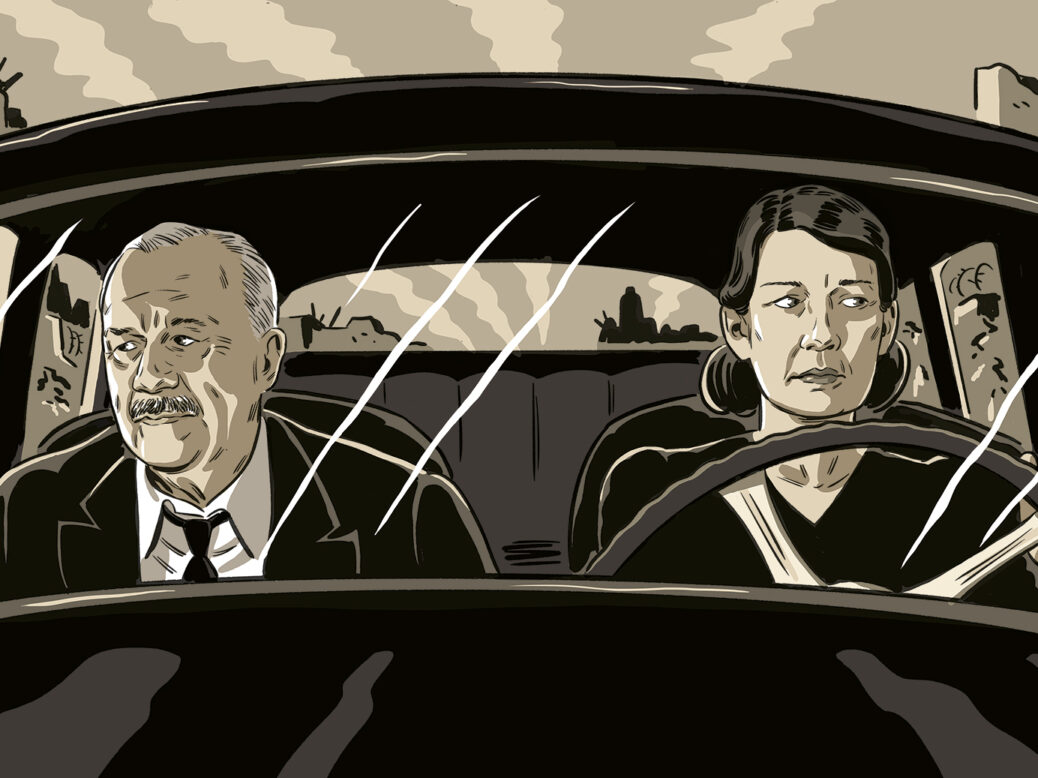
After the titles, we follow Mann (Hanns Zischler) on the road, through Germany’s wrecked streets, driven by Erika in a huge Buick. They arrive in Frankfurt, Erika hoping to find Klaus at their hotel. She translates for her father at a press conference. “Where is home?” he is asked. He’s an American citizen and a German writer, he replies. “Where my Heimat is, where I belong, is a much more difficult question.” He offers platitudes about Goethe being “always a point of reference for those who believe in a good Germany”. But at a grotesque reception party that evening he tells Richard Wagner’s grandsons that Bayreuth’s opera house should be razed and their mother put on trial, and Erika slaps her former husband, a Nazi favourite. “Imagine what they were doing four years ago,” she says at the banquet.
They move on to Weimar in East Germany, where they are serenaded not by string quartets and cabaret singers but by propaganda choirs of schoolchildren and Russian soldiers (music is central to Pawlikowski’s films). Mann again makes his idealistic speech about Goethe – “one German could become the model not only for his people but for all humanity” – to an indifferent audience. Erika revolts against her father’s preoccupation with his own legacy, his coldness to his own family. Fatherland has multiple meanings.
If Zischler is excellent as Mann, hiding narcissism behind his intelligence and reserve, Hüller’s performance is absolutely compelling. Pawlikowski’s filmmaking is not about the acting, though, so much as the composition of every single picture, each a fully realised work of art, not only in the framing and lighting but the whole sculpted mise en scène, which includes the actors. Everything we see matters here, every moment counts. Fatherland is both precise and sweeping. In brief, it’s quite beautiful.
Fatherland is in cinemas on 23 October
[Further reading: Digger is the best film of the year]
Content from our partners



Related
This article appears in the 21 Oct 2026 issue of the New Statesman, Sally Rooney is a writer, not a terrorist
Join the debate
Subscribe here to comment