
Do you want to see a truly bleak film about dementia and the end of life? Is it possible actually to enjoy such a production? Queen at Sea tells a simple story, despite its cryptic title. For there is no queen, no sea; it’s a gamesome way of suggesting, perhaps, what a noble mind is here o’erthrown.
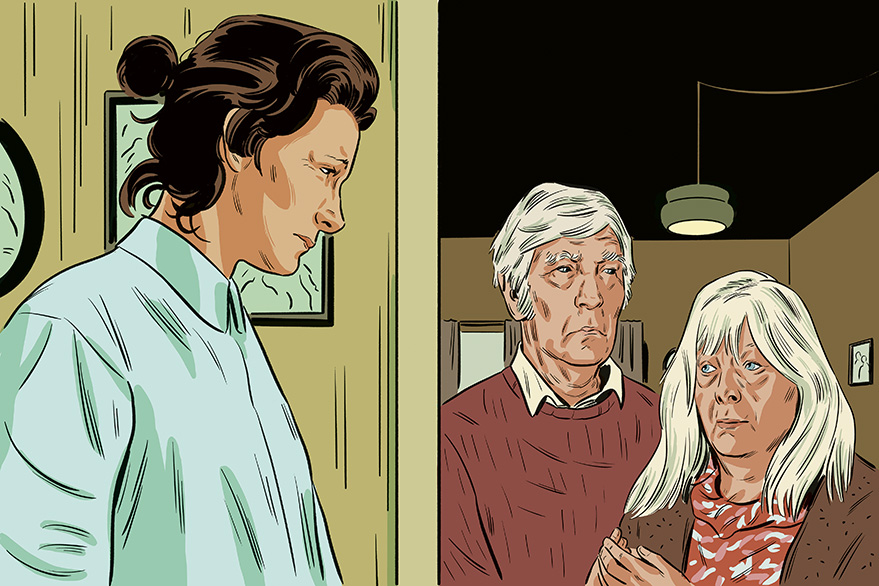
Martin (Tom Courtenay, 89) and Leslie (Anna Calder-Marshall, 79) have been married for 18 years, since the death of their first spouses. They share a passion for classical music and live in a tall, terraced house in Tufnell Park in north London. Leslie has advanced dementia. She’s baffled, wide-eyed and unable to express herself, although still calmed by the presence of Martin. We first see them from behind, out for a walk, hand in hand, painfully managing the steps of a bridge.
Two minutes in, there’s a shock. Leslie’s daughter Amanda (Juliette Binoche) and Amanda’s 16-year-old daughter Sara (Florence Hunt) visit, and walk in on Martin having sex with a blank-faced Leslie, obviously far beyond meaningful consent. They are outraged. “I told you I was going to call the police if you didn’t stop but you just keep doing it!” Amanda rages. “You’ve no right to ask of that,” Martin retorts, his own formal speech only produced with some effort.
Amanda retreats downstairs and rings the police. The system takes over. Martin is arrested, the marital bed investigated as a crime scene; Leslie is taken away for a medical examination she can’t comprehend, and a social worker appointed. Amanda protests: “I just wanted you to wake him up! They can’t be separated – she’s completely dependent on him. He loves her dearly.” It’s too late. The film follows the family through a situation that gets ineluctably worse, with a particularly horrific episode in a care home.

You might suppose such a film would be hard to watch – one to dodge, even. But it is gripping, even pleasurable. The photography (by Adolpho Veloso, the cinematographer of Train Dreams) and editing are exquisite: this is a rare film in which you never wonder why the camera’s there rather than elsewhere, what that movement or edit is supposed to convey; you just trust it. The soundtrack, using Gavin Bryars alongside Brahms, Schubert and Schumann, is eloquent. The use of space within the couple’s orderly, white-walled house is marvellously expressive too, the ups and downs of the stairs always mattering, the windows framing life outside.
It’s the ensemble acting that makes Queen at Sea so moving, based on protracted workshopping and improvisation. Courtenay and Calder-Marshall jointly won the Silver Bear for Best Supporting Performance at this year’s Berlinale (the film itself won the Silver Bear Jury Prize); they both deserved it for the honesty with which they reveal their age and the rapport they maintain in desperate circumstances (they last acted together on stage in 1968). The way Juliette Binoche is so emotionally present only makes Leslie’s unreadability and Martin’s wounded stiffness the more affecting.
This is the second feature by the American director Lance Hammer, despite his first, Ballast (2008) – a tough study of a poor black family in Mississippi trying to cope with suicide – having won prizes. He blames the absence of state funding for indie films in the US. “I couldn’t choose a more difficult film to get made than about dementia and the elderly and sex,” he has said. “Youthful society doesn’t want to see that.”
The film he has made isn’t redemptive or heartwarming in the end, like some movies about dementia are. He doesn’t pretend to have insight into Leslie’s experience, certain that she remains unknowable in her plight. Queen at Sea is almost the opposite of, say, The Father, which theatrically dramatises the confusion of its protagonist. Instead, it is about how we ourselves respond, our own urge to look away – “our fear of looking at old people, suffering and being fearful for ourselves, because we’re seeing our own potential futures”, says Hammer, acknowledging that he has made a film that opens a door people don’t want opened, a movie they might not want to see.
It helps a little that, pointedly intercut with the final tragedy, we see teenage Sara’s joyful discovery of sex. Not much, though. Queen at Sea is a brutal masterpiece about the end of life, comparable to Andrew Haigh’s 2015 film 45 Years (also with Tom Courtenay, from the same producer, Tristan Goligher) or even to Michael Haneke’s imperishable Amour (2012). To be seen, at any age. But maybe not on a first date.
Queen at Sea is in cinemas now
[Further reading: Late Fame is a story of snatched youth]
Content from our partners



Related


This article appears in the 16 Sep 2026 issue of the New Statesman, Will AI kill us all?
Join the debate
Subscribe here to comment