
At this point, the cataclysm of the Second World War almost makes for comfort viewing. A war that had to be fought; a just war that was won. Our inclination to keep revisiting this victory is hardly mysterious.
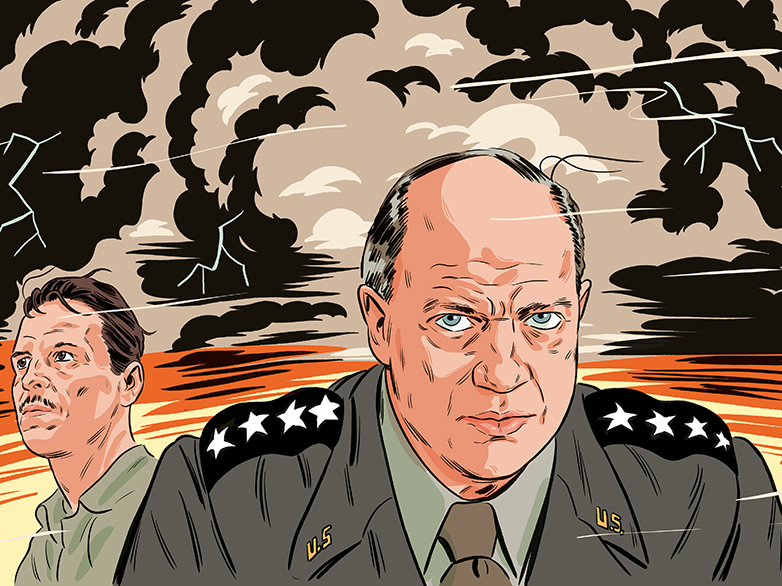
There’s no shortage of worthy films about D-Day: The Longest Day, Saving Private Ryan, Overlord, The Big Red One – not to mention the series Band of Brothers. Pressure, though, from the producers of Darkest Hour, finds a niche not yet occupied. It focuses not only on the days immediately before Operation Neptune – the Normandy landings on 6 June 1944 – and all the dilemmas faced by Dwight “Ike” D Eisenhower, but on the importance of the weather forecast to the success of the mission.
The Allied meteorological team, headed by the Scottish scientist Group Captain James Stagg, warned Eisenhower at the last possible minute that the day he had chosen for the invasion, 5 June, would likely be too stormy. However, on 4 June, Stagg predicted a calm interlude for 6 June, the day the operation was successfully launched. The forecast was momentous.
The film closest to this subject is quite a curiosity. Ike: Countdown to D-Day was filmed entirely in New Zealand for American TV in 2004, resulting in some eccentricities. Churchill, played by the Kiwi actor Ian Mune, tells Eisenhower, “No one in Britain lives more than 150 miles from the sea.” In truth, it’s less than half of that. Tom Selleck plays Ike rather impressively, though, smoking like a chimney. The weather forecast appears among many other more political problems. In the treasurable manner of historical dramas, Eisenhower tersely observes: “You realise, group captain, that this may be the most important weather forecast in history?”

Pressure refines this. “This is a true story,” we’re told for starters. Up to a point, only. The film opens with sweeping views of bloody disaster: corpses washing up, the sea incarmined; the catastrophic dress rehearsal for D-Day, named Exercise Tiger, on Slapton Sands, Devon, in April 1944. Eisenhower looks on, aghast.
Six weeks later, we meet Group Captain Stagg, bidding farewell to his heavily pregnant wife, as he sets off to take control of the meteorological unit and meet Eisenhower for the first time, just 72 hours before D-Day. In fact, Stagg had already been in position for months – but, you know, drama. Moreover, possibly the most important meteorologist involved, the Norwegian Sverre Petterssen, has been completely omitted – to the annoyance of Norwegians.
Never mind. Stagg, intelligent but obstinate, rude and asocial, is superbly rendered by Andrew Scott, the film’s main attraction. Eisenhower thought Stagg a “dour but canny Scot”, but I feel sure that the note Scott took for this part, whether from the Australian director Anthony Maras (Hotel Mumbai) or self-selected, was PG Wodehouse’s celebrated observation that it is never difficult to distinguish between a Scotsman with a grievance and a ray of sunshine.
Stagg’s main grievance here is not with Eisenhower, (Brendan Fraser), a big softie when he’s not in a sudden rage, nor the irascible Monty (Damian Lewis), but with rival Yank meteorologist, Irving P Krick (Chris Messina).
Krick, an over-confident flibbertigibbet, first seen singing and dancing, believes in forecasting by looking at meteorological maps depicting the same date across years gone by, whereas Stagg prefers gathering the latest scientific data. Mighty rows ensue. Shouting and storming off are how the film proceeds, for its origins are theatrical. Pressure began its life as a play by the actor and writer David Haig, commissioned by the Royal Lyceum Theatre in Edinburgh. Haig himself appeared as Stagg for its premiere in 2014.
Maras has made good use of restored documentary footage of the landings, deploying a thrumming score by Volker Bertelmann (All Quiet on the Western Front). For the Allied HQ, the director has brazenly substituted Southwick House near Portsmouth for the Jacobethan enormity of Mentmore Towers – impressive if absurd. Whereas Ike: Countdown to D-Day didn’t bother with women, Pressure does better. Ike’s Irish driver and assistant, Kay Summersby (Kerry Condon), plays a big part, supplying the warmth and empathy otherwise lacking between the imperious men.
Yet it remains irretrievably a play, constructed to work in a theatre. I have never understood the appeal of people arguing furiously with each other on stage, a deficit that has denied me many outings. Others, I understand, will have broader sympathies.
Pressure is in cinemas now
[Further reading: Nigel Farage’s oyster politics]
Content from our partners



Related

This article appears in the 10 Sep 2026 issue of the New Statesman, The World According To Ed
Join the debate
Subscribe here to comment