
The classics always need reviving; what keeps them classic is their adaptability. Even so, making a new Sense and Sensibility is a bit of a poser. The 1995 version, written by and starring Emma Thompson and directed by Ang Lee, was a corker, rated by many as the best Austen adaptation ever. Thompson’s Englishness melded wonderfully with Ang Lee’s more purely cinematic approach. The cast was fabulous: Hugh Grant, Alan Rickman, Kate Winslet. It still seems just right, and not yet itself a period piece.
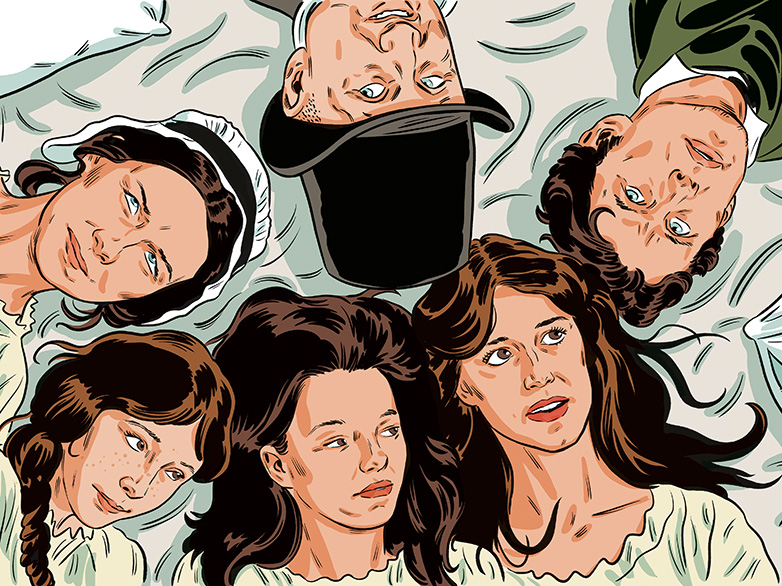
Here comes a new take, generationally different: a Gen-Z Sense and Sensibility, scripted by the young Australian novelist Diana Reid – whose 2021 debut, Love & Virtue, saw her hailed as the new Sally Rooney – and directed by Georgia Oakley. The film establishes its differences immediately. It opens on an extreme close-up of a girl’s face, revealing her to be lying in long grass in a loose white gown, adoring a caterpillar on her finger. Deer run by. We’re at one with nature – if not quite at Malickian levels, still pretty Hamnet-y.
The plot kicks in. A letter containing the will of the late Mr Dashwood arrives, leaving all his property to his mean son John, and a pittance to his second wife and three daughters. These four – Mrs Dashwood (played by Caitríona Balfe, 46), Elinor (Daisy Edgar-Jones, 28), Marianne (Esmé Creed-Miles, 26) and even Margaret (Bodhi Rae Breathnach, 15) – seem strangely girlish together, somehow almost of an age.
They’re upset. But Austen’s obsessive rating of unearned incomes has been more or less binned. Mrs Dashwood muddles £5,000 with £50,000, brightly remarking that she’s no good at numbers. Other period features that are largely deleted include servants, carriages and formal manners.

John Dashwood rolls up with his sheerly nasty wife, Fanny, to claim their inheritance. But, before being expelled from Norland Park, the Dashwoods’ estate in Sussex, Elinor meets and falls for Fanny’s brother Edward Ferrars (played by George Mackay, handsome enough but devoid of Hugh Grant’s charm: a comparison that is automatic, almost unconscious). None of the men turn out to be much cop in this movie.
The girls relocate to Barton Cottage in Devon, offered by the overbearing Mrs Jennings (Fiona Shaw, playing the pantomime dame). In the 1995 film, this retreat was too grand to have been called a cottage by anyone in any era, but now it’s an impeccably rustic hovel, possibly a former cowshed.
Here the girls do their own laundry and vegetable gardening unaided (in Austen they’re reduced to two maids and a man, almost as threadbare an establishment as my own these days). Marianne meets moody Colonel Brandon, played by the Norwegian actor Herbert Nordrum (Eivind in The Worst Person in the World). Again, comparison is unavoidable: Nordrum seems oddly dull, almost a fraud, when one remembers the superbly sardonic Rickman. And then Marianne is picked up by the dubious John Willoughby (Frank Dillane, the young Voldemort: Greg Wise was more dashing) after picturesquely twisting her ankle on a beach, rather than a hillside.
In their romantic frustrations, Elinor and Marianne console each other in bed a lot, cuddling and kissing in close-up, in fetching calico night-dresses. Their garments are inspired more by Toast than the 18th century – even their bonnets often seem proto-hoodies.
Throughout there’s a clash between the wholly contemporary, casual body language, facial expressions and classless speech presented here and the formalities and hierarchies that matter so much in Austen. It becomes particularly incongruous in the moments when Austen’s structured dialogue – “it was every day implied but never declared” – is preserved.
Even more out of place is the filming style: constant close-ups, cutting back and forth between expressive speakers, often in murkily tenebrist lighting. Georgia Oakley once worked in theatre, but, she has said: “Even then, I always craved the camera and its ability to communicate intimacy. To provide a window into a character’s soul.” Here that approach is exaggerated. Intense focus isn’t Austen’s perspective, as Lee knew.
Such emotiveness pays off in a stops-out, tearful ending: “I love you, Elinor – I have since we met,” Edward gets to say. But all this Sense and Sensibility demonstrates is how much further we are from Austen than we were just a few decades ago; her fantasy of fulfilment grows ever more remote. I blame Tinder.
Sense and Sensibility is in cinemas now
[Further reading: Queen at Sea: a brutal masterpiece about the end of life]
Content from our partners



Related


This article appears in the 24 Sep 2026 issue of the New Statesman, A Sense of Power
Join the debate
Subscribe here to commentThe best Austen adaptation by far for me is Roger Michell’s 1995 “Persuasion” with Amanda Root and Ciaran Hinds.
It’s obvious that Anne is clinically depressed and has every right to be given her appalling family. Corin Redgrave is a superbly narcissistic, snobbish and uncomprehending Sir Walter; Sam West is believably creepy as Mr Elliot; Sophie Thomson is hilariously awful as Anne’s youngest sister; Simon Russell Beale is a bonus as her husband Charles. Above all, it sticks to the book and its spirit with neither script nor director imposing a contrary vision. And as John Mullen often says, you feel that Amanda Root has actually read and understood the novel and that Ciaran Hinds might really have stood on the quarterdeck battling the French fleet. You see them both think and feel in stillness and feel with them. Ot at least I do.
Emma Thompson and Ang Lee were more free with Sense and Sensibility, but you often have to be in adapting for a different medium and it’s a good film that I could happily watch again. There are some films and TV adaptations that I would flee from.