
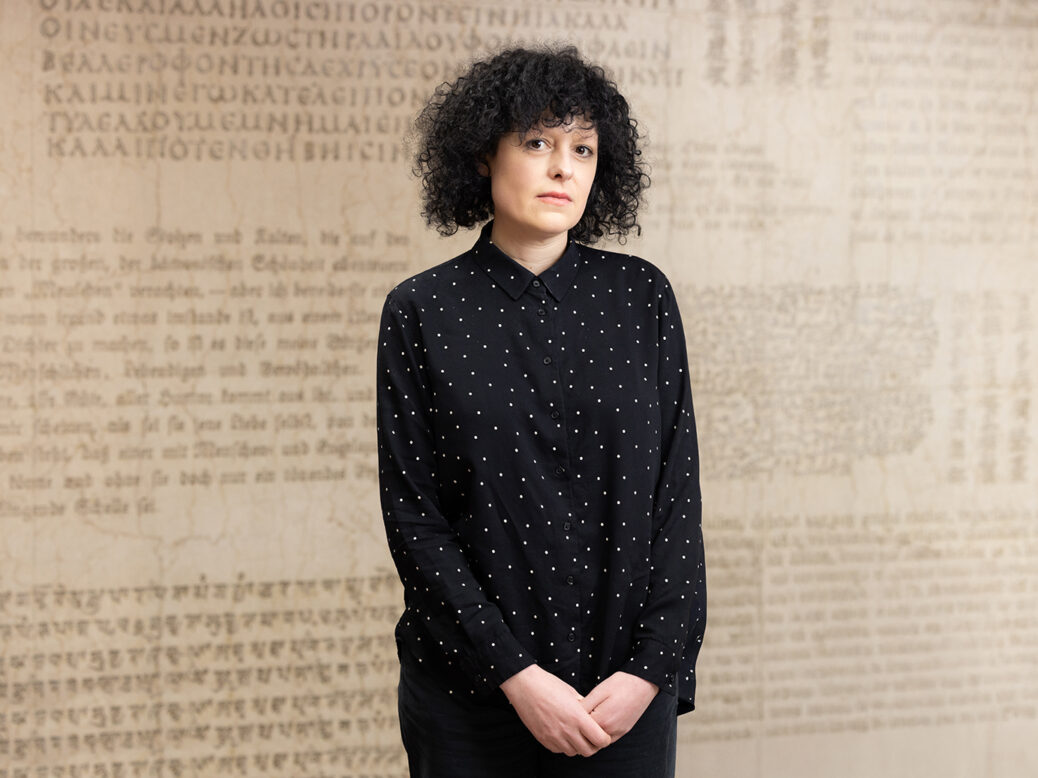
The writer and award-winning translator, Polly Barton, is one of the two debut novelists on this year’s Goldsmiths Prize shortlist. Having worked on both Japanese fiction and nonfiction, she is noted for her translation of Butter by Asako Yuzuki. Her non-fiction debut Fifty Sounds (2021) won the Fitzcarraldo Editions Essay Prize, while Porn: An Oral History (2023) is described as a “landmark work” by literary critics. What Am I, A Deer? is Barton’s first work of fiction.
What Am I, A Deer? is a roman d’analyse, narrated by an unnamed young woman who moves to Frankfurt as a translator for a Japanese gaming company. The narrative takes the reader through the young woman’s innermost thoughts and feelings across decades and locations as she grapples with her relationships, romantic fixations and what it truly means to live a life. In the words of Francis Spufford, the Chair of Judges for this year’s Goldsmiths Prize, Barton’s novel “extends the great modernist experiments in charting minds in motion.”
Zuzanna Lachendro: The Goldsmiths Prize was set up to reward fiction that “breaks the mould or extends the possibilities of the novel form”. What can an “innovative” approach offer the reader (and writer) that a more conventional novel might not?
Polly Barton: For me, a novel is about creating something that feels real, alive, true to the lived experience in some way. I rarely find conventional novels written in the present day that do that, for me. I think about it in terms of ripping apart. I think often I have the sense of people having to rip up the accumulation of tropes that serve to comfort but also to numb, in order to access the raw open vein.

What Am I, A Deer? is your debut novel. You’ve made a name for yourself through your successful Japanese literary translation and have written two works of non-fiction before turning to fiction. Tell me about this journey. Have you always wanted to write a novel, or was it something that you found yourself drawn to as time went on?
I think I originally wanted to write fiction, when I was very young, and had a go, but it was really just a mess of artless imitation: bad novelist karaoke. Then I got into translation, and subsequently non-fiction, and didn’t plan to write fiction anymore. But then this book sort of happened to me. For a while I didn’t know what it was supposed to be.
Yrsa Daley-Ward, shortlisted for the 2025 Goldsmiths Prize, asked, “How could anyone keep themselves all the way out of a novel?”. There seems to be quite a cross-over between you and the novel’s unnamed protagonist. How much of What Am I, A Deer? is based on your life?
I don’t really know how to go about assessing that. I could give a factual percentage, but the salient point to me is much more about an emotional kind of reality. In that sense, I absolutely agree with Daley-Ward: how could you write a good novel without drawing upon that? But people have different ways of doing that. After writing non-fiction I don’t feel squeamish about including parts from my own life, and I think because I was so late to admit to myself that this was a novel that I was writing I didn’t have any of this sense that I definitely used to have when writing my bad fiction that everything had to be veiled with surface-level falsifications. I was focused on what was going on underneath those. And it’s funny, as you go on writing, it blurs your sense of what truly happened and what didn’t.
I am fascinated by the protagonist. While reading the novel, I could not help but feel that I related to her. Was this your intention when writing the book? How did you want people to react to the protagonist?
I think I wanted this book to probe the possibility of genuine connection with others and the world outside, and to do that through the lens of a consciousness that feels often solipsistic in its overthinking, but is also self-aware enough to think through all of those meaty issues about solipsism, and games, and distraction, and fantasy. I also wanted to present the utter perilous mayhem of being in your twenties, and the way that you are grappling with so many different concerns, of so many different orders of magnitude, as part of your minute-to-minute reality. I’m glad you found her relatable, but I don’t think that was my intention, per se. Maybe I did want people to relate to her thinking, but I also imagined that they might find it quite exasperating and claustrophobic to be inside her head. One audience member at an event told me that it was the most exhausting book she’d read for years because she couldn’t put it down but the too-muchness of being inside that person’s head almost finished her off, and I thought, yeah that sounds about right.
The novel begins unconventionally by using the second-person narrative while describing an event from the protagonist’s childhood. When the narrative turns to her adult years, the protagonist is largely referred to in the third-person. What was behind that choice?
It happened quite instinctually, I’d say: both voices came to me that way, and then I questioned whether they should really be that way, before discovering that no other way worked as well. The prologue in the second person with which the novel opens was one of the very first parts I wrote, and it’s more or less unchanged from that original form. I’m interested in the second person, in the way when done well it can seem enormously intimate and universal. I heard a Japanese author who had written her book in the second person saying that for her it was about giving her young mother protagonist someone else, a sort of alongsideness, in this experience within which she felt so alone. And as I write that I think that that was true both of the prologue and the very close third person: they both felt like a way of bringing a very intimate relationality to the presentation of those characters, that hopefully opened the window through to a kind of universality.
The plot of What Am I, A Deer?, told through the protagonist’s stream of consciousness, is nuanced and often contradictory. It explores a wide spectrum of themes from authenticity to sexuality and a sense of belonging. What did you hope to achieve while writing the book? Do you feel like you were successful?
This goes back to my answer to your first question about what a novel should do, but I think when setting out to write this book, I felt very strongly that I didn’t want to write something that simplified what it was like to be in the world. I wanted the mess and the chaos and the thinking through all these overlapping themes to be there jostling on the page, not finding resolution, but throwing up connections. As to whether that was successful, I really mean it when I say that I don’t think I’m the one to judge that. Some people think yes, some people think no, and that’s great.
You make a very interesting comparison between karaoke and translation: both are means of being somebody else, of impersonating someone. How did you come to that realisation? They are, on the surface, unlikely bedfellows.
It was something that somebody said to me, very nonchalantly: “everyone knows that translation is karaoke”. That was the seed of the book for me – I couldn’t get it out of my mind. A lot of the novel is about thinking through the comparison, and the mechanism behind it – how impersonating another can offer not only escape but also a sense of authenticity to oneself. Becoming more oneself through merging with the other.
Tell me about a piece of art, literature or music that was important to you when writing this book.
I listened to lots and lots of music during the writing of this book, some of which found its way inside its pages. One song that occupies a particularly important place within the novel is Half Past France by John Cale, which everybody should listen to if they haven’t: it’s a totally singular, utterly haunting track, that served as a great shortcut to me when I needed to reimmerse in one of the atmospheres crucial within the book.
What past British or Irish novel deserves a retrospective Goldsmiths Prize? Why?
The Seers by Sulaiman Addonia. It’s a raw, blazing, sui generis novel that expanded my conception of what a book could do and contain.
Why do we need the Goldsmiths Prize?
Publishing tends to be quite risk-averse and operate according to iterative logic, and the Goldsmith’s Prize is a reminder not just of the glory of taking the road less travelled but also that some readers really savour work that does just that.
“What Am I, A Deer?” by Polly Barton is published by Fitzcarraldo. The winner of the 2026 Goldsmiths Prize is announced on 4 November. Read more interviews with the shortlisted writers here.
Content from our partners



Related
Join the debate
Subscribe here to comment