
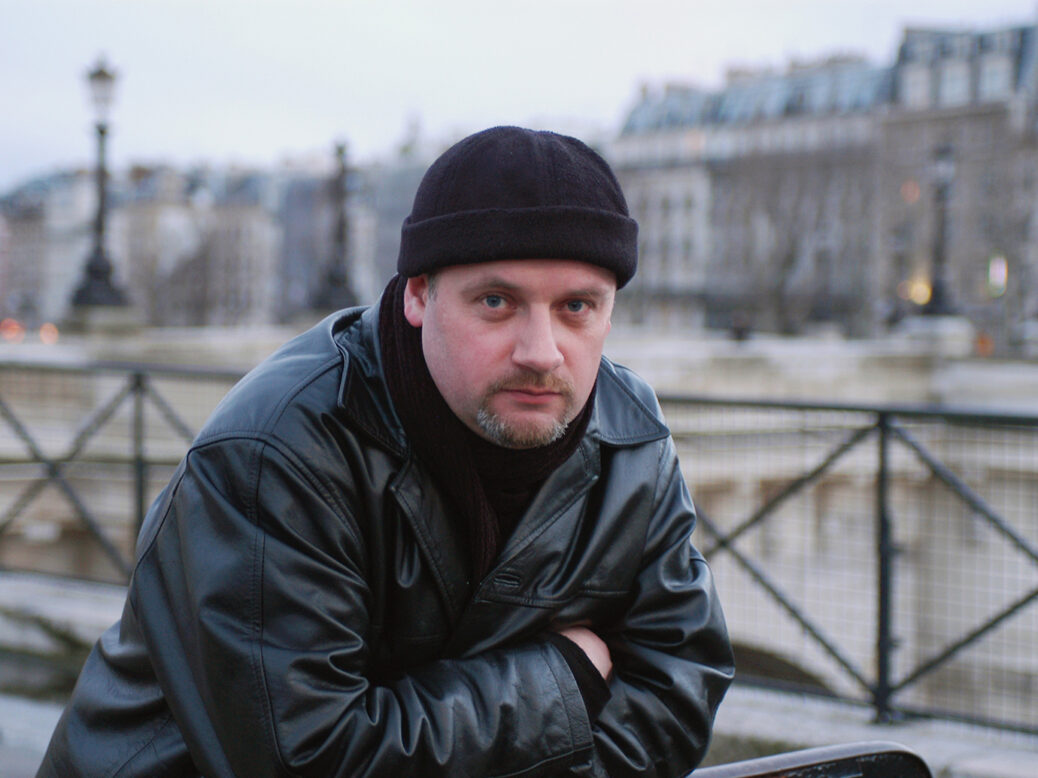
Keith Ridgway is one of the two award-winning Irish authors on this year’s Goldsmiths Prize shortlist. His mind-bending, uncompromising novels and stories push the conventions of narrative fiction to its limits. His debut novel, The Long Falling (1998), concerned itself with an English woman trapped in an abusive marriage in rural Ireland and won both the 2001 Prix Femina Etranger and Premier Roman Etranger; The Parts (2003), took Celtic Tiger Dublin as its setting, exploring the atomisation of urban life; Animals (2006), saw Ridgway’s gaze turn to London with a tale of mental disintegration; Hawthorn and Child (2012), dismantled the conventions of crime fiction.
Ridgway was born in Dublin. He now lives in south London, where he works as a creative writing teacher and writer. At the beginning of Dooneen, the protagonist, Mew, steps through the bushes of a London park and finds himself in an alternate reality – and an entirely different city, Dublin.
Luke O’Reilly: The Goldsmiths Prize was set up to reward fiction that “breaks the mould or extends the possibilities of the novel form”. What can an “innovative” approach offer the reader (and writer) that a more conventional novel might not?
Keith Ridgway: It’s writers trying to do things to readers. Sometimes just telling a story doesn’t quite get you there. Sometimes you want to do other things to a reader. And sometimes a reader might want something other done to them. You can tell a wonderful story and entertain readers and that’s fantastic. But writers get bored, sitting all day at our desks, and we try to figure out ways of getting things not just onto the page, but through the page, into the room where you are. Sounds a bit creepy. And of course, it is.

When you begin writing, do you already know where the story will go?
I have a sense of direction. With Dooneen, I knew the ending before I knew how to start it. But it was written quite late on – the ending I mean. I think and reconsider and mull over in my mind quite a lot. Then I make a run at the page. And inevitably things arise in the writing that nudge me one way or another. Sometimes I end up somewhere that surprises me.
Why did you set the novel in an alternative version of Dublin? Did it give you more freedom?
I just wanted to embrace the fiction of it. The novel isn’t set in a version of Dublin so much as it is a version of Dublin. The Dublin of the novel called Dooneen. There’s an alternative version of that Dublin which anyone can visit if they want to. Ferry from Holyhead. But the genuine article is only available to readers of the book.
The novel also concerns social unrest. How do you feel about the current political climate in Ireland?
It’s a localised manifestation of a widespread disaster. Locally, whether in Dublin or in London, we’re faced with the crisis of housing, which is part of a wider system of inequality that is eroding healthcare, social care, education, the public realm. And internationally, of course, we see genocide, we see genocide-denial, we see war crimes, we see open corruption on a remarkable scale, we see the pooling of unimaginable wealth amongst a tiny number of individuals – and we see that all of these things are linked. And in Ireland, as in the UK – as in most places I think – this generation of politicians is utterly unsuited to the moment. So, I feel a great despair, to be honest.
In such a surreal world, how do you make characters feel believable?
I try to write people rather than characters. By which I mean I suppose that I have to believe them myself before I let the reader at them. Believability is a slippery thing, though. The reader knows they’re reading fiction. I know they know. They know that I know they know. The characters emerge out of that – the slightly awkward situation that the writer sets up and the reader steps into, in which believability can often take a back seat to other things. But I always try to write people.
It seems as if any novel set in Dublin must contend with comparisons to Joyce, but the city has moved on considerably since the early 20th century. Do you find that comparison frustrating or flattering?
It’s annoying. I get it a lot. And it’s not flattering because it’s way off. It tends to come from people who haven’t read any Joyce. Beckett has been much more important to me over the years than Joyce. And in terms of influences on Dooneen, Joyce wasn’t in my mind at all. But Liam O’Flaherty was – especially The Informer. And Ishiguro’s The Unconsoled. And Anna Kavan’s Ice. And Ferenc Karinthy’s Metropole. Those are the books that Dooneen is built on.
Dooneen is in some respects reminiscent of Flann O’Brien’s work. To what extent was he an inspiration for you?
I think I may have started a Flann O’Brien novel as a teenager, I can’t remember which one, and I didn’t finish it, and I haven’t read him since. I’m sure I should change that. But he hasn’t been an inspiration at all, I’m afraid.
Tell me about a piece of art, literature or music that was important to you when writing this book.
There were lots of things – lots of books particularly. But of course the song “Cliffs Of Dooneen” is at the heart of it. Very simple, very beautiful, with its evocation of a sort of impossible home-place which nevertheless exists. There are many versions, but Christy Moore’s live recording from On The Road is just perfect. Beautifully played and sung, and recorded, against what feels like a deep silence. And despite having heard it a million times it still astonishes me when he invites the audience to sing with him, and the silence turns out to be filled with people. Which is really what the book is about.
What past British or Irish novel deserves a retrospective Goldsmiths Prize? Why?
He doesn’t need any more prizes, but Kazuo Ishiguro’s The Unconsoled is a wonderful, strange novel, and was very important to the writing of Dooneen. And I love the fact that he wrote it after his big success with Remains Of The Day. He had the bravery to write a big, baffling, melancholic dream of a book, that a lot of people hated. Those people are to be pitied. It is a really beautiful book.
“Dooneen” by Keith Ridgway is published by Fitzcarraldo. The winner of the 2026 Goldsmiths Prize is announced on 4 November. Read more interviews with the shortlisted writers here.
Content from our partners



Related
Join the debate
Subscribe here to comment