
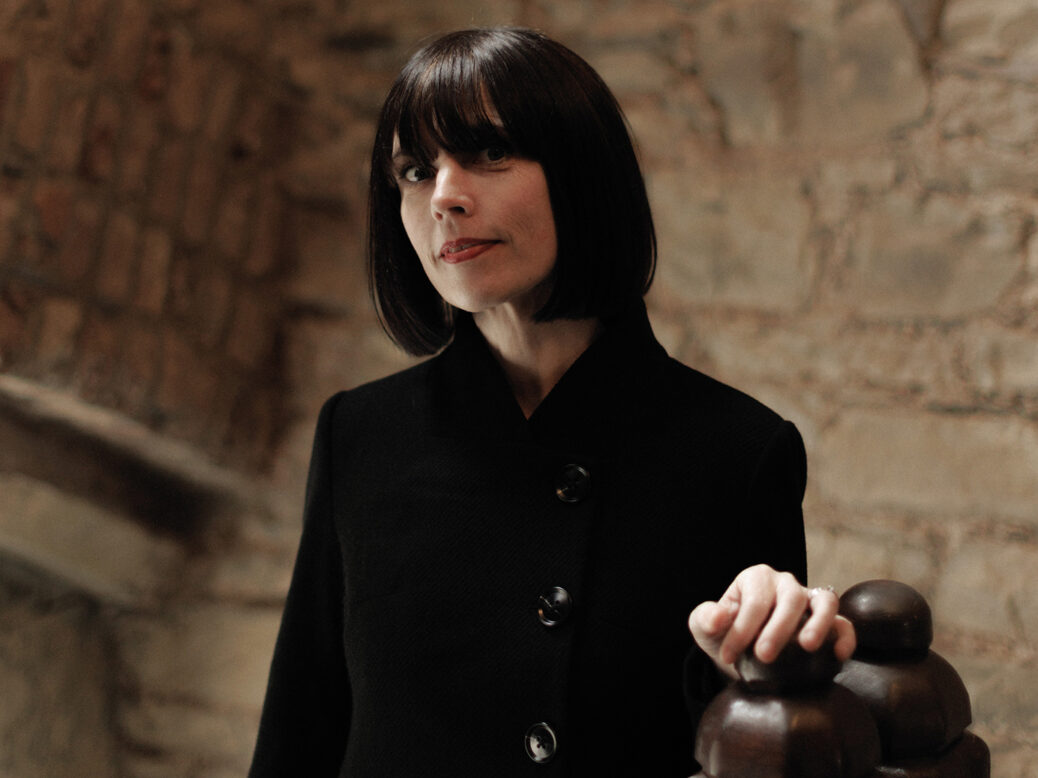
Doireann Ní Ghríofa is an award-winning Irish poet and author who has published poetry in Irish and English. She writes across languages, genres and centuries. Her debut novel, A Ghost in the Throat, won the James Tait Black Prize and An Post Book of the Year, and was shortlisted for the Rathbones Folio Prize. She has also authored seven critically acclaimed poetry collections.
Said the Dead is her second novel. It defies the confines of a single genre: it is part memoir, part ghost story, and part historical fiction, yet remains grounded in archival research and historical records. The book follows the research of an unnamed, twenty-first century woman, the “Reader”. She immerses herself in the history of Cork’s mental asylum. Through entering the derelict asylum, examining patient records, photographs and other primary sources held in the city archives, she breathes life into the building and its past.
The Reader finds Dr. Lucia Strangman at the heart of the late 19th– and early 20th-century history of the asylum. Lucia’s personal and professional lives developed around the institution, and it is through her case notes that the Reader pieces together the lives of her patients: tracing their individual experiences from symptom onsets, to admission, to discharge or death. These documents offer only fragments of their stories but provide enough detail for the Reader to reconstruct their narratives into three-dimensional lives.
Eleanor Hutman: The Goldsmiths Prize was set up to reward fiction that “breaks the mould or extends the possibilities of the novel form.” What can an “innovative” approach offer the reader (and writer) that a more conventional novel might not?

Doireann Ní Ghríofa: To engage with a book that presses against boundaries of form always implicates the reader in some way. It draws us in. It shakes us. In writing a book like Said the Dead, this meant taking the Reader’s hand and dragging them right into the scene. Only together could we bring it into being. I might have assembled all available evidence to construct the conditions and the room where a man’s death was soon to occur, but I needed the text to turn to the Reader and say, “See that man? We have to kill him. Together. I know you don’t want to do it. Neither do I. But fact is fact, so if you’re going to keep reading, we must kill him.” Such wilful disturbance of history through narrative is not something I could hope to engineer through a more traditional form. I wanted this book to experiment with time, to let the Reader be present in the past.
As the Reader encounters individuals from the historical narrative surrounding the Victorian asylum, they quickly transform from names in an archive to three-dimensional figures. At what point in this literary project did the historical research of the asylum become a form of personal encounter?
From the very beginning. In opening the first of the asylum casebooks, the people being described felt immediately, vividly alive. They were right there, I could feel them, on the other side of the book I was holding in my hands. I felt a depth of tenderness for these women in their suffering and exasperation and distress, but there was also a sense of recognition, since I, too, have struggled with depression and suicidal ideation. Many years had passed between their lives and mine, and yet, they felt so close.
Said the Dead characterises physical spaces as vessels of connection between women living in very different times. This is particularly poignant in the context of Ireland’s relationship with land and its history of dispossession. Do you see the Irish setting as a way of connecting people across generations, and of preserving a sense of shared history and identity?
Reading is a dark magic. Our eyes follow a paragraph, letting us feel our way into a place in which the living and the long dead may co-exist. Writing such (re)possession is a radical act, returning power to those deemed powerless in life. In the asylum casebooks, a woman named Kate declared, “Ireland is mine”, words transcribed by doctors as evidence of delusion. When I transcribe her speech into my book, however, it becomes an assertion of defiance, power, shared identity.
How did gender shape the ways the women in Said the Dead were understood and treated within the asylum? Were there moments in the historical records when you felt that being a woman had fundamentally shaped how a patient’s condition was diagnosed or distress was interpreted?
In short, yes. Gender was often a factor in the committal of women to this institution, as evidenced under the heading “Probable Cause of Insanity”, where doctors might suggest “menstrual derangement”, “childbirth”, or “desertion by her husband”.
To what extent did contemporary acts of female testimony and truth-telling resonate with you as you wrote the book?
Courage is contagious.
Dr. Lucia Strangman’s voice appears throughout the book in brief but significant interjections. Sometimes her voice is encouraging, other times she seems to diagnose the Reader. As you spent more time with her through your research, how did your relationship with Lucia evolve?
Part of an asylum doctor’s power lay in their record-keeping – Lucia was often the casebook’s author, and in the archive, I became her reader. Writing this book, however, let me snatch the pen and write her life, although I might have been among her patients in another time. As her own passions and complications and sorrows slowly became clearer, she came to feel less like a distant historical character, a closeness that culminated with her family’s generous opening of their own archive. Reading Lucia’s letters as a young woman, newly arrived at the asylum, “Oh,” I thought, “there you are!”
The book’s images and visual arrangement create moments of intimacy that words alone might not achieve. How did you approach the interplay between image, text and white space, and what can a photograph allow us to know – or imagine – about a woman whose life has otherwise been preserved only in fragments?
The inclusion of archival ephemera (torn letters, patient photographs, architectural drawings) aims to evoke for the Reader the physical sensation of archival discovery: turning a page to find oneself meeting a woman’s gaze in black and white, say, or the heart-quickening moment of finding a patient’s letter tucked into a casebook. Such collisions occur somewhere beyond the reach of words.
Tell me about a piece of art, literature or music that was important to you when writing this book.
Paula Rego’s painting Angel watched over me while I wrote. A provocation, she wields a sword in one hand and a sponge in the other – the inextricability of care and harm.
Why do we need the Goldsmiths Prize?
Every year, it gifts us six strange and daring books to provoke us, to move us, to carry us away. Nothing else comes close.
What past British or Irish novel deserves a retrospective Goldsmiths Prize? Why?
Maybe Flann O’Brien’s At Swim-Two-Birds, for its mischief and cartwheeling vigour.
“Said the Dead” by Doireann Ní Ghríofa is published by Faber&Faber. The winner of the 2026 Goldsmiths Prize is announced on 4 November. Read more interviews with the shortlisted writers here.
Content from our partners



Related
Join the debate
Subscribe here to comment