
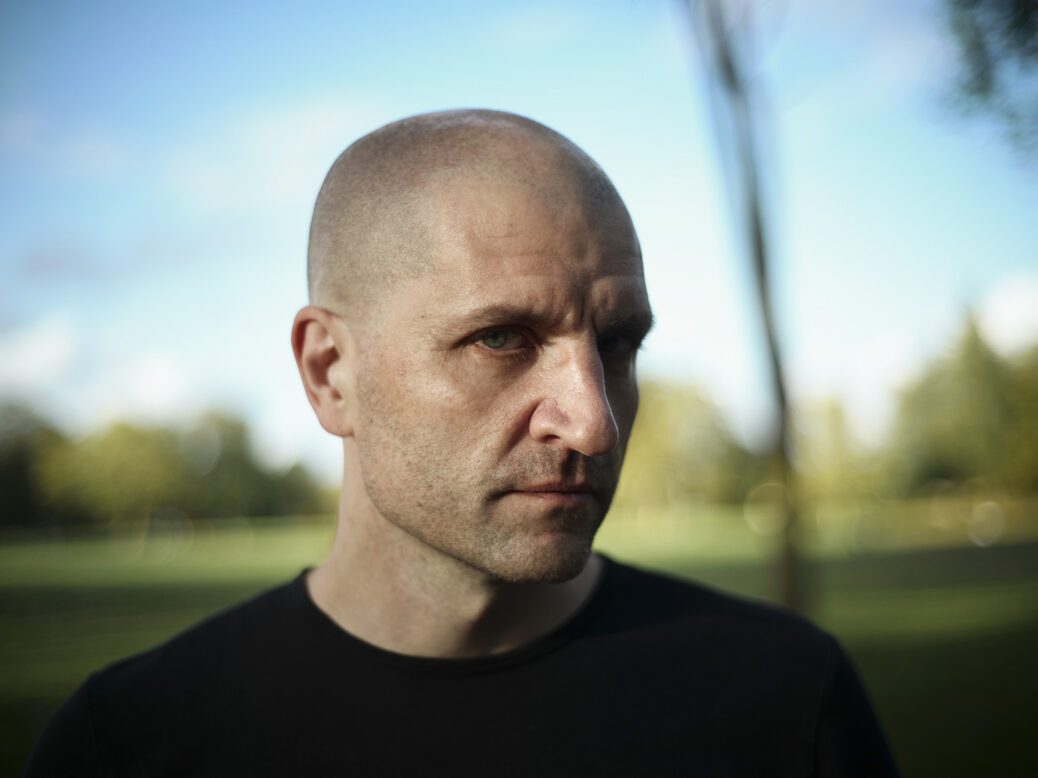
China Miéville is one of the most established writers on this year’s Goldsmiths Prize shortlist. He is an award-winning and bestselling author of fiction and nonfiction. Miéville’s novels fall within the realm of science-fiction, for which he has won numerous prestigious awards. The City & The City (2009) won the international Hugo Award – also held by the likes of Isaac Asimov, JK Rowling and Philip K Dick – while Perdido Street Station (2000) won the the Arthur C Clarke Award. His latest novel The Rouse (2026) is described as “a monumental work” by Hari Kunru, one of the judges of this year’s Goldsmiths Prize panel.
The Rouse is a novel that combines speculations about what awaits us after we die with the history of Britain’s postcolonial entanglements in the second half of the 20th century. Maur, the book’s protagonist, is plagued by loss and misfortune. But things are not what they seem. At the heart of an ordinary tragedy is a link to an old soldier connected to Maur through their shared loves, obsessions and regrets. In the words of this year’s Goldsmiths Prize judges, The Rouse “is a reminder that the novel is capable of containing multitudes.”
Aled Maclean-Jones: The Goldsmiths Prize was set up to reward fiction that “breaks the mould or extends the possibilities of the novel form”. What can an “innovative” approach offer the reader (and writer) that a more conventional novel might not?
China Miéville: Obviously, there being “nothing new under the sun”, we should all be humble about claiming much “innovation”. The hope would be that you never fully know the answer to that question until you read some such work and find out what you were missing. Let me try out a simile: reading a great, more “conventional” novel can be like strolling in delight through a beautiful house that you know well and love. A true pleasure. But reading something more unconventional can be like noticing a door that was there the whole time, opening it, walking into an unfamiliar room.

A big part of The Rouse is the military world that many of its characters inhabit, orbit around, and are irrevocably shaped by. Depictions of the military in fiction often sit at the extremes: soldiers are either mindless automatons or superhumans capable of impossible feats. I was struck by the empathy, curiosity and depth of detail with which you portrayed these soldiers and their inner lives. How did you approach researching and portraying military life?
First, may I offer a spoiler warning for everything that follows? We don’t go into too much plot detail but there are elements in your questions and my answers that some readers might prefer to encounter in the text. So henceforth, caveat lector.
I did an enormous amount of research, over more than two decades – that’s a lot of reading and discussion. As well as going through a huge number of texts about strategy and military history, I read as many military memoirs as I was able, from as many ranks, periods of history, perspectives and points of view as possible. (Let me give a particular shout-out to Joe Glenton for Veteranhood.) I lurked on various bulletin boards where military personnel (and some “mitties” – fantasists) debate and snark. And I interviewed ex-soldiers and members of their families. I can never thank them enough for their generosity.
A long-running strand in the novel is how the British, for reasons that infuriate the Americans in particular, have an affinity with the Roused that no other nation can quite match. What gave rise to this idea, and do you think the same affinity with the supernatural holds true in our own world? If so, is it a genuine source of cultural richness, or a kind of consolation prize in the post-war era?
I think it would be meaningless to suggest that “the British” – or anyone – have a particular affinity for supernatural culture. That doesn’t mean that there aren’t vague cultural currents and lineages and specificities, as with any cluster of traditions. People talk a lot about “the English ghost story” and there’s no point getting too prim about that, as a quick-and-dirty shorthand for a set of variably related texts, so long as we remember it’s a construct that gets less useful the more precise you want to be. Certainly, I do think the supernatural is a vast source of cultural richness. And I am very interested in (and formed by) British culture of the 1970s and 1980s, not least including its supernatural. So that sub-tradition is incredibly important to me. (Though I passionately love supernatural culture tout court.) Obviously, that doesn’t mean that “we” are any “better at it” than anyone else.
On your last point, I’d say we can often diagnose something as a genuine source of cultural richness not just and, but as, a socio-political consolation prize. AL Morton describes chivalry and jousting “reaching their highest pitch” during feudalism’s decline, “a fantastic if superficial refinement of manners, an elaborate mask … hiding the reality of decay.”
Having asked that, there is one way in which the British really don’t seem to be able to get the Roused: linguistically. The Uniteers are always grasping at different words to describe them. Is English, ironically, particularly ill-equipped to describe the supernatural, and did that sense of linguistic inadequacy shape how you wrote the novel?
I doubt English is particularly ill-equipped to deal with, let’s call it the numinous – the ultimate horizon of the supernatural. My hunch is that such difficulty is shared, pretty much definitionally, by most, if not all, tongues. The linguistic inadequacy you mention I think is of language itself. We’re talking here about a species of the sublime, which is to say that which is beyond words. I have an abiding fascination with the attempt to speak that which cannot be spoken, whether in its pulpiest form, more respectable versions like high modernism, or its most vatic iterations, such as the tradition of apophatic theology. I know it’s hardly unusual among writers to be obsessed with the limits of language, but the hope is that you can try to do new and interesting things with the yearning it engenders. That project of pushing language till it breaks, striving to fail better and better at expressing the inexpressible, for a reach that exceeds the grasp, I can never get enough of – as reader or writer.
For me, hallmark of your work is how real and embodied you can make the fantastic feel. Take something like Kraken, where from the off, I need no convincing whatsoever that talking tattoos, striking familiars, and bodies folded into origami are things that exist in that world. The Roused, by contrast, seem to be much more ontologically contested: we’re much less sure what they are. Was that shift to a less materially concrete kind of weird intentional?
Thank you. Maybe it’s not that surprising that the defining book of my life, that I’ve been writing for most of my adulthood, including during the writing of a lot of other books, feels both like a culmination of and a rupture with what I’ve done before. To me, all the stuff I’ve always swirled around is all very much there, if anything in heightened form. But at the same time, it does seem quite different to me. I think you’re pointing at one aspect of that. I wasn’t aware of it beforehand, it wasn’t strategic, but I can see it more clearly in the rear-view mirror. More so than any other long-form fiction I’ve done the substrate of this book is our world and history, real families and people – which means that the irruption of the weird, when it happens, has to feel earned, monumental and disruptive. This is a book in part about ontological contestation, to use your term, and the challenge is how much that can be expressed and made foundational without banalising or ‘domesticating’ that estrangement.
There’s a lot of play in The Rouse with the book’s visual form: not only the different-coloured pages, but how the words are placed on the page at different points throughout the novel. How did you experiment with the novel’s form? Were there earlier iterations in which the novel was, spatially, even more radical?
I remember the physical shock of excitement I felt when, as a child, I encountered Golem 100 by Alfred Bester, the first adult novel I’d seen with fractured, broken-up text, where the typography is haunted by holes, illustrations, musical scores, artefacts. Ever since, I’ve been excited by ergodic literature and textual shenanigans, when they’re done well, but obviously the more familiar one gets with them, the higher the bar should be for deploying them. It would be nice to think of what happens in The Rouse as radical, but, again, these techniques go back hundreds of years, to Tristam Shandy and further back, so I’d frame it more about trying to earn a place in a tradition.
I have no principled objection to experimentation “just for the sake of it”, but it is particularly exciting when it deliberately and materially frames the reading experience. I remember with House of Leaves that as the text breaks down to just a single line per page, it meant that I was flipping them more quickly. I was charmed that a technique associated with more rarefied “experimental” fiction literally made the book “a page-turner”. Wherever the text is non-traditional in The Rouse it’s always trying to earn itself, towards some end. And obviously, this all has to work irrespective of whether the reader knows or cares about any of that.
In 2011, you made a distinction between the literature of recognition and the literature of estrangement. You pointed out that the world of literary fiction has traditionally been much more comfortable with the former than it has the latter. Today it feels like the literature of estrangement (and perhaps the weird more broadly) is having something of a moment. Is there anything here to worry about? Or should we welcome it?
I’ve certainly noted an increasing openness to what John Clute calls “fantastika” more generally. But even back then, I was trying to stress that while there may be more of an overlap between “mainstream lit-fic” and “recognition” on the one hand, and “speculative fiction” and “estrangement” on the other, I saw the two sets of axes as distinct. Among my favourite works of fiction are many I’d consider fully realist yet estranging, and there’s plenty of all-too-recognisable fantastic. Nor is it either/or: I think all art expresses both “recognitionary” and “estranging” pulls to distinct degrees. There’s excellent and leaden work in both registers. Though I don’t pretend that my own taste doesn’t run more towards estrangement, nor that at its best, I don’t feel there’s something more exciting and reconfigurative about it than art that celebrates recognition. If this is indeed a moment for the literature of estrangement I welcome that – assuming a certain quality threshold: I find lacklustre “estrangement” literature particularly depressing.
It’s also worth grimly acknowledging that a swell of such fiction may be a mediated expression of this truly horrifying moment. It might be an artistic silver lining, but I’d still rather not live at a time of such burgeoning fascism, crisis and social sadism.
Why do we need the Goldsmiths Prize?
Of all the prizes out there, the Goldsmiths has by some way had the biggest impact on my own reading. It’s introduced me to many books I never would have discovered otherwise, some of which have become keystones in my pantheon. It validates an approach to reading, no less than writing, for which a certain destabilisation that comes with straining against nostrums is a feature, not a bug. For which taking your time is key. For which conclusions are less prioritised than epiphanic questions.
“The Rouse” by China Miéville is published by Picador. The winner of the 2026 Goldsmiths Prize is announced on 4 November. Read more interviews with the shortlisted writers here.
Content from our partners



Related
Join the debate
Subscribe here to comment