
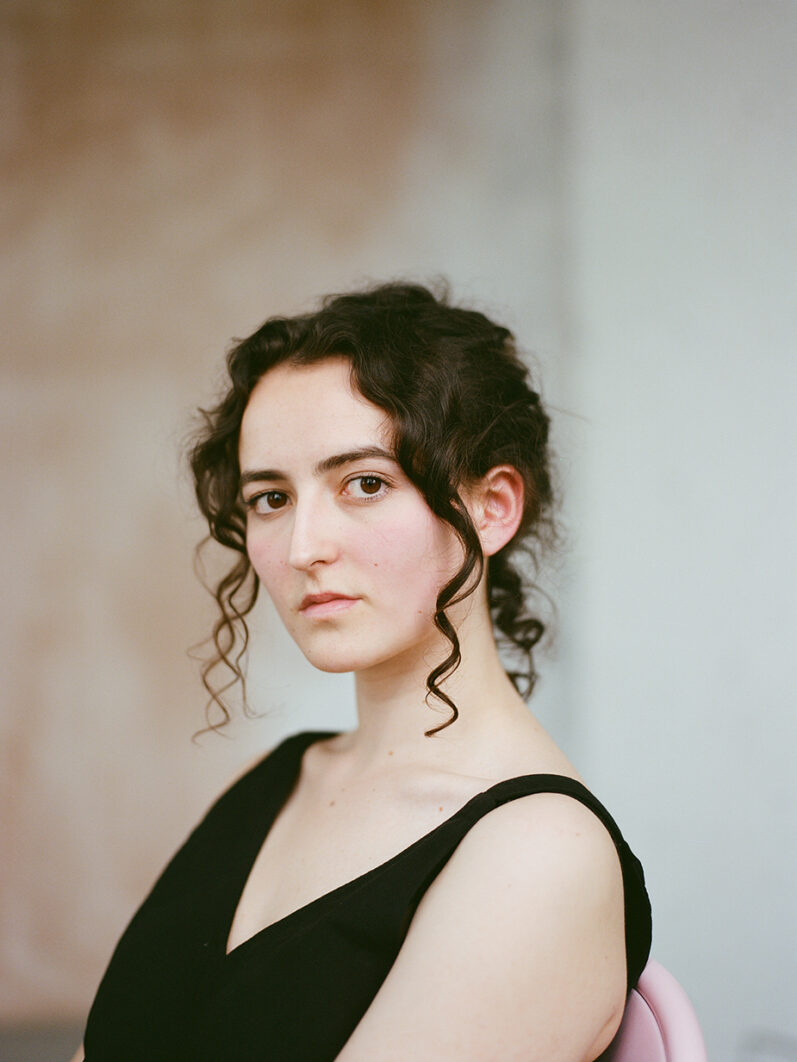
Attention-Seeking Behaviour is Aea Varfis-van Warmelo’s propulsive debut novel about a woman who can’t stop lying. The narrator (who shares certain characteristics with Varfis-van Warmelo) is on the cusp of forming a meaningful relationship, but her compulsive dishonesty threatens to tear everything apart. Meanwhile, she is hounded by visions of horrific violence.
Varfis-van Warmelo is British-Greek poet and writer living in London. She is an editorial assistant at Granta magazine.
Emily Lawford: The Goldsmiths Prize was set up to reward fiction that “breaks the mould or extends the possibilities of the novel form”. What can an “innovative” approach offer the reader (and writer) that a more conventional novel might not?
Aea Varfis-van Warmelo: I think innovation is often productively alienating; it goes against the grain and forces a kind of alertness – an awareness of convention that may not have been there before. I’m distinctly aware of our inclination to narrativise our lives and make logic of events that sometimes have no association. Lots of stories emerge from this practice, and many are bad. I’m also anxious about how much disinformation is comfortably imbibed these days, so I like novels that give me an acuter awareness of narrative’s construction, and I like how this can spill productively into the rest of my thinking, where I begin to dislocate some of my impulses. I think a good, original book can make me a better reader and thinker, and this might have the accidental consequence of making me a better person.

The narrator of Attention-Seeking Behaviour treats the book like a memoir, concealing some details to protect other characters’ privacy. What is the intended effect of this?
This goes back to my thinking about alertness. By forcing a reader to wonder whether they’re reading something true or not – whether it’s fiction or memoir – I wanted them to feel alert to the ways text can persuade or trick them, and to feel implicated in its construction. Whether the reader believes me determines whether the book is fiction or not. And I wanted this compromise to go two ways – I also had to be implicated, and my trustworthiness also had to be jeopardised by writing the novel: if a reader believes it’s memoir, then I’m a liar, and if they believe it’s fiction, then I am also a liar.
Are any parts of the novel true to your real life? Did you have a lying phase?
The narrator should conceivably be me, so key biographical details are true – my narrator was also raised in Greece, is French-educated, and moved to the UK as a teenager after her mother died – but I’m not a liar. I did lie as a child, though, like most children do, because it felt like the only way to gain any autonomy or privacy. So when I conceived of the narrator, who is essentially a version of me who lies, I just imagined what kind of insecurities and fears from my childhood would have had to carry into adulthood, and it was fairly easy to imagine a version of myself that was still scared she would never be loved, be intelligent, or have any value and independence.
The plot is interspersed with lengthy sections of fascinating information about psychology and the history of lying. What made you include all the facts?
There are quite a few reasons. I wanted the text to play-act lots of genres and reveal their construction in doing so, and I wanted to write about “facts” in a form that prioritises them and distinguishes them from opinion. This latter point is why I also found it important to include this information in a way that wasn’t entirely woven into the story.
Like everyone, my cognition extends beyond narrativising events and inventing character or opinion – lots of my thoughts are dedicated to things that have nothing to do with me, but I find this plane of cognition is often erased in fiction, where detail is almost always put to the service of creating character, or advancing plot. I said earlier that I wanted to dislocate some of these associations, so it seemed necessary to create tonal distinctions throughout the book, which force the separation. And I trusted that my reader also thinks across these planes, and would be able to put some pieces together themselves. I hoped they’d gain something by doing so.
But I’m not entirely innocent of the urge to construct character, and on some level I did include the essays as a way to show how the narrator (who is technically the author of the essays) might try to tell the truth.
Your narrator is what we might term a “problematic woman”, or, to be cruder, “complex female character”. Do you see that as following a recent tradition? Are we getting better at depicting bad women?
I wouldn’t say so. I think these terms (we can include “female rage” too) are just marketing terms in popular culture designed to sell women narratives about their disempowerment as some kind of noble arc. If we compare Euripides’s Medea to Netflix’s recent re-writing of Cathy Ames, we’ll find the more credible and morally complex woman was written two and a half thousand years ago. It seems to me that popular culture is currently more inclined towards saying that women are justified in behaving badly as a correction for life’s injustices, but I find this a patronising idea that narrows women’s moral scope and diminishes their agency in new and more disappointing ways.
How do you conceive the gender politics of the novel? Would it work differently if the narrator (and liar) were a man?
I don’t conceive the gender politics in the book as being any different from the gender politics of real life. I was struck by how often people are accused of being liars, both in social and legal contexts, when they are just accurately reporting the ways they’ve been harmed by structural inequalities. The book focuses on social and sexual power from the perspective of a woman, so it seemed natural that this would lead to a focus on women’s testimonies of sexual abuse, where attempts at justice are often determined by whether the victim or the perpetrator is seen as more credible.
Had the narrator been a man I think he would have just had a different relationship to the power in his life, and whether he feels he can claim it.
Tell me about a piece of art, literature or music that was important to you when writing this book.
I remember thinking of George Eliot’s Middlemarch a lot, and the structure of dialogue in that book, but this wasn’t technically the most important piece of art during my writing “process”. I have a bad relationship with deadlines and I can only write under pressure, so my strongest memories of writing this book mostly feature me vibrating with anxiety in libraries, listening to a sequence of four or five energising pop songs on repeat. I listened to them so many times they came to acquire a kind of divine beauty, like they were entangled with and perhaps produced by my own mind. On a number of occasions in the British Library, I was moved to tears by the wisdom and heart being displayed by Sabrina Carpenter. I can’t say I’m proud of any of this, but I do feel a duty to be honest about it.
Why do we need the Goldsmiths Prize?
I’m not sure I’d ever say we “need” literary prizes, but I’m heartened by the Goldsmiths’ mission, and I do think it’s a positive force in an industry that can veer towards conformity. I’m also glad for the recognition it offers indie publishers, who often take the risks larger publishers are too chicken to.
What past British or Irish novel deserves a retrospective Goldsmiths Prize? Why?
Under the Net, Iris Murdoch! The only book I’ve read that manages to include an extended slapstick sequence about kidnapping a huge dog. Perhaps all novels would be improved by the inclusion of such a scene.
“Attention-Seeking Behaviour” by Aea Varfis-van Warmelo is published by Peninsular Press. The winner of the 2026 Goldsmiths Prize is announced on 4 November. Read more interviews with the shortlisted writers here.
Content from our partners



Related
Join the debate
Subscribe here to comment