
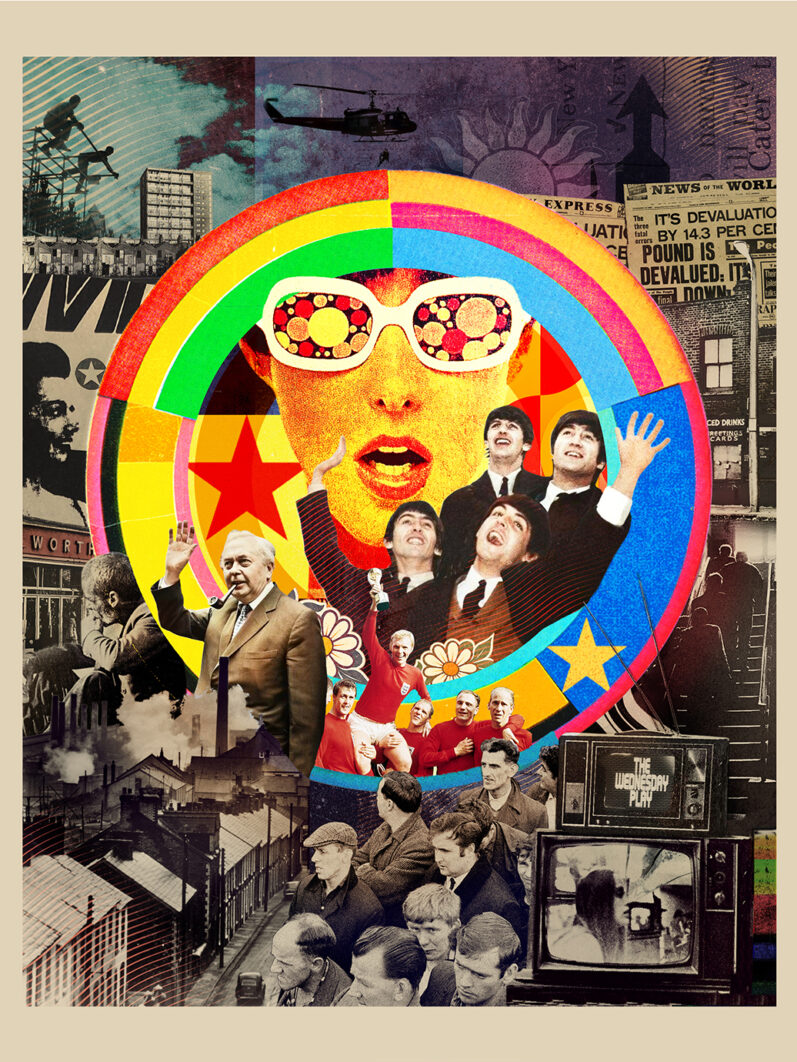
I may be the only one who believes that Labour edged to its narrow four-seat majority in the 1964 general election because of the Beatles. For most of 1963, the prime minister to be, Harold Wilson, had been talking of a new Britain – on the move from the antiquated, public-school-dominated establishment represented by the aristocratic prime minister, Alec Douglas-Home, to a country characterised by youth, dynamism, mobility and innovation. But where was the proof of the “dead wood” being cleared, of a New Jerusalem brought into being? The Anglo-French treaty to collaborate on the supersonic Concorde was signed in 1962, but there was little to show for it even after construction started in 1965. The most modern weapons system, TSR2, another symbol of a new world, was just about to be cancelled. The economy was subject to repeated cycles of stop-go. What evidence did Wilson have in 1964 of a youthful, northern-led Britain attracting the attention of the world other than the Beatles, and the pop culture flowering around them? The group was to become, as David Kynaston, the author of a masterful and highly addictive multi-volume series on post-1945 Britain’s culture and politics, tells us, “ample irrefutable testimony of a new age”.
Indeed, Deep into the Sixties is Kynaston’s brilliant sequel to A Northern Wind (2023), which itself starts with the release of the first chart-entering Beatles single, “Love Me Do”. He now picks up in October 1965, and while he had planned to end in May 1967 with another epic Beatles release, Sgt Pepper’s Lonely Hearts Club Band, his material is so extensive that, having completed 600 pages, he has stopped short in July 1966 with England’s historic World Cup win.
The entire book is set against the background of what the author calls “new possibilities”, of “life opening up” and there being “a buzz in the air”, signalling a changing of the guard. Sadly, it is also the story of hopes raised and then dashed – a balance of payments crisis at the outset and a sterling crisis at the end, each aggravated by the inflationary effects of the escalating war in Vietnam. It is also the story of a deeper, more complex set of longer-term changes underway. Our traditional civic organisations, especially our religious institutions, were starting to hollow out. The balance between individuals’ personal autonomy and social obligations to their communities was undergoing a shift, with a new phrase, “the permissive society”, becoming widely used to describe the conservative reaction to the change.
Wilson himself represented novelty, after three Eton-educated prime ministers whose elite backgrounds did not, Kynaston says with obvious regret, “prove as much the electoral liability that some understandably hoped it might be”. We may now have forgotten just how big and divisive a political issue the arrival of comprehensive education was. With social mobility and class, it was a topic that dominated much of the political debate, from the Department of Education and Science circular requesting (but not requiring) a democratisation of education – “If it’s the last thing I do, I’m going to destroy every fucking grammar school,” said the education minister Tony Crosland – to the opening up of the universities (private schools supplied 55 per cent of the Oxbridge intake in 1959; eight years later, in 1967, it was 38 per cent).

We read that Roy Jenkins refused Wilson’s invitation to become education secretary because he had sent his three children to private schools, a decision Wilson “brushed aside as being of no importance: ‘So were mine,’ he said.” Eventually came the long-promised but unsurprisingly utterly unsuccessful Public Schools Commission to advise on the integration of private and public schooling. But, as Kynaston reminds us, “education itself was not the silver bullet, not the key driver of social mobility”. Instead, changing labour force requirements meant skilled and semi-skilled manual workers became, for the first time, a minority, and what was called the golden age of mobility “had simply if prosaically been a case of more ‘room at the top’”. Indeed, as the recent ITV series 70 Up showed in graphic detail, class has never ceased to be the important determinant of opportunity and outcomes and, for all the changes we have witnessed over 60 years, it remains a real barrier to community cohesion.
Foreign affairs may not decide elections, but they can define the character of a government. Just as Iraq damaged the 1997 Labour government, Vietnam was the issue on which, as Kynaston reports, “the party of conscience seemed to lose touch with its soul”. Wilson was pleasing no one by supporting American action in principle while refusing to send British troops – not even the platoon of bagpipers Lyndon Johnson said would satisfy his request for visible support. Immigration, however, was also starting to become a divisive issue. The foreign secretary, Patrick Gordon Walker, had been the victim of a racist campaign when he lost Smethwick at the general election, but he stood again at a by-election in Leyton only to lose a second time.
As governments discover, economic policy dominates even when the government wants to talk about anything but the economy. The most important decision in this period was one that wasn’t actually made until 1967: whether to devalue the pound. Wilson decreed he never wished to hear the word “devaluation” in the corridors of Whitehall. It was, he said, like an “aching tooth”. Labour governments “are willing to sacrifice anything – life, liberty, the pursuit of happiness – to the maintenance of sterling”, quipped the young Observer columnist Alan Watkins. Devaluation, as a future Conservative chancellor said, had become “the last taboo in a newly permissive society”. But when the cabinet discussed the national economic plan, Crosland asked the right question: “How could we talk about a plan based on a 4 per cent average increase of production each year when we now knew perfectly well that for the next 18 months at least… the government was actually cutting back production by its deflationary measures?”
Kynaston’s book ends in July 1966, just after the cabinet voted 17 to six to oppose devaluation. The question has never been fully answered as to why Wilson, the most economically gifted prime minister, held out so long against what in retrospect seems an inevitability. Yes, he had promised the US he would maintain sterling, and yes, he also saw devaluation as a diversion from a focus on the real economy. But was resistance, Kynaston asks, more to do with Wilson’s “northern nonconformism” than economics?
This goes to the heart of the book: old hierarchies were being challenged by a new individualism. Deference was on the way out. The “we” society seemed to be giving way to the “I” society as a more home-based, individualistic culture developed. But did the mid-Sixties get the balance right between individual freedom and social obligation? The changing of the guard brought big, necessary and lasting shifts – the abolition of the death penalty, the legalising of abortion, the implementation of the Wolfenden Report (which had been lying on shelves for eight years) on gay rights, the Equal Pay Act and the rise of feminism.
The decade was not so liberal that the BBC’s replacement for the ditched That Was the Week That Was, the equally satirical Not So Much a Programme, More a Way of Life, was not also unceremoniously taken off the air. But Kynaston reminds us of the extremes: pop groups smashing up hotels, avant-garde BBC Wednesday Plays, student sit-ins, a drug culture and ever-shorter miniskirts. “The claims of emotion and personal authenticity [were] enjoying an increasing sovereignty over those of impersonal reason or traditional moral authority,” he writes.
As he suggests, however, only one part of the Britain of 1966 heralded the arrival of the Carnaby Street culture. “The habits of most people in most places were barely touched at the time,” he writes, with the majority situated uneasily between the new Britain and the old. “The Sixties never came to Blackburn,” Kynaston quotes a northern resident telling us. Did these years mark “the end of the postwar era?” the author had asked at the end of A Northern Wind. “Yes, in some senses undeniably,” he answers, “but whether the tug of the past would really lose its power – that was another matter entirely.”
The changes of the mid-Sixties laid a framework whose social revolution, Kynaston tells us, arrived decades later. He traces the long fuse that eventually fired up Brexit back to a reaction against the liberalism of the Sixties and a 50-year-long nostalgia for times past.
He also suggests the deepest roots of that socially conservative lament lay in the Sixties, that “much-publicised decade of broadly liberal and progressive actual or incipient change.” In fact, what survived was a social conservatism which existed side by side with the rising individualism and which was to become “a cry of despair against, or at least a profound discomfort with, modernity and the forces of change”. And his conclusion? “The old certainties are never coming back, but it is indeed only human to regret the loss of the reassurance, of an almost taken-for-granted underlying stability, they once provided.” It is not change itself that Kynaston is regretting, but what he sees as the loss of community as a result of individualism.
England’s sensational extra-time World Cup victory against Germany rounds off the book. Post-match BBC coverage, which today would last for hours, actually ended “barely a quarter of an hour after the last kick”, to make way for Juke Box Jury. At the tail end of the victory celebrations at the Royal Garden Hotel in Kensington, where players’ wives were invited but kept apart in a separate room, a well-oiled George Brown, deputy leader of the Labour Party, was found singing the West Ham anthem “I’m Forever Blowing Bubbles”.
At a party nearby, the famous historian EP Thompson had a fist fight because of the anti-German chauvinism of a fellow partygoer. Not to be outdone, Denis Law, Scotland’s most famous footballer, boasted he preferred to play golf rather than watch the match. A few days earlier, on 12 July, the cabinet announced £500m of public spending economies. The World Cup celebrations were short-lived. The cuts were to mark the beginning of the end for the Labour government. That was the Sixties that was.
Deep into the Sixties: Britain 1965-66
David Kynaston
Bloomsbury, 704pp, £35
Purchasing a book may earn the NS a commission from Bookshop.org, who support independent bookshops
[Further reading: Eric Hobsbawm, the man who knew almost everything]
Content from our partners



Related


This article appears in the 05 Nov 2026 issue of the New Statesman, Nigel Farage's bastards
Join the debate
Subscribe here to comment