
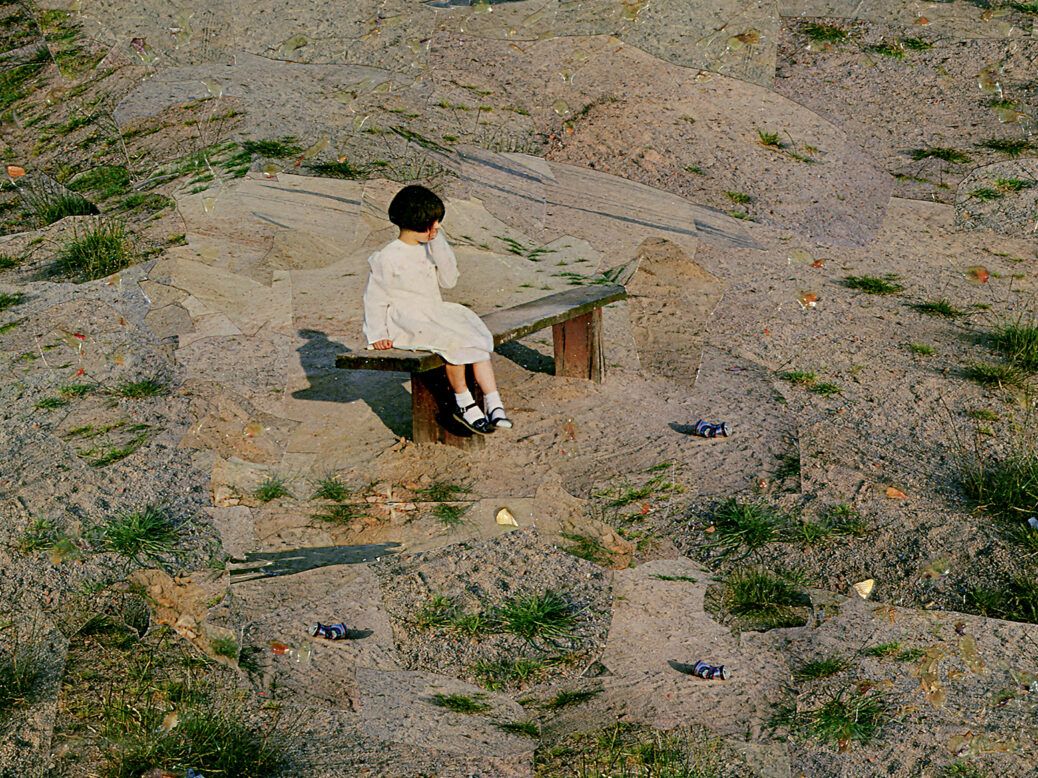
A grandmother who dispenses dubious advice like boiled sweets; a hill that must be climbed, and climbed, and climbed again; a tower; a girl; a world in which darkness lurks just over the page – you could almost remix the ingredients of Harriet Clark’s stunning debut novel to make a fairy tale. Instead, The Hill is a crystalline story of growing up in the shade of the generations who came before.
Suzanna, who narrates the novel, lives with her grandparents in New York City. On the weekends, she travels with her grandfather to the hilltop prison where her mother, Helen, is an inmate, serving a life sentence for her role as the getaway driver in a bank robbery that led to the death of a security guard. When her grandfather dies, a kindly nun escorts her. Eventually, she takes herself there. Her grandmother, Sylvie, who is in many ways the softly beating heart of the novel, refuses to go: “You think I’m taking you to that prison? I’m never taking you to any prison.”
Much of Suzanna’s time is spent with a gaggle of Sylvie’s friends, old commies who discuss the dead and the dying. “What wars were ahead were not their concern,” Suzanna tells us; “what needed figuring out was what had happened already.” The same is true for her own life. She has few friends her age, doesn’t apply for university when the time comes, and cannot or does not imagine a future untethered from processing, visiting or being by her grandmother’s bedside. There is no sense, she says, between herself and the elderly women for whom she pours vodka or gin that “my life was ahead and theirs behind; life was elsewhere and we were together”. Her mother’s incarceration traps Suzanna in some ways. But in Sylvie’s company, the past is so thick that wading through it into the future seems impossible.
For Sylvie, her history is a series of well-thumbed picture postcards to be taken out and rehearsed “until they required of her and me very little in the way of concentration and functioned instead to hold her thoughts and past at bay”. During the Soviet Union, Suzanna’s grandparents lived in Moscow where her grandfather was employed by the Daily Worker and Sylvie stayed at home with an infant Helen. This period is communicated to Suzanna through an oft-repeated anecdote about Helen throwing her only pair of shoes overboard on the passage to Moscow. “One moment and I knew what kind of person she was,” Sylvie is fond of saying. This turns out to be another story told to bend the world into a less complicated or troubling shape. Towards the end of the novel, nearing death, she tells her granddaughter, “The shoes had only fallen behind the bed of the cabin, waiting to be found.”

Helen, too, attempts to bend the world Suzanna inhabits. In the children’s centre at the prison, she insists that the two of them sit in the “reading roost”, a curtained cubby in the corner of the room where they can be “as alone… as one is closing their eyes in a crowd”. Even when Suzanna is large enough that they must lie curled on their sides, Helen tries to keep the future at bay, closing the curtains on the day when her daughter ages into regular visiting. Clark’s precise handling of time is one of this book’s great joys. Years slip by without fanfare, but while Suzanna is visiting her mother, small movements – Helen brushing hair from her daughter’s face, or another visitor walking to a vending machine – seem heavy with consequence. Watching visits, we are told, “felt less like watching the current day unfold and more like watching days that had already happened”. The result is a hypnotic attention to detail that bleeds into the world beyond the hill. Light variously makes its stab, slices through glass, shifts from dreary to sinister.
Clark’s mother, a founding member of the Weather Underground, was involved in the robbery of a Brink’s truck in New York state in 1981. She served 38 years in prison. Clark, as a result, was raised by her grandparents. And yet in The Hill she does not clog her narrator’s experience with facts and background information pulled from her own. Instead, she weaves strands of truth with threads pulled from other fictions: Grace Paley’s generation of political Jewish women, Marilynne Robinson’s lyrical voice, Kazuo Ishiguro’s melancholy calm. The result is spectacular. I will be pressing this book into the hands of everyone I love for years to come.
The Hill
Harriet Clark
Hodder & Stoughton, 288pp, £16.99
Purchasing a book may earn the NS a commission from Bookshop.org, who support independent bookshops
[Further reading: Mathias Énard’s meditations]
Content from our partners



Related


This article appears in the 05 Nov 2026 issue of the New Statesman, Nigel Farage's bastards
Join the debate
Subscribe here to comment