
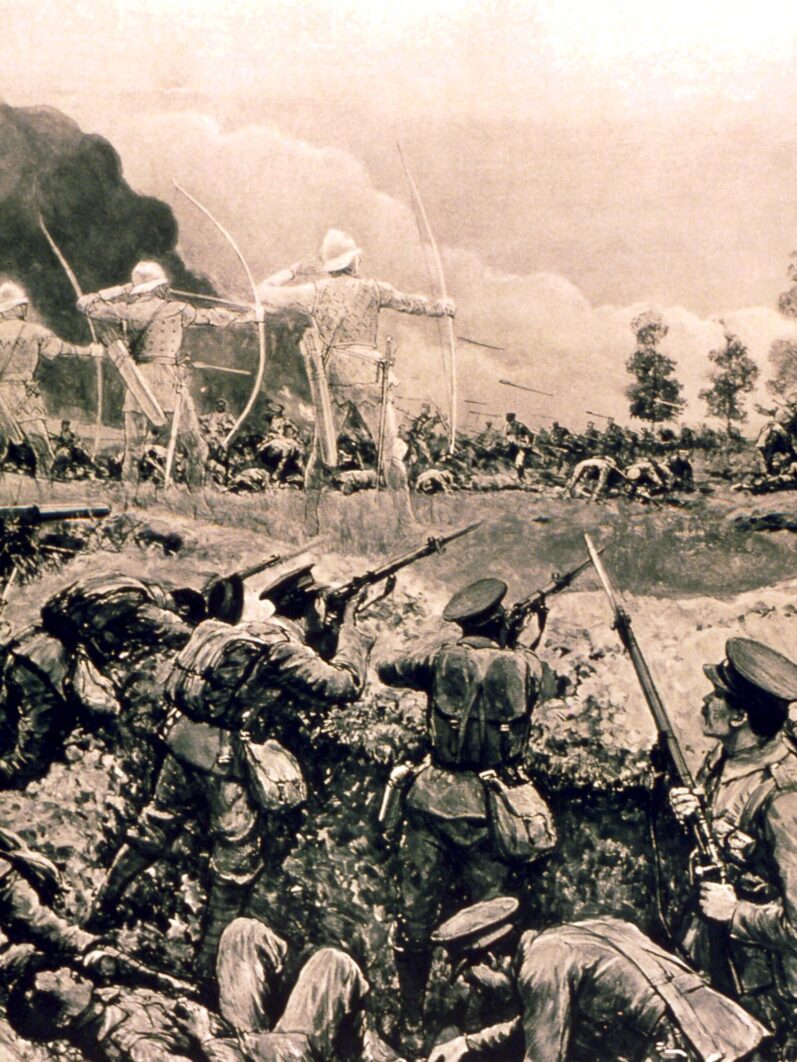
Every good novel on the condition of England should involve at least one fantastical creature. Or so Dickens thought. The first thing we are told in David Copperfield is that our hero, on account of being born at midnight on a Friday, is “privileged to see ghosts and spirits”. In A Tale of Two Cities, we have to wait until the third paragraph for the Cock Lane ghost to turn up. In Bleak House, we need wait only until we’re four lines in before a Megalosaurus, 40ft-long, churns its way through the London mud to the top of Holborn Hill.
More recently, any lover of the weird and sweepy has had to make do with slim pickings, clutching at the single page of Wolf Hall in which Hilary Mantel breaks from the usual programming to tell us of Grecian kings, Britannic giants, and Gogmagog’s death at the hands of Corineus. “Inside a history, another history,” Mantel reminds us. But which one matters more? Can the inner history, the secret history, the occult history, in the right conditions, emerge Kraken-like and swallow the one we think we know whole? Why not make Bleak House a story about a Megalosaurus?
China Miéville has been working on The Rouse, which was published in October and has now been awarded the Goldsmiths Prize, for two decades. The novel’s 1,264 pages are less a page count than a statement of intent: the product of a secret second parallel track, running alongside almost everything else he has published — from the Bas-Lag novels, now staples of the New Weird genre, to his best known work, 2009’s The City & the City (think Raymond Chandler detective procedural meets M John Harrison after an ayahuasca retreat).
The simplest way to describe The Rouse is as a supernatural thriller. Not that it starts that way: the first 100 or so pages, centred around Maur Towns, a single mother raising her son in the grittier corners of 1970s London, owe more to Penelope Mortimer or Margaret Drabble than to Arthur Machen or Algernon Blackwood. Then, a tragedy. This is the end, Maur tells us. “Now everything is codas.”

The codas, spanning the next 1,000 pages, get weird pretty fast. We go back to 1950s England to join Steven Allardyce, who, after a less-than-auspicious start to life, joins the newly reconstituted SAS on a Boy’s Own adventure in Malaya. A few supernatural encounters later, he’s sent to join a secret military research unit hidden away in Orford Ness, the tip of the spear in Britain’s new role as the world’s “overwhelming spectral superpower”. Their job is to track “the Roused”: powerful, unnameable emanations – usually of the dead – that can be summoned, manipulated and penetrated, and put to work for queen and country.
Hence the thriller: at points, The Rouse isn’t a million miles away from the Andy McNab and Chris Ryan novels I used to read secretly as a teenager while Saul Bellow lay untouched on the floor. In Miéville’s fictional world, much to the chagrin of the Americans, Britain occupies a unique place at the frontier of paranormal warfare. This is the island of mystics and weirdos, of ghost-fuckers and helicopter-worshippers, of sanitary pads soaked in ectoplasm, seers in Willesden, and black ops units named for pickled onions.
Through the story of Allardyce and his mystic hardmen, we get all the locations you’d expect in a romp through late-empire: Kenya; Hong Kong; Northern Ireland; the Falklands. Through Maur, we get something different: a sense of time, of history remorselessly moving forward. The 1970s become the 1980s, which become the 1990s; children grow up, relationships collapse, political dreams are dashed. Although centred mainly on London and its “places hitherto imaginary”, her story spreads itself across Britain.
Which I suppose brings us back to our Megalosaurus. What’s unusual about The Rouse is not its length, but its ambition. In an age of the perfectly poised 200-pager, in which nothing, beautifully, ever happens, this aspires to something bigger: to comprehend not merely some small slice of a much bigger cake, but the national whole. Not just a haunting, but “a proper haunting”, as one character puts it.
Its success comes, I think, from the novel’s discipline. Miéville leads us up the north face with just enough oxygen to sustain us: a perfect phrase here, a diversion on the phenomenology of helicopters there, a scene of horror that hits you bodily, in just the right place, leaving the long afterglow of pleasant discomfort that carries you on to the next hit. It sounds strange to talk of discipline in a book this long. But that’s what it is. Not the discipline of economy, of cuts, of killing darlings, but a different kind: the discipline to see a story through.
Plus there’s Miéville’s understanding that England’s strangeness is not an ornament, but the main event. As one character half-remembers it, “the Goths pointed in Britain’s direction to show where the dead went”. One of the cruellest ironies of the novel is that as the national affinity with the Roused becomes greater, the harder it is to recognise or accommodate them. Quite often it seems Allardyce and his teams are searching not for the Roused, or the “apports” used to summon them, but for a language adequate to describe them: some shaman or healer to give them the magic word. Perhaps this is why the novel can feel bleaker without the ghosts than with them. At times, you find yourself breathing a sigh of relief when humans stop doing terrible things to each other and let the ghosts have a turn.
Yet there is one last twist, a final Megalosaurus to contend with. A nation might get stuck in the mud, misunderstanding its own strangeness, but for an individual, such ignorance need not be quite so painful. The traditional model of speculative fiction is simple: find some clever people, place them in front of something they cannot understand and watch them go mad. But what happens when someone, instead of being unmade by such new uncertainty, is made by it instead? This, for me, is Maur’s story: dead son; bull-rushed by grief; and then suddenly thrust into a world of wraiths, revenants and ghouls. In all, she wears it pretty well.
“Can I learn to fall upwards?” is the question that ushers us into the novel’s final pages. Maur, it turns out, can. A nation, after all, probably does need to know itself. Yet we – as Maur and Miéville both remind us – are richer for remaining a mystery.
The Rouse
China Miéville
Picador, 1,264pp, £35
Purchasing a book may earn the NS a commission from Bookshop.org, who support independent bookshops
[Further reading: Aea Varfis-van Warmelo: “Innovation is often productively alienating”]
Content from our partners



Related
This article appears in the 05 Nov 2026 issue of the New Statesman, Nigel Farage's bastards
Join the debate
Subscribe here to comment