
Fairy tales were not – or not just – entertainment for children. As JRR Tolkien frames the genre in his 1939 lecture “On Fairy Stories”, they comprised complete and coherent “secondary” worlds, alternate realities formed by their “sub-creators” as refuges from disenchantment. Middle-earth may never have existed, but the simple pastoral life it conjures up represents an alternative to a desolate, machine-governed modernity.
Freely admitting that The Lord of the Rings was an exercise in escapist myth-making, Tolkien insisted that seeking escape from mechanisation was both natural and rational. The crucible of his mythology was his experience as a front-line officer in the First World War. Deployed to France in June 1916, he arrived just before the Battle of the Somme. At the time it concluded in September of that year, it was the bloodiest single battle in modern history, with more than a million casualties, including over 300,000 deaths. On its first day (1 July 1916), British forces alone suffered more than 57,00 casualties, nearly 20,000 of them fatalities. Exposed to artillery bombardment and the filthy carnage of the trenches, Tolkien contracted trench fever and was evacuated back to Britain in October 1916. The illness – spread by lice – saved his life. By 1918, all but one of his closest prewar friends were dead and his battalion almost annihilated.
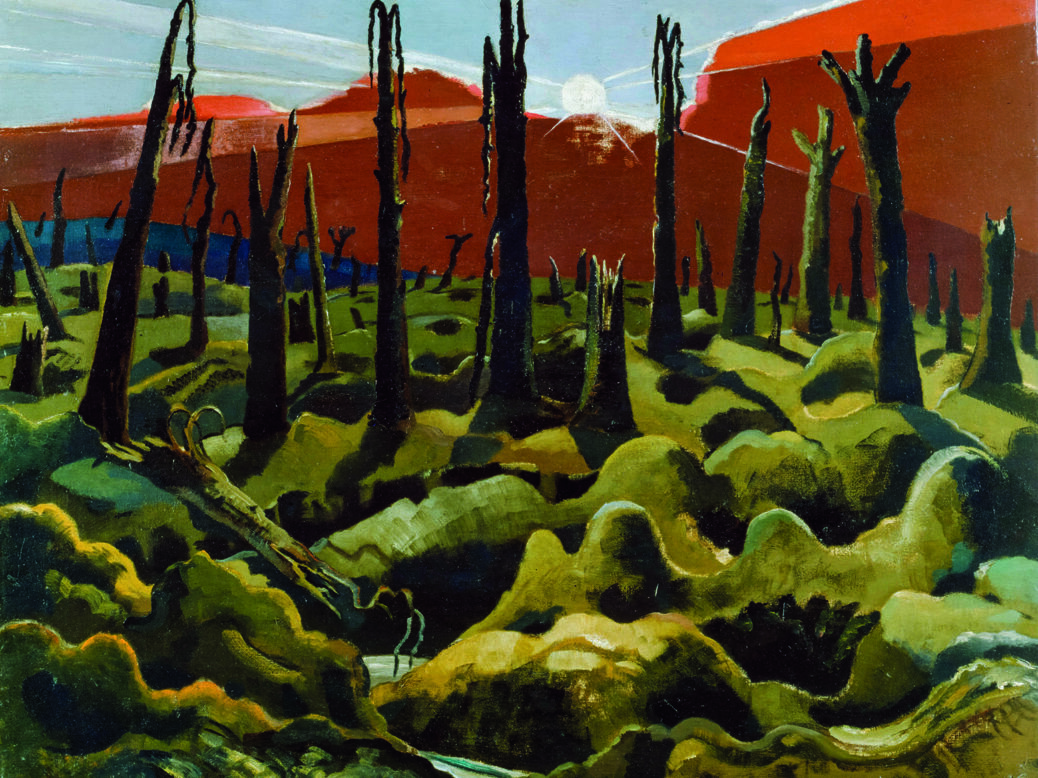
As DJ Taylor, the critic, novelist and biographer of George Orwell, notes in this engaging and illuminating study, Tolkien dismissed any suggestion that his work reflected his life in any direct fashion. Writing to WH Auden, a lifelong admirer, he described himself as a writer “whose instinct is to cloak such self-knowledge as he has, and such criticisms of life as he knows it, under mythological and legendary dress”. Yet traces of his past are clearly visible. Crossing the Dead Marshes to reach Mordor, Frodo sees the pale faces of soldiers trapped in the mud – an image that recalls the Somme’s no-man’s land. Mordor is ashen and dead, mirroring the ruined landscape of the Western Front, where the soil was poisoned and trees stripped of their bark and leaves. The enormous catapults used by the Orcs in The Return of the King are tank-like “great engines” rolling across the fields, the ground shaking beneath them. The sturdy courage of the hobbits reflects that of the regular British soldiers Tolkien commanded: “The privates and batmen I knew in the 1914 war and recognised as so far superior to myself.” This was the world, a hellscape lit up only by the stoical endurance of common folk, and from which Tolkien wished to escape.
Born of trauma, Middle-earth is not a sunny arcadia. Evil is inherent in the pursuit of power. In a letter written in 1956, Tolkien wrote: “I do not expect ‘history’ to be other than a ‘long defeat’ – though it contains (and in a legend may contain more clearly and movingly) some samples of glimpses of final victory.” He put the same words in the mouth of a character in The Fellowship of the Ring: “Together through ages of the world we have fought the long defeat.”

“Faerie is a perilous land, and in it there are pitfalls for the unwary and dungeons for the overbold.” These cautionary words in his lecture anticipated the objections of Tolkien’s critics. For many, The Lord of the Rings was a flight into a romanticised medieval past, and the hobbits’ Shire far removed from the historical actualities of technological revolution and social division. Tolkien’s attitudes were epitomised in his revulsion against “the infernal combustion engine”. His admiring reviewer the American conservative Russell Kirk refused to acquire a driving licence, denouncing the motor car as “a mechanical Jacobin”. Modern technology was inherently disruptive and tyrannous, dissolving communal bonds and enslaving human beings to meaningless routine.
Tolkien’s values were undoubtedly reactionary, but he had no truck with the worst bigotries of his day. Approached in 1937 by a Berlin publishing house about a German edition of The Hobbit, he reacted furiously when it enquired whether he was of “Aryan extraction”: “If I am to understand that you are enquiring whether I am of Jewish origin, I can only reply that I regret that I appear to have no ancestors of that gifted people.” The book did not appear in German until 1957. His loathing of “wholly pernicious and unscientific” racial doctrines was lifelong. In his valedictory address on retiring from his professorship in 1959, he declared: “I have the hatred of apartheid in my bones.”
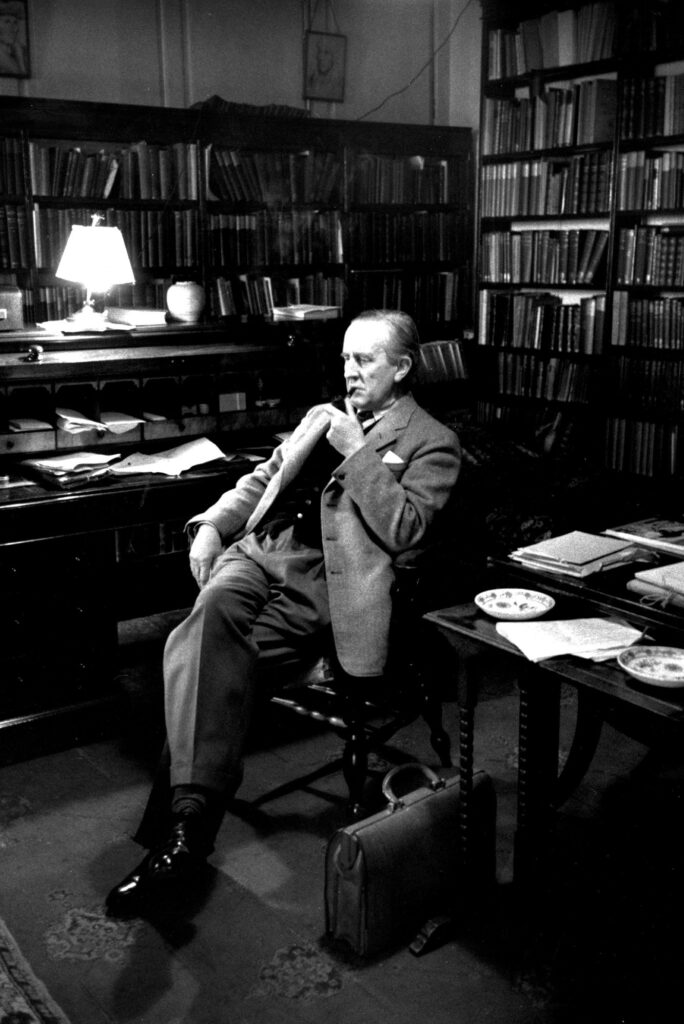
The King Under the Mountain is not so much a biography, Taylor tells us, as “a series of fan’s notes, material brought back from some of the remoter caverns of Tolkien’s imagination, in which, or so it seems to me, critics and biographers have rarely strayed”. Not the notes of an uncritical fan, however. Liking some parts of Tolkien’s work “better than others, and some not at all”, Taylor “finds splendour amid the fustian and jewels amid a fair amount of dross”. An impassioned fan, nevertheless. “No other writer meant more to me as a child than John Ronald Reuel Tolkien.” This was not simply a preteen literary infatuation. Reading him with “a feeling almost like recognition”, Taylor has remained a “Tolkien obsessive” to this day.
He is not alone. Tolkien’s visible cultural influence may have peaked in the late 1960s and early 1970s, but it persists. Led Zeppelin and other rock bands drew on Middle-earth, while “Frodo lives!” became a common graffiti slogan across the US and UK, partly, no doubt, in protest against the Vietnam War. Taylor gives a strong account of those years and Peter Jackson’s hugely successful films released between December 2001 and December 2003, which grossed nearly $3bn worldwide. He is less convincing in accounting for the reverberations of Tolkien’s mythology today.
Taylor identifies the psychological roots of Tolkien’s work in his early life. Picturing him at the age of 19, he writes: “Childhood hardships; dead parents; forbidden love; the lure of an imaginary world; an exacting religion; an engrained sense of personal and social deracination – all this… would make for powerful magic.”
Born in January 1892 in Bloemfontein, South Africa, in a middle-class family of German heritage, Tolkien relocated to England with his mother, Mabel, after the sudden death of his father. Money was tight, and it was only with financial support from relatives that Tolkien was able attend the fee-paying King Edward VI school in 1900 after passing a competitive entrance examination. In 1902, this support was withdrawn when Mabel converted to Catholicism, infuriating her Protestant family, and Tolkien had to leave the school. A year later he passed another examination, this time for a scholarship, and returned to King Edward’s – “exactly the young Tolkien’s sort of place, a grammar school of ancient foundation, with connections to the great universities”. If he had failed the second exam and not gone to Oxford, his life as a scholar and writer might never have begun.
When Mabel died in a diabetic coma in 1904 at the age of 34, the 12-year-old Tolkien’s care passed into the hands of a legal guardian, a Catholic priest with strong views on the boy’s future, who forbad him from seeing or writing to his future wife Edith, a Protestant he had met and fallen in love with at the age of 17. Tolkien obeyed the priest’s injunction. Nevertheless, the two married in March 1916, a few months before he left for the Somme. It seems to have been a happy marriage, though Edith played no part in Tolkien’s exclusively masculine circle of friends. In the summer of 1930, while the hard-up professor was marking examination scripts for extra income, he wrote on a blank page: “In a hole in the ground there lived a hobbit.” In that sentence a modern myth was conceived that spread to the far corners of the Earth, which in later years he viewed with bafflement and distaste.
Taylor’s analysis of Tolkien’s relations with the broader culture is well-judged. He does not shrink from noting the mediocrity of his poetry, and complete inability to portray relations between men and women in other than mistily romantic terms. He says little that explains the revival of interest in Tolkien’s mythology, or its echoes in politics.
Peter Thiel’s data company Palantir is named after a type of magical object in The Lord of the Rings – an indestructible crystal ball or seeing-stone, which allows people to look across vast distances, communicate mind-to-mind and peer into the past (but not the future). When she was sworn in as Italy’s youngest cabinet minister in 2008, the now Italian prime minister, Giorgia Meloni – who in her autobiography described The Lord of the Rings as “a sacred text”– vowed not to let herself be corrupted by “the Ring of Power”. The American vice-president, JD Vance, who founded a venture capital outfit, Narya, named after Gandalf’s Elven Ring of Fire, has claimed that much of his conservative worldview was influenced by Tolkien. As he leaned towards anarchism or “unconstitutional monarchy” in politics, Tolkien would have been deeply uncomfortable with all of this. But it poses a question Taylor does not answer: why does Tolkien’s mythology still resonate?
A tweed-suited, conservative-minded Oxford professor of philology whose special subject was the early English dialects of the West Midlands is an improbable guru for a hippy counterculture or Silicon Valley techno-futurists. The all-male gatherings in which Tolkien met with like-minded (but not always harmonious) colleagues and friends to drink, smoke and discuss language, theology and each other’s writings, are even stranger. The Inklings – an informal circle that met regularly from the early 1930s to the late 1940s in the back room of the Eagle and Child pub and in CS Lewis’s Magdalen College rooms – are central to explaining Tolkien’s enduring cultural appeal.
It was not by accident that theology and religion were central concerns for many of the Inklings. Tolkien concluded his lecture on fairy stories by linking his literary theory with his Catholic faith. The life of Jesus was a “eucatastrophe” – a neologism combining the Greek word for good (eu) with catastrophe, which originally meant a sudden narrative unravelling or reversal. A seeming tragedy, Jesus’s crucifixion redeemed humankind. In a midnight walk in Magdalen in September 1931 with Lewis, by then a theist but not yet a Christian, Tolkien described this story as a “true myth”. In different ways, the recovery of myth is the common thread running through the Inklings’ conversations.
While Tolkien and Lewis are the best known of the group, two other writers were integral to its development. The mystical philosopher Owen Barfield, sometimes called “the first and last Inkling” because he met Lewis long before the formation of the group and had outlived every other major member when he died in 1997 at the age of 99, exercised a formative influence on both men. A lifelong devotee of anthroposophy, a “spiritual science” founded by the Austrian thinker Rudolf Steiner, Barfield argued that if the human mind was no more than an accidental by-product of matter, logic and science are also meaningless accidents. Materialism was a self-refuting philosophy, or at best an unprovable hypothesis.
Charles Williams, the writer of “supernatural thrillers”, joined the Inklings in 1939 when Oxford University Press (OUP) moved its London office back to Oxford during the Second World War. In many ways an outsider in the group, Williams grew up in London in a working-class cockney family that was too poor to fund him through his studies for a university degree. He rose through the ranks at OUP, from being a book-packer in a stockroom to an editor. A seeker who at one point joined the Fellowship of the Rosy Cross, a splinter group from the Hermetic Order of the Golden Dawn to which the Satanist Aleister Crowley had briefly belonged, Williams electrified the fusty gatherings with his energy, fluency and charisma. Lewis was bewitched, and Tolkien horrified.
Lewis loved Williams’s novels because, in them, the natural and the supernatural realms interact everywhere: spiritual wars are fought out in provincial towns and London suburbs. In a letter to the author, Lewis hailed The Place of the Lion (1931) as “one of the great literary events of my life”. Tolkien was deeply suspicious of Williams and his esoteric theology. He intensely disliked Lewis’s novel That Hideous Strength (1945), the third in his “science fiction” trilogy, in which the space-travelling Dr Elwin Ransom directs resistance against a cabal of progressive ideologues, the National Institute of Coordinated Experiments (NICE), which aimed to reconstruct society on a “rational” model. Perhaps it was Williams’s disruption of his friendship with Lewis that Tolkien most resented, for in their view of technology as an instrument of repression they were at one.
In his booklet The Abolition of Man (1943), Lewis argued that human power over nature was, in practice, the power of one group of people over the whole species. Future generations have no voice in the world that progressive thinkers believe can be built with new technologies, nor do these thinkers have any clear idea of what they are creating. Their true interest is in power itself, the love of which is the root of evil throughout Tolkien’s work. The pathology of the modern world is that it is ruled by a cult of human will.
Tolkien had no remedy for this disorder. The alternate world he imagined has no relation to any conceivable reality, past or future. It is not that he is a writer gripped by nostalgia – not always an unreasonable emotion. Instead, he diverts the reader from the intractable present in which, one way or another, we must learn to live. To inhabit Middle-earth, the world alone would not need to be radically altered; we too would have to become unrecognisably different. Perhaps this is why, when reading Tolkien, I have never shared Taylor’s sense of recognition.
Our condition seems to me better captured in the last volume of Mervyn Peake’s Gormenghast trilogy, which Taylor mentions only in passing as one of many contemporaneous works of speculative fiction (the first volume, Titus Groan, was published in 1946, Gormenghast in 1950). In Titus Alone (1959), the 77th earl of the crumbling castle leaves his tenebrous, ritual-governed home to discover what may be beyond its walls. He finds a city of towering skyscrapers, pilotless flying machines and floating surveillance globes. Beneath it runs the Under-River, a subterranean tunnel network inhabited by the city’s outcasts and derelicts. Titus flees back to the edge of Gormenghast, but when the castle appears on the horizon, he halts and turns back to confront life in the city. There is no escape from the machine. We must coexist with it as best we can.
Rationalists who sneer at fairy stories are possessed by their own infantile fantasies. For all its unreality, Tolkien’s world is a truer myth than the ruling legends of our age. A long defeat offers a more humane vision than narcissistic dreams of technological control fused with ancient hatreds and endless mechanised warfare.
John Gray’s books include The New Leviathans: Thoughts After Liberalism (Penguin)
The King Under the Mountain: In Search of JRR Tolkien
DJ Taylor
Constable, 320pp, £25
Purchasing a book may earn the NS a commission from Bookshop.org, who support independent bookshops
[Further reading: The ghost of Hannah Arendt in the Banality of Evil]
Content from our partners



Related

This article appears in the 14 Oct 2026 issue of the New Statesman, Fool Britannia
Join the debate
Subscribe here to commentTo quote John Gray from his wonderful book ‘Heresies’, “the human animal is itself only a passing tremor in the life of the planet”. A sobering thought!
Why do I get the idea that Gray does not like the idea that science and technology might save us from human nature? It could.
Yes it could happen but I think John Gray is saying that given the track record of ‘humanity’ at best we tend to be go for expedient solutions – short term convenient remedies and then move on. We cannot take too much reality!