
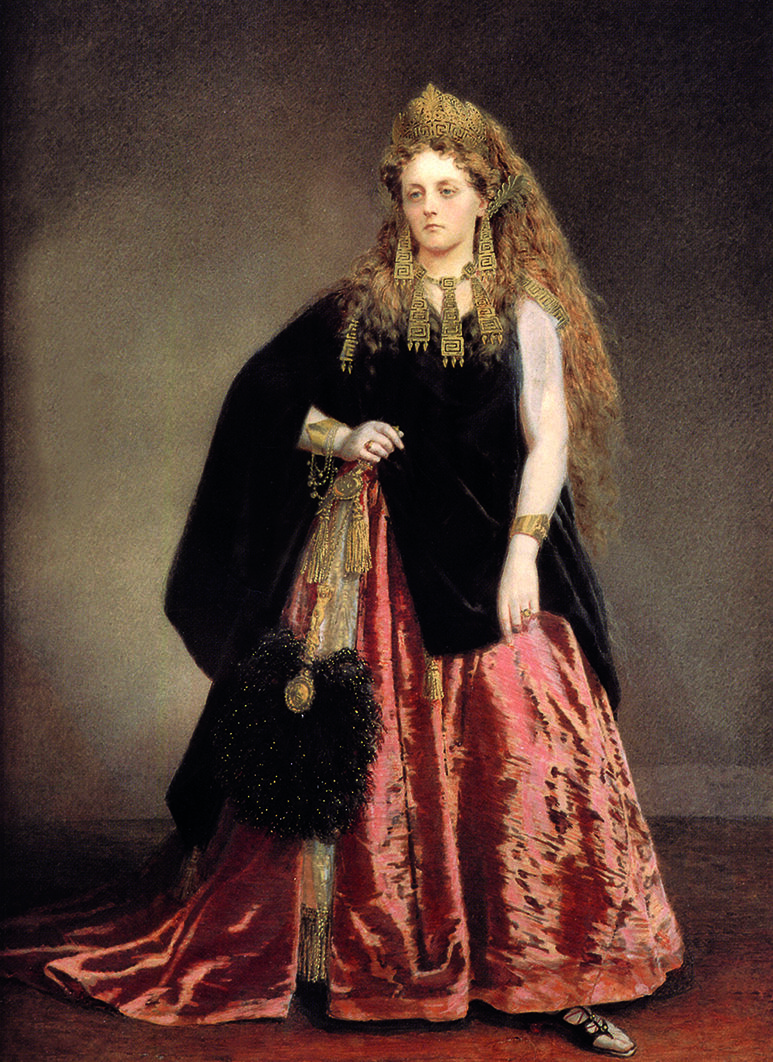
Here are three of the many people with whom Virginia Verasis, Contessa di Castiglione, had sex: Victor Emmanuel II, king of Sardinia/Savoy and subsequently of all Italy; Napoleon III, emperor of the French; Adolphe Thiers, a president of France’s Third Republic.
In her lifetime (1837-99), Europe was in a state of flux. New nations (Italy and Germany) were coming into being, elbowing aside ancient principalities and powers. Castiglione believed that she was among those reshaping the continent. She claimed that it was she who “by myself” (forget Mazzini, Cavour and Garibaldi) “made Italy”. She also claimed that she had saved the papacy by advising the Pope to remain in Rome in 1870, and that it was thanks to her intervention that Bismarck held his troops back from sacking Paris in 1871.
It appears, though, from Benedetta Craveri’s exhaustive biography, that Castiglione’s greatest talent was not for statecraft, but for making a spectacle of herself. In the 1850s she began a collaboration with the Parisian photographer Pierre-Louis Pierson, commissioning and art-directing dramatic portraits of herself. Posing in fantastical hairstyles and costumes, she was creating wordless mini-dramas – enigmatic, strikingly beautiful, surreal avant la lettre. There were hundreds of images. They were made up into albums, which she gave to her friends. She was creating a new art form, much admired by the aesthetes of the next generation. In 1913, Count Robert de Montesquiou wrote her biography, La Divine Comtesse, which celebrated her self-fashioning. His friend Gabriele d’Annunzio, another master of that art, contributed an introductory essay.
She was born, in Florence, Tuscany, as Virginia Oldoini. Her father was an undistinguished diplomat. “No one likes Oldoini,” according to his superior, “not even his own wife.” Her mother, Isabella (with whom she later shared a lover), oversaw Virginia’s education. By the age of 15, she was speaking English, French and German fluently, and had been described as “one of the most phenomenal Florentine beauties of the day… with a grace that hardly seems of this world”.

Her parents saw her good looks as capital that should be judiciously invested, but – in her opinion – they botched the job. “If my mother hadn’t been a fool,” she wrote later, “she would have taken me to Paris and the emperor would have married me and not Eugénie.” Instead, at the age of 16, she was wedded to Francesco Verasis, the Count of Castiglione. A contemporary wrote: “The Oldoini bride has been enthroned in Turin society with maximum applause.”
The couple had a son. They quarrelled frequently. Virginia had an affair with Francesco’s best friend. After two years, they decided to visit Paris. The prime minister of Piedmont-Sardinia (and later of a united Italy), Camillo Cavour, wanted Napoleon III’s support against the Austrians. He resolved to make use of Virginia’s cleverness, her languages, her promiscuity and her beauty. He wrote: “I have enlisted the lovely Countess of Castiglione in the diplomatic corps, inviting her to coqueter [sic] and seduce, when necessary, the emperor.” He gave Virginia a code to use when writing to him. She had become a secret agent.
Francesco went ahead to Paris. On the night before Virginia left to follow him – after her latest lover had visited, interrupting her packing, and she had had sex with him on the floor – she was informed that King Victor Emmanuel was coming to visit. She gave orders that the front door be closed but the garden gate left open, dismissed all the servants, and put on a black velvet dress. That night, according to her diary, the King “forced himself” on her. Her diary entry adds: “Finished up the trunks with Antonio, whom I gave 20 francs; wrote some letters. By 12 I was all done and I went to sleep.” She was still only 18, but three years earlier her mother had noted her “reputation for having no feeling for anyone”. No feelings of love, no feelings of outrage or self-pity, no fear.
In Paris she shone at a court that the disapproving Goncourt brothers described as one “without hierarchy, where all one need do is show up to find a place, and often an important one”. Virginia showed up in a sequence of outfits as provocative as they were theatrical. When she appeared at a court ball as the Queen of Hearts, she was shockingly uncorseted. When she entered the Tuileries Palace as an Etruscan queen, she wore an immense ostrich-feather fan on her hips and her bare arms were covered with bracelets of gilded leather studded with jewels. (She would soon be receiving a new lover in nothing but those bracelets.) When she attended a party at a lakeside chateau she was wearing marabou feathers and a transparent white muslin dress – a toilette, wrote one observer, so suggestive that one had to “call upon every inch of one’s virtue” to resist the implied invitation. Napoleon III didn’t try to resist. He asked her to join him in a boat, rowed her over to a secluded island and there withdrew with her into the undergrowth, “liberties” that, according to the English ambassador, “scandalised all of Paris”.
Virginia’s triumph was brief. She was soon replaced as the emperor’s favourite mistress by the more discreet Countess Walewska. Her marriage foundered. Francesco di Castiglione asked for a separation – because she had publicly cuckolded him, but also because her extravagances had ruined him financially. In July 1858, at Plombières, Cavour and Napoleon III agreed to work together to oust Austria from its territories in Italy. The Contessa di Castiglione’s mission was accomplished, but it was accomplished without her. She was just 21, and the most significant part of her life was over.
The rest of her story, lasting 41 years, and taking up three quarters of this book’s 500 pages, makes a sorry tale. She had lost the emperor’s favour and – what seems to have been more important to her – she had lost access to the information he had been giving her, allowing her to make profitable investments (a courtly kind of insider dealing). She spent the rest of her life fretting about money. Although a few of her erotic adventures could be called love affairs, the most celebrated were pragmatically undertaken. She cultivated, and slept with, the banker Charles Laffitte, telling him: “Let’s leave the heart to the imbeciles.” “If one doesn’t get anything out of it, what’s the purpose of abasing oneself?” she wrote.
Craveri structures this latter part of the book around Virginia’s correspondences with her male friends and lovers – material that she is the first to have used. It is a voluminous archive. To Prince Joseph Poniatowski alone, Castiglione wrote almost 2,000 pages over the course of five years. Craveri takes the epistolary relationships one by one, a strategy that leads to a lot of back-tracking and repetition. Characters are introduced several chapters after they first appear. Incidents are alluded to long before they are actually described. The result is confusing, and it is rendered a great deal more so by Virginia’s descent into insanity.
Her delusions about her own historical importance became ever more grandiose. She described herself to one of her admirers as “the greatest woman of all time, past, present and future”. Her sense of grievance became ever more acute. She sank into depression, spending days in bed under black silk sheets, writing increasingly incoherent letters. There were times, reading this book, when I found myself overcome by the peculiar exhaustion that comes from trying to make sense of a story told by a drunk.
Castiglione’s career was a remarkable one, but the way in which it is narrated here is off-putting. Craveri uses too many words in almost every sentence. She switches from stilted archaisms – “a splendour that brooked no comparison” – to jarring modern idioms – “the congress, for [Cavour], was a bust”. (Many of these infelicities must be blamed on the translator.) And all the time Craveri seems to be wavering between her attempts to acclaim Castiglione as a proto-feminist free spirit and her admissions that the Contessa was, in her own mother’s words, a “witch” and a “bitch”. Her treatment of her son Giorgio was deplorable. Prosper Mérimée was one among many to remark on “the look of scorn she always wore on her marvellous face”. Princess Metternich summed up: “The Countess of Castiglione was lacking in one essential thing – charm!”
In 1878, in her early forties, the Contessa moved in to an apartment on the Place Vendôme and there she sequestered herself, living as though in mourning for her life. Black carpets, black walls, permanently closed shutters. She went out only at night. And then, in 1893, she returned to Pierson’s studio and created a new set of photographs in which her physical decline was recorded. As a young beauty she had had Pierson take a scandalous picture showing only her shapely legs. Now those bare legs were photographed again, sadly swollen, feet resting on a dark pillow, “like the feet” writes Craveri “of a dead woman in a coffin”. In her life and letters, Virginia di Castiglione was always a poser. In these pictures, at last, she confronted reality.
Lucy Hughes-Hallett’s books include The Pike: Gabriele d’Annunzio, Poet, Seducer and Preacher of War (Fourth Estate)
The Contessa
Benedetta Craveri, trs Alex Andriesse
New York Review of Books, 512pp, £36
Purchasing a book may earn the NS a commission from Bookshop.org, who support independent bookshops
[Further reading: In praise of Winnie-the-Pooh’s idleness]
Content from our partners



Related

This article appears in the 14 Oct 2026 issue of the New Statesman, Fool Britannia
Join the debate
Subscribe here to comment