
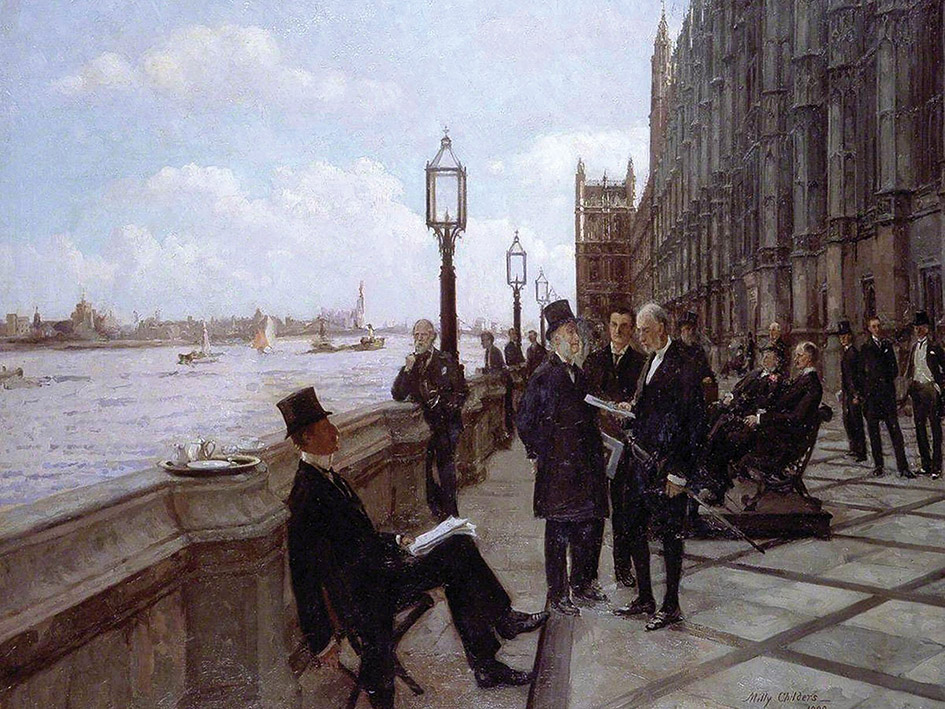
It’s an interesting quirk of the English literary canon that there are almost no great novels about Westminster politics. At a push, one might suggest House of Cards by Michael Dobbs (1989) or CP Snow’s Corridors of Power (1964), though neither quite belong in the first rank. Why is this? It may be that the comings and goings of Westminster, all those dusty corridors and division bells, are somehow anti-literary. Novels might be better suited to bedrooms and kitchens, ballrooms or battlefields, where all the essential human dramas play out.
There is some truth to this, but I suspect in reality there have simply been vanishingly few great authors who also had the knowledge, and inclination, to immerse themselves in the petty yet consequential dramas of parliament.
In fact, there might only have been one: Anthony Trollope. And so, having spent the past year conducting my own immersion into SW1 as a newly appointed political journalist, I decided to dedicate this summer to the Palliser novels, Trollope’s six-part roman-fleuve about Westminster during the high summer of the Victorian age. The fifth book in his series, The Prime Minister, represents the culmination of Trollope’s story, as his protagonist Plantagenet Palliser ascends to the highest office in the land. It was published in 1876 – when the occupant of No 10 was Benjamin Disraeli – and yet I found it a surprisingly useful guide to the swirling melodramas of our current political moment.
Palliser begins the series as a rising man in liberal politics. “Planty Pall” is an awkward and dry technocrat, but he is also the heir to a lavish dukedom and so is married off to an unwilling Lady Glencora McCluskie: gorgeous, mercurial, fantastically rich and in love with someone else. Their abiding union is one of the series’s central threads, running alongside the chequered and undulating career of Phineas Finn, a silver-tongued and generally irresistible Irishman. The great debates of the lateish Victorian age – extending the franchise, disestablishing the Church of England, many Irish questions – play out in the background.

As he answers these questions, Trollope satirises and snarks, but he also admires parliament deeply, declaring in his autobiography that “to sit in the British parliament should be the highest object of ambition to every educated Englishman”. (Trollope tried for a seat himself, at Beverley in the 1868 election. He failed, but put his humiliation to good use by writing exquisitely in The Prime Minister about the indignities of the failed carpetbagger.)
The Palliser novels do not express a political philosophy, as the fictions of Orwell or Di Lampedusa did. Nor do they capture the great tides of history like a Hugo or a Tolstoy. Trollope’s lasting achievement in these books is his portrayal of the humanity behind politics. What draws these men of ego and ambition to risk their reputations in the political arena? What are the strange and barely discernible rhythms that cause political reputations to rise and fall? Why do politicians who begin with such high ideals and ambitions so often end up trapped in hollow compromises?
Trollope had plenty of literary fans, among them Tolstoy and Virginia Woolf, but notably, the most meaningful endorsements of the Palliser novels come from men in the arena. Winston Churchill became so obsessed by them while recovering from a stroke in 1953 that his secretaries would turn the (many) pages for him to spare him from fatigue. When Harold Macmillan was prime minister, he marvelled at their political verisimilitude and used to joke that after a long day he liked to “go to bed with a Trollope”. Enoch Powell felt that Trollope’s cautious liberalism lacked “passion” but, ever the romantic, he found himself drawn to the Palliser novels for their love stories and subtle female characters. In 1991, when asked to contribute a foreword to a new edition of the Palliser novels, Roy Jenkins declared that the author belongs on the “fourth plinth” in the “pantheon of English mid-19th-century novelists”, in the company of Charles Dickens, William Makepeace Thackeray and George Eliot.
High praise. Yet many also view Trollope as a saloon bar second-rater and have done ever since his autobiography was published posthumously in 1883, causing his reputation to plummet. Polite opinion was horrified by Trollope’s mercenary approach to art, setting a timer to ensure he wrote 250 words every 15 minutes and publishing a list of how much he was paid for each novel. The fascination with pecuniary practicalities was also a source of strength, though: “Of all novelists in any country, Trollope best understands the role of money,” wrote WH Auden in his 1972 New Yorker essay on the author, “A Poet of the Actual”.
Much like their author, the Palliser novels have had their critics. Henry James described them as “distinctly dull”. They certainly aren’t fashionable today and undoubtedly have their flaws, primarily long-windedness and occasional ineloquence. But these are ultimately secondary critiques. Had I still needed convincing of its merits, the striking parallels between Trollope’s writing and actual events in Westminster over the summer cemented my good opinion.
In June, as the country baked and Andy Burnham charmed his way to a giddy victory in Makerfield, Keir Starmer announced he was resigning as prime minister and the political class had a final debate about this terminally enigmatic leader. Starmer’s defenders, myself occasionally among them, tended to advance the line that he was a decent and serious man who struggled with the presentational and managerial demands of the job, also known colloquially as “politics”. His detractors would argue that he was often insincere, disloyal and detached towards his underlings. That he was not even a decent bloke. Strangely, it was in Plantagenet Palliser, a fictional character from the late 19th century, that I found a sort of answer to this riddle.
Palliser is a duke, so we can safely say his father was not a toolmaker. But his character bears distinct similarities to Starmer’s, as does his political fate. In The Prime Minister, Palliser is asked to form a government because the country is exhausted by political turbulence and wants a safe pair of hands at the helm. The duke is initially respected for his perceived virtue, competence and dignity, along with a grinding appetite for hard work. He is a decent man in private and commands loyalty from those he allows close. But he is so tightly wound and emotionally stiff that he proves incapable of the flattery and seduction necessary to succeed in the role. In his autobiography, Trollope describes Palliser as “scrupulous, and, as being scrupulous, weak”.
As Palliser’s thin-skinned premiership crumbles, a few of his remaining allies express puzzlement at the ferocity of his critics. Trollope reflects that these allies “hardly knew how thoroughly men may be alienated by silence and a cold demeanour”. With things and facts Palliser could deal, but human beings “had not yet opened themselves up to him”.
What Trollope, the poet of the actual, grasped as well as the best journalists is just how much of politics is about relationships – and their durability under pressure. Were he observing politics in 2026, he would have understood precisely why Starmer fell and Burnham replaced him. One notable disadvantage Starmer had as a politician was that he was never really in the “Labour family”. He hadn’t sung enough karaoke, hadn’t shed blood in the Blair-Brown wars. Like Plantagenet Palliser, he didn’t have many political friends to fight his corner.
If he had to choose, Trollope muses towards the end of The Prime Minister, “What gift should a prime minister ask first from the fairies, one would name the power of attracting personal friends.” Why? The rest of the paragraph, one of the author’s best, explains:
“Eloquence, if it be too easy, may become almost a curse. Patriotism is suspected, and sometimes sinks almost to pedantry. A Jove-born intellect is hardly wanted, and clashes with the inferiorities. Industry is exacting. Honesty is unpractical. Truth is easily offended. Dignity will not bend. But the man who can be all things to all men, who has ever a kind word to speak, a pleasant joke to crack, who can forgive all sins, who is ever prepared for friend or foe but never very bitter to the latter, who forgets not men’s names, and is always ready with little words – he is the man who will be supported at a crisis… It is for him that men will struggle… and if needs be, fight, as though the very existence of the country depended on his political security.”
If Andy Burnham manages to survive and flourish as prime minister, it will surely be along these lines; as a cracker of pleasant jokes, a forgiver of sins, and a man who can be all things to all men. If he wants some more pointers, he could do worse than go to bed with a Trollope.
The Prime Minister
Anthony Trollope
Penguin Press, 736pp, £12.99
Purchasing a book may earn the NS a commission from Bookshop.org, who support independent bookshops
[Further reading: The Booker Prize 2026 shortlist]
Content from our partners



Related
This article appears in the 24 Sep 2026 issue of the New Statesman, A Sense of Power
Join the debate
Subscribe here to comment