
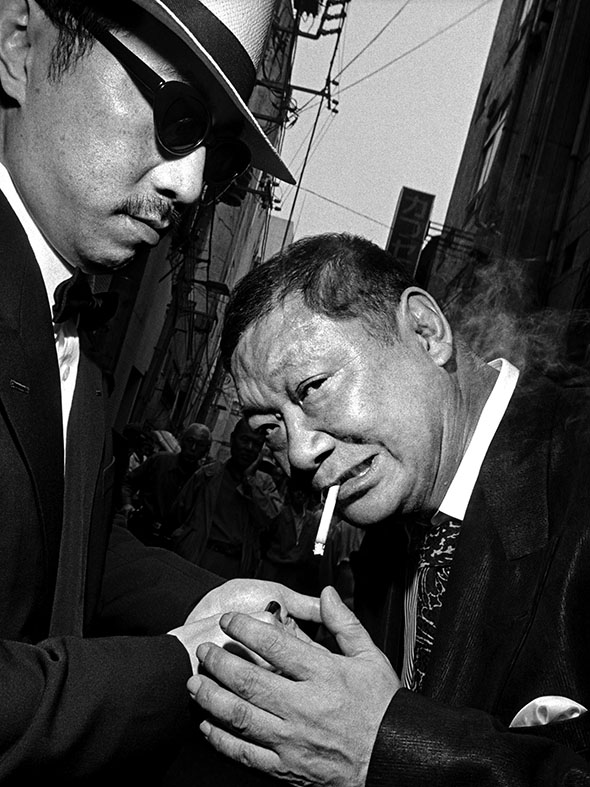
For most of us, meeting an American mobster would be both difficult and unpleasant. Difficult, because they prefer the shadows; unpleasant, because if you did meet one, it would probably not be by choice. Having seriously displeased them, you would be there to discover your fate. Compare this to Japan, where, contrary to their popular image as violent, tattooed thugs armed with samurai swords, yakuza have long striven to portray themselves as a legitimate and necessary force. Gang membership has never been a crime in Japan, and the headquarters of every major syndicate is publicly listed by prefectural police, along with the boss’s name and the number of men under him. Members can be seen coming and going from clearly marked HQs, wearing suits and sunglasses, getting on with their work – some of which, at least, is lawful. If a fight breaks out in public, it is regarded as a “mistake” (machigai), rather than something to brag about.
Far from being outlaws, these yakuza like to point to a long record of upholding parts of Japanese society: supporting businesses by brokering deals; gathering intelligence abroad for Japan’s armed forces and at home for the police; providing emergency response to natural disasters. After the devastating 1995 Kobe earthquake, the Yamaguchi-gumi crime syndicate – Japan’s largest – responded faster than the government. It provided food aid and mobilised trucks, boats and even a helicopter as part of its relief efforts.
At the same time, the word “outlaw” suits the yakuza rather well, for reasons both romantic and unsavoury. As Andrew Rankin tells us in the introduction to his entertaining new history, in common with gangsters elsewhere in the world, the yakuza regard themselves as “chivalrous organisations”, standing up for traditional values when contemporary society threatens to betray them. In the mid-2010s, the Yamaguchi-gumi even launched a website and theme song, advertising its mission to “banish drugs and purify the nation”. And yet many of its activities are beyond the law: drug and sex trafficking, racketeering, extortion, and the lending and laundering of money.
Excellent work on the yakuza already exists: David E Kaplan and Alec Dubro’s Yakuza: Japan’s Criminal Underworld (1986), Peter Hill’s The Japanese Mafia (2003) and various books by the journalist Jake Adelstein, drawing on his extensive police and underworld contacts. The great virtue of Rankin’s contribution is that he devotes serious attention to the pre-history of the yakuza, providing us with an epic 400 years of swashbuckling stories, populated by men with names such as Three-Worms Kanbei and Morishita the Viper. Rankin shows how the relationship between criminal gangs and society at large has evolved across that time, concluding that such groups have tended to flourish less because they are run by criminal masterminds and more because Japanese society has had need of them.

Rankin begins his account in the Tokugawa period (1600-1868), which many in Japan associate with peace and flourishing after decades of civil war. For some young men, however, peace proved dull or insufficiently remunerative. They became, if not fully fledged gangsters, the kind of people who would once in Britain have been issued with an Asbo: noisy, violent – and, in this case, armed with samurai swords.
Drawing mainly on Japanese scholarship and Tokugawa-era commentaries, Rankin shows how the dubious talents and proclivities of these samurai thugs were channelled into embryonic criminal organisations. Oaths were sworn to loyalty and brotherhood, sealed by drinking saké spiked with members’ blood. And yet for all the mystique of these oaths and ideals, the gangs were involved in little more than protection, extortion, street-fighting and the occasional murder.
An important thread in Rankin’s account is the ever changing relationship between Japanese gangsters and the authorities. In the Tokugawa period, the police were not up to the task of stamping out crime by themselves. This gap was filled by more gangsters. Townspeople in places like Edo – what is today known as Tokyo – formed defensive gangs every bit as violent as their upper-class samurai oppressors.
The early modern entertainment industry lapped it all up. Alongside nostalgia for the heroes of Japan’s civil war, kabuki playwrights and woodblock print artists mythologised men such as Banzuiin Chōbei (1622-57). The leader of a townsmen’s gang who was ambushed at a bathhouse by a rival organisation, murdered with spears and thrown into a river, he came to be celebrated as a defender of the common man against warrior-class entitlement and overreach. As a popular phrase from fictionalised versions of Chōbei’s life had it, he “vanquished the strong and helped the weak”. Many a yakuza later took it up as a personal motto.
Rankin gives readers just enough context to turn anecdotes about early modern mafiosi into what feels, at times, like an alternative social history of Japan. He welcomes us into 18th-century homes, where stock images of respectable men and women posing in kimono are replaced by desperate people crouched on tatami-mat floors, rolling dice or playing oicho-kabu. This was a card game in which a particularly unlucky player might find themselves with a hand consisting of eight, nine and three – in Japanese: ya-ku-za. Organised crime gangs later adopted the term to refer to themselves, borrowing too from elsewhere in early-modern Japan the use of fictive kinship ties to bind their group. Bosses came to be referred to as oyabun: literally “parent role”.
Gangs also drew from the Tokugawa era’s culture of firefighting. It attracted payment from the authorities for those who attended a fire, alongside free food and drink from local eateries. Gangsters began to infiltrate, fighting both fires and rival firemen, and adopting the latter’s practice of tattooing their skin with colourful images from folklore, from demons to fish.
Focusing on a particular location in each chapter, Rankin chooses the city of Kyoto to explore the decline of the Tokugawa shogunate and the rise of a modern nation state. He tracks, with relish and flair, the criminal opportunities thrown up by this momentous and chaotic transition, which played out across the second half of the 19th century. True to his emerging argument about the usefulness of gangsters to society – which could have done with being more explicitly developed throughout the book – Rankin finds yakuza operating closely with Japan’s modernising authorities. The latter cracked down on traditional gangster territory such as illegal gambling and prostitution – in response to which gangs began trafficking girls from poor families abroad to places like Singapore and Hong Kong. But they also offered gang members employment. Some were hired to intimidate political opponents, or encouraged to break strikes and protect “Japanese” values in the face of ideologies such as anarchism. In return, yakuza received lenient treatment at the hands of the police and courts whenever their illegal activities landed them in difficulty.
Rankin goes on to tell the story of how the yakuza helped to rebuild Japan after the Second World War. This was not, of course, a philanthropic exercise. Gangsters earned fortunes running black markets, supplying workers for postwar enterprises and looting supplies from army stockpiles built up in anticipation of a protracted defence against the Allies. Some supported the emergence of a new conservative politics, by intimidating socialists and communists, and funding right-leaning political parties. Rankin’s account doesn’t go into detail on the political activities of Japanese gangsters in places like China and Korea, perhaps because few of those men fit a strict, family-based definition of yakuza. We do, however, encounter the shady power-broker and businessman Yoshio Kodama, who made a fortune in China during the war and afterwards counted a host of senior politicians and executives as friends. Of the era’s alliance of conservatism, big business and gangsterism, Kodama once remarked that “loving our country and protecting it from leftists is the same as the yakuza defending their turf. The only difference is the scale.”
All the best mafia films feature a rise to riches, glamour and power, followed by devastating collapse – and Japan’s underworld does not disappoint. From the 1950s to the early 1970s, the country’s crime syndicates took shape – mirroring, Rankin wryly observes, the success of “upperworld” corporate behemoths. The two worlds interlocked. Alongside bankrolling conservative politicians, yakuza forged legitimate real estate and transport businesses while greasing the wheels of corporate Japan. Many a lucrative deal was saved after a hesitant participant received a persuasive visit from some burly men. Money-making inspired myth-making, courtesy of the 20th-century equivalent of kabuki plays: cinema. By the early 1970s, Rankin tells us, the Toei film studio was producing a new yakuza film every few months, many starring the legendary actor Ken Takakura.
And then, quite rapidly, that world began to fall apart. A civil war within the Yamaguchi-gumi led to too many “mistakes” – too much public violence. Foreign gangs became a headache, Chinese and Russians among them. It became clear that excitable foreign media coverage of the yakuza was harming Japan’s postwar reputation as a peaceable consensus society. Public opinion within Japan turned against the yakuza, and legislation from 1991 onwards enhanced the powers of the police to designate and investigate violent organised groups and to penalise members of the public who deal with them. Some had wanted an outright ban on gangs, but this was thought to infringe on people’s constitutional right to freedom of association.
A vicious cycle now appeared to set in. Some yakuza, angry at their dwindling privileges, numbers and reputation, lashed out with new levels of violence and a previously unheard of willingness to target the public with burglaries and scams. This in turn, argues Rankin, hardened attitudes against the yakuza further still. A watershed moment came in August 2021, when Satoru Nomura, leader of the infamous Kudō-kai gang, was found legally responsible for the violent actions of some of his underlings. He was sentenced to death by hanging.
Where will Japan’s “chivalrous organisations” go from here? Rankin’s account ends before the 2024 overturning of Nomura’s death sentence, a Yamaguchi-gumi pledge in 2025 to end their civil war, and the rise of tokuryū – new-style gangsters who connect on social media, lack the bonds of the old yakuza, and operate internationally. Tokuryū and yakuza memberships overlap, and it isn’t yet clear what all this might mean for the future of the latter.
But Rankin is surely right, at the end of his highly enjoyable account, to say that despite their falling numbers we ought not to count the yakuza out just yet. After 400 years of taking on tasks that respectable society shuns, and with “traditional values” still a live concern in Japan, they may yet discover a fresh opportunity or two.
Yakuza: A 400-Year History of the Japanese Underworld
Andrew Rankin
Elliott & Thompson Limited, 386pp, £25
Purchasing a book may earn the NS a commission from Bookshop.org, who support independent bookshops
[Further reading: The agony of Sebastian Faulks]
Content from our partners



Related


This article appears in the 24 Sep 2026 issue of the New Statesman, A Sense of Power
Join the debate
Subscribe here to commentHow would you wield a samurai? Especially if he were in full armour?
I sympathise with the author who did not, I know, write the headline.