
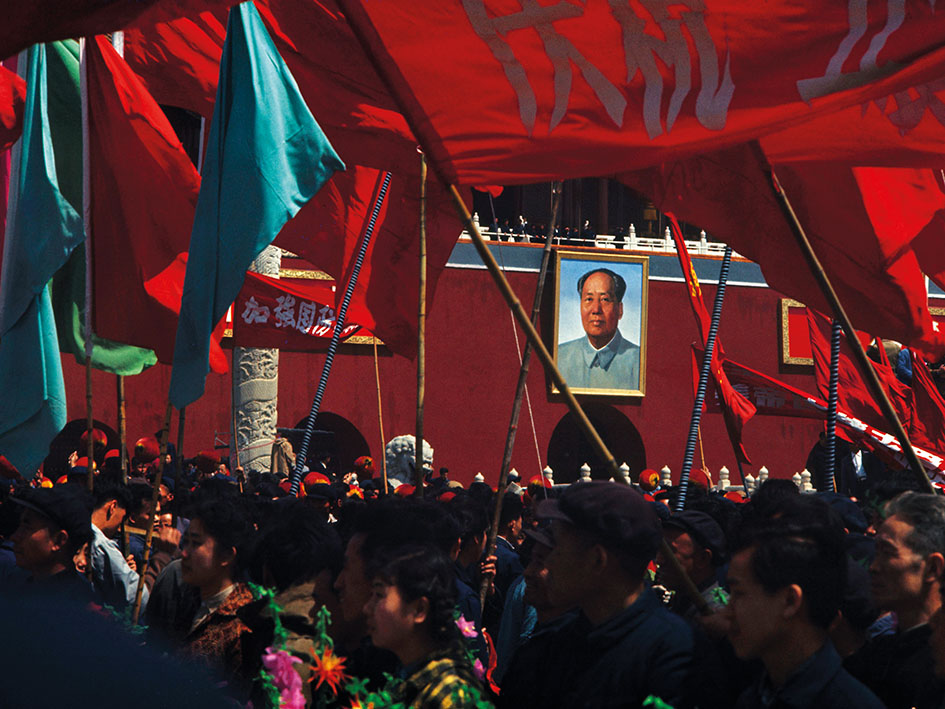
Capitalism is broken, “spiralling towards authoritarianism, penury and war”, and liberal democracy is “imploding”. So where are we to turn if we want to find something better – for example, “a humane, democratic and sustainable path towards the human freedom Marx imagined”? If you answer “communism”, Paul Mason wants to tell you you’re wrong. Basically, because of Stalin’s and Mao’s authoritarianism and willingness to accept mass killing. That’s why he has written his global history of communism, starting with Marx and the utopian socialists and ending with present-day China.
More than 500 pages might seem a lot to give a non-starter for the solution of the contemporary world’s most urgent problems, which Mason identifies as human rights, the rule of law, the nuclear threat and climate change. It might also seem surprising that Mason feels it necessary to hammer home his indictment of Stalin and Mao, however justified, given the existence of a huge Cold War literature making the same points. But he has his reasons. First, he is writing for the left, and the British left at that, which was never fully part of the American-led Cold War consensus. (Rather surprisingly for a historian of communism in the 20th century, he seems uninterested in American anti-communism and rarely mentions the Cold War.) Second, the history of communism matters to him personally; even in his indictment there are recurrent notes of regret that it didn’t turn out better.
Éric Weil’s dictum that “the history we write is always at bottom our own intellectual and political autobiography” is one of the book’s epigraphs, and it applies. “It’s fair to say I was a lefty activist,” Mason said grudgingly in a 2011 interview, adding that his politics now were “very complicated”. He’s a bit conflicted about identifying as a Marxist, too, although on my reading he obviously is one – not slavish or doctrinaire, but someone for whom class and exploitation are basic analytical categories, economic structures matter, capitalism is the enemy and the working class is viewed with hope.
Mason’s book is about communist regimes and movements rather than Marxist ideology – although there’s some of that, too. And he understands communism not as a static essence but as something that evolved over time. (“Chronology is your friend,” he admonishes the reader, a sentiment that I wholly endorse, even if he seems to expect academic historians like me to disagree.) Given that premise, it’s reasonable for him not to get hung up on definitions, but basically he defines his subject as regimes and movements that self-identified as communist, cared about a relationship with “the masses” and believed in central state planning as a way of producing social and cultural transformation. Capitalism is communism’s antithesis. Drawing up a balance sheet, he concludes that capitalist regimes, though probably morally and intellectually inferior, have out-performed communist ones.

On the Soviet Union, Mason is not one of those on the left who contrast a “good” Lenin with a “bad” Stalin. He sees the emergence of Leninism as a pivotal point, when “the word ‘communism’ loses its association with utopian designs and begins to signify a ruthlessly enacted project of state power”. Stalin, of course, was worse. In addition to the violence of collectivisation and the mass murders of the Terror, his slogan of “socialism in one country” was just bad Marxism; the violent collectivisation of agriculture he introduced served no useful purpose, and the famine that followed – the Holodomor – constituted, as Ukrainian nationalists and (uncited) right-wing commentators such as Robert Conquest and Anne Applebaum claim, an intentional genocide of Ukrainians. The massacres of the Great Terror are condemned, albeit briefly, but it’s the Nazi-Soviet Non-Aggression Pact of 1939 (which won the Soviet Union a bit of time at the expense of the Baltics and western Ukraine) that gets the most passionate denunciation as “the ultimate betrayal”, one of “the most criminal acts of the 20th century”.
Khrushchev’s reform efforts in the mid-1950s are given short shrift. In general, Mason has none of the wistful regard felt by some on the left for anti-Stalinist leaders such as Bukharin, Dubček and Gorbachev who tried to give communism “a human face”: he tips his hat only for the revolutionary left’s “beautiful troublemakers… like Dimitrieff, Kollontai, Gramsci, Bogdanov, Chen Duxiu and Mariátegui”, who never had power to wield in the first place.
By Brezhnev’s time, the whole communist project in the Soviet Union had lost steam, and its version of central economic planning was no longer fit for purpose. Mason – who spent some time in Russia in the early 1990s – is hard-headed about perestroika: Gorbachev gets no marks for democratic intentions, and fails in economics because the conservatism of the Soviet economic bureaucracy prevented him from doing the obvious, which was to emulate Deng Xiaoping’s reforms in China. The pro-Ukraine theme introduced with Holodomor is picked up again in the description of the Soviet Union’s final collapse: on 25 December 1991 “the flag of the USSR passed into history, with the Russian tricolour replacing it on the Kremlin, and the blue-gold flag of Ukraine flying, for the first time since 1918, over a sovereign Rada”.
With regards to China, Mao is presented as more of a realist than Stalin and, at least initially, more in touch with the masses. His focus on peasants (rather than workers) and general “Sinification” of Marxism seems to be good, not to mention his call for the Chinese people to stand tall and recover their past “civilisational greatness”, which, “from the vantage point of the present”, turns out to be “the most consequential act in the history of communism”. Still, Mao was explicitly indifferent to the prospect of mass death, and he bequeathed a legacy of brutal authoritarianism to his successors. China’s recent rise was “achieved under a system and a ruling party calling themselves communist. But the method used was capitalism.” While “Chinese totalitarian capitalism” may “outlast the democratic order in the West”, this will not be a victory for Marx.
Why, then, does Mason end his story with China? Here, as with most books that have a message to deliver, it’s crucial to understand whom he is arguing against. In this case, that includes left-wingers who “think China’s system is better” than the West’s, and are not interested in hearing about mass murders and abuses by communist regimes. There are other opponents hovering on the edge of this field of vision: for example, “pro-Putin influencers operating throughout the West” whose aim is “diminishing the Holodomor, and denying its ethno-nationalist motivation”; and leftists “aligned with the PRC and Putin’s Russia [who] have begun to whitewash the Stalinist record in ways even dedicated communists did not during the Cold War”, notably the Italian Marxist political philosopher Domenico Losurdo. Not to mention “a younger generation that has absorbed the whole simplistic package of neo-Leninism”, whose powerful allies include “the disinformation machine of Putin’s Russia” and “the CPC’s ‘United Front Work Department’”. Well, you know who you are, even if I don’t.
It was an odd experience for me, a survivor of the passionate fights about “revisionism” in Western Sovietology during the Cold War, to read the Soviet story that is at the core of Mason’s book. He perhaps has some peripheral knowledge of those Sovietological polemics, but they are as irrelevant to his frame of reference as Losurdo is to mine. On the whole, I found this a plus. Mason’s take is interesting and sometimes unpredictable: he is not a Losurdo putting a case for the defence who never lets qualification or nuance interfere with advocacy. Mason may be making the opposite case, but he doesn’t make it like a prosecutor. He’s interested in understanding the evidence, and if there’s an exception or complication to his preferred generalisation, he often points it out. Of course, there’s a touch of parochialism in his agenda of discomforting Stalin-lovers, Putin-understanders and China-admirers on the British left. But how refreshing, not to say remarkable in a long book whose counter-subject is capitalism, to have the US, and even its current publicity-loving president, almost entirely ignored.
Sheila Fitzpatrick’s books include The Shortest History of the Soviet Union (Old Street Publishing)
Reds: A Global History of Communism
Paul Mason
Apollo, 592pp, £30
Purchasing a book may earn the NS a commission from Bookshop.org, who support independent bookshops
[Further reading: Is Reform waving or drowning?]
Content from our partners



Related

This article appears in the 10 Sep 2026 issue of the New Statesman, The World According To Ed
Join the debate
Subscribe here to commentI’m on p.102 and so far the book strikes me as a useful summary of early socialist ideas for liberal undergraduates unfamiliar with the territory, although nothing that hasn’t been done better by others. But I remember Paul as a leading member of the Trotskyist group Workers’ Power, the British section of the League for a Revolutionary Communist International. He was, as we used to say, a ‘serious comrade’. Is he honest about his political evolution, or is this just the latest addition to the ‘wistful memoirs of a former leftist’ genre? I’ll find out as read on, I guess.