
Early in Valeria Luiselli’s new novel, Beginning Middle End, we learn that the narrator, Ella Camposanto, a recently divorced writer, is going through a fallow phase in-between novels. “I was looking to find a way into a new form of motherhood,” she writes, “and maybe even a way back into writing.” She takes her 12-year-old daughter Manuela out of school one spring and sets out on a shapeless sojourn around Europe: “We would move and move again, light suitcases, loose schedules, until things fell back into place.” They end up in Catania in Sicily, in an apartment that belongs to a pianist with whom Ella had a “feverish encounter” in New York some time back. Nearly a century ago, Ella’s grandmother was born in a town 100 miles away from Catania. The port from which she, at 22, had sailed away to Mexico is a short walk from the pianist’s apartment.
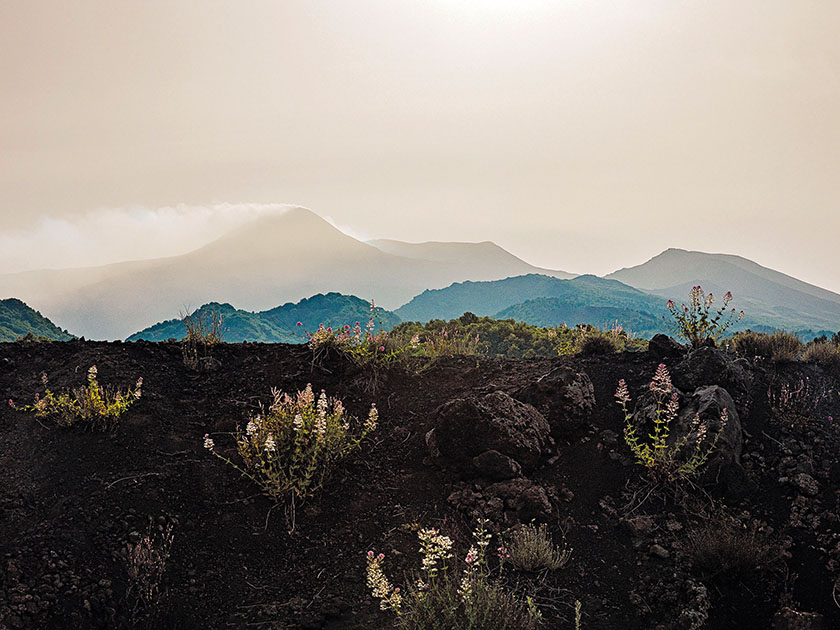
The novel hits the ground running as an Odyssean pursuit of roots and a search for home. The pianist is away on a month-long tour when Ella and her daughter arrive, and in his absence, Ella reads aloud to her daughter from the Loeb classics editions of ancient Greek and Latin texts in his library. Manuela is soon absorbed in this version of literary homeschooling: like her mother, she too learns to see the canon as a return to first principles, “a beginning”. Reading Virgil’s Aeneid, she can relate to a passage that describes the coast near Catania and the neighbouring presence of Mount Etna, the volcano which “thunders with terrifying crashes, and now hurls forth to the sky a black cloud…”. On a drive to the beach, she can stare out at the rock formations known as the Cyclopean Isles, where Odysseus is said to have battled the Cyclops Polyphemus in the Odyssey.
And then there is Proteus, whose image decorates a small mosaic tile that Ella carries in her luggage. Her grandmother had stolen the tile while working on an archaeological dig decades ago. Manuela asks her mother if they can make a trip to the ruins and return the mosaic. Ella, who is more preoccupied by the prospect of her mother in Mexico succumbing to dementia, initially ignores her daughter’s pleas, but when the pianist returns from his tour and drunkenly assaults her, mother and daughter pack up the Loeb books in a suitcase and run away. The quest to return the Proteus mosaic also imparts to the novel a protean shape: you could describe the book at once as autofiction, a road novel, a spirited defence of the classics in our Anthropocene age, and even a fantastical teen adventure story.
Ella worries that her daughter might grow up believing that the characters and scenes in her novels are real: “I am afraid of both the loss of memory in my mother and the fabrication of memories in my daughter.” But Manuela, too, is writing a novel of sorts. “Not everything that I also write is not-fiction,” she tells her mother once. She buys a Polaroid camera and clicks photos throughout the trip. She scribbles down notes on unsent postcards addressed to her grandmother.

Much like Luiselli’s 2019 novel Lost Children Archive, which also features a child narrator in one section and ends with a stack of Polaroid photos, the book sags when the adults are relating the story. Ella ruminates a tad too often on the etymology of names. (Does she really need to wonder if “fiction” shares the same root as the verb “to finger”?) It’s funny the first time she refers to the automated voice on Google Maps as “the lady who knows where we are going”, less so the 15th. You wish she’d just reflect on the unreliability of memory, or the role of local tombaroli – illegal grave robbers – in archaeological excavations in Sicily, instead of waiting for Manuela to ask her leading questions such as “What do you mean, Ma?”.
And yet the scenes between mother and daughter are unmistakably tender. In passages in which they are reading together in bed, or figuring out directions in the middle of an empty road, you realise that the charm of these mundane moments is in their evanescence. Manuela will soon grow up and start living on her own, much like Ella, who now lives far apart from her own mother. Reading Virgilone night, Ella empathises with the plight of Aeneas, who leaves a battle-ransacked Troy with his son and his old father. She realises that her own predicament is, in many ways, the same: “Mother on my shoulders, daughter by my side – how do I get us to where we all need to be?”
Beginning Middle End
Valeria Luiselli
4th Estate, 368pp, £18.99
Purchasing a book may earn the NS a commission from Bookshop.org, who support independent bookshops
[Further reading: Why the triple lock is here to stay]
Content from our partners



Related
This article appears in the 10 Sep 2026 issue of the New Statesman, The World According To Ed
Join the debate
Subscribe here to comment