
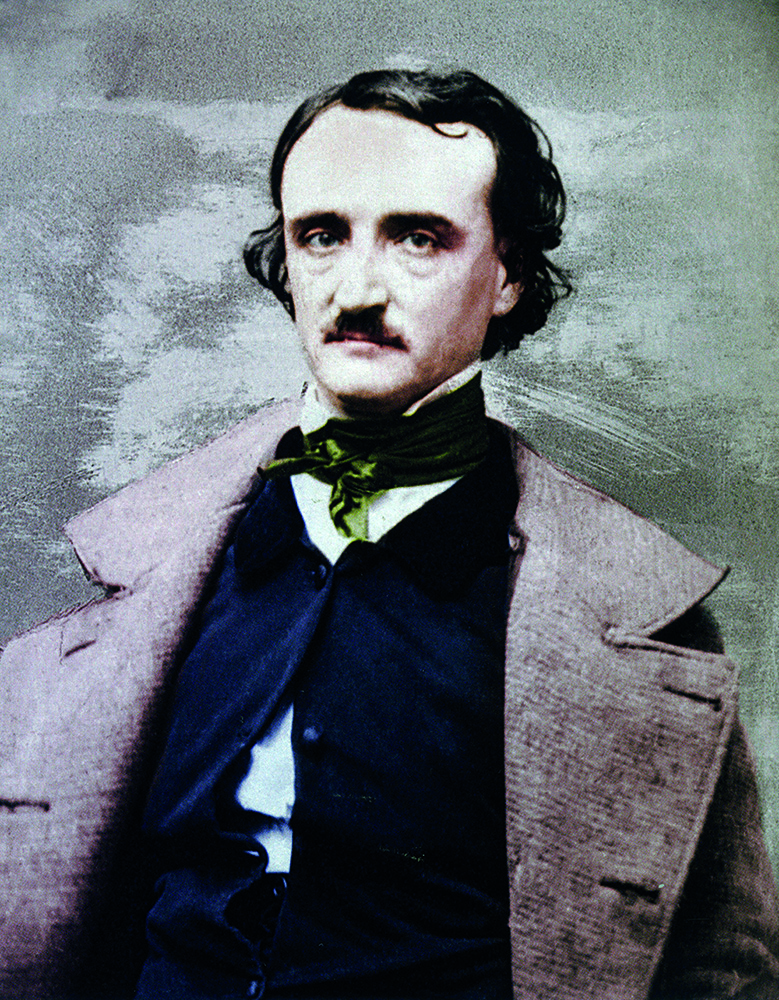
One summer day in 1849, Edgar Allan Poe arrived on the Philadelphia doorstep of a friend and former colleague named John Sartain. The 40-year-old author, who would be dead within the year, was in awful shape. As he explained to his host, he had been travelling south by train to Richmond, Virginia, when he overheard a sinister group of men plotting to kill him. To evade them, he disembarked, made his way to Philadelphia, spent several days on a drunken bender and was briefly deposited in prison. Sartain was glad to offer him shelter. Yet he was frightened by his guest’s hallucinatory chatter, along with his suicidal impulses: first Poe asked to borrow a straight razor, then he seemed intent on jumping from a high platform the two men visited later that night.
Emily Ogden has chosen this incident to open Darkness Becomes Bright. In fact, it forms the spine of her book, a mini-narrative to which she returns again and again. For Ogden, this miserable episode functions as a lodestone. It encapsulates both Poe’s dogged pursuit of dangerous emotions – terror, shame, guilt – and his ability to enlist his audience as fellow travellers. “On the edge of the abyss,” she writes, “Sartain kept vigil. He stood between Poe and precipices both literal and figurative, hoping that his friend could right himself.”
Viewing an entire life through the prism of a late-in-the-game nervous breakdown, which is essentially what Poe was going through, is not a conventional move for a biographer. Then again, Ogden’s book is anything but conventional. It is, for starters, a highly selective account of Poe’s existence, skimping on the sort of detail that curious readers can find in such standard accounts as Kenneth Silverman’s Edgar A Poe (1991). It also foregrounds the author, who is no narrative wallflower but a vivid persona, in active dialogue with her subject. To emphasise that connection, she includes episodes from her own life, several of them tinged with a Grand Guignol atmosphere that makes them Poe-adjacent at the very least.
What Ogden means to do, then, is to explore the bond between writer and reader, that strange intimacy that can bridge continents and centuries, dissolving all customary boundaries. She also extends this project to Poe’s literary inheritors – “to those of us who, like Sartain, have let him be our guide into the darkness. Much of the time, the dark side is the last place we want to look.”

That sentence is Ogden’s critical stance in a nutshell. What Poe does, in her argument, is to turn his face to the worst human impulses, and force his readers to turn theirs, too. In the pre-Freudian climate of Poe’s America, this was not as common as you may think. Of course the Puritan habit of self-examination, with its inevitable picking of sinful nits, had not died off completely. Evangelical Christians, too, might loudly declaim their faults, but doing so was a way station and stepping stone to grace. In either case, the scarier aspects of human nature were still being viewed in religious terms. Nathaniel Hawthorne, a contemporary of Poe’s and a fellow investigator of ripe and rotten humanity, had begun to write about evil as a psychological fact. Yet the rhetoric of Puritanism still came naturally to him, while Poe dived straight into the abyss without any theological water-wings to keep him afloat.
Poe claimed to be in rigid control of the effects in his poetry and fiction. Ogden quotes a letter he wrote to his friend and editor TW White, in which he brags about his ability to dial up literary qualities until they morphed into steroidal versions of themselves. His specialties, he said, were “the ludicrous heightened into the grotesque: the fearful coloured into the horrible: the witty exaggerated into the burlesque: the singular wrought out into the strange and mystical”. As a brand statement, this seems pretty good. Yet it minimises Poe’s debt to his unconscious, and the way in which his work embodied his deepest anxieties. Indeed, some of his uncanniest moments as a writer – the rattling box of teeth in “Berenice,” or the enormous, snow-white apparition at the end of The Narrative of Arthur Gordon Pym – seem to indicate that even the author, often a shameless wire-puller of gothic stage effects, has been left in the dark.
There is no question that Poe’s life was shot through with considerable woe from his earliest years. His parents, David and Eliza Poe, were actors. His father abandoned the family in 1810, less than a year after Edgar’s birth, and his mother died a year later. Young Edgar was adopted by a prosperous Richmond family, whose patriarch, John Allan, eventually washed his hands of his scapegrace charge. The sense of being abandoned – not merely as a legal condition but an existential one – shadowed Poe’s life forever.
So did death itself, even before his wife, Virginia, perished of tuberculosis in 1847, at the age of 25. Consumptives, of course, were the walking dead in Poe’s day, with no cure for the disease in sight. This dutiful husband knew what awaited his bride – he could not pretend otherwise. Ogden shrewdly points out that Poe’s tales of death and decay and burial “pry open a gap in our wall of denial. He can help us to remember, for the duration of the story, that we really will cease to be.” You could also say that death and life were simply inseparable in Poe’s imagination, mirror images of a kind. Hence his formulation in “Loss of Breath”, a lighter tale whose narrator declares himself “alive with the qualifications of the dead – dead with the propensities of the living”. With striking frequency, Poe wonders whether the many cadavers in his stories might not be alive after all.
But that is just the point. For Ogden, Poe isn’t remotely dead. She suggests that by attending to the words and acts of the departed with scrupulous intensity, we can reanimate these ghostly presences. “I feel that in listening to him, in evoking him, I am coming when called,” she insists. “I am correcting the record. He did not die. He lives.” Ogden condemns her own statement as magical thinking, but there is no doubt that she means it.
Nor is she the only one so enthralled by Poe’s afterlife. A substantial portion of her book consists of what we might call case studies of Charles Baudelaire, Marie Bonaparte and Julio Cortázar. Each of these writers (Bonaparte was a psychoanalyst with a literary bent) went far beyond the boundaries of traditional fandom. Baudelaire, 12 years younger than Poe and a poète maudit whose taste for squalor and decay matched that of his idol, spent years translating his work into French. He adored Poe’s strict sequestering of art from morality, and the lugubrious music of his prose. Yet his devotion was driven by a much deeper feeling of identification. “Do you know why I’ve translated Poe so patiently?” he wrote in a letter to the critic Theophile Thoré. “Because he was like me.” (For that matter, in a final entry in his intimate journal, the dying poet addressed a prayer to God, his father, his long-departed nanny – and to Poe! )
Bonaparte made crucial use of Poe’s work during her lengthy analysis with Sigmund Freud. She would read a tale in the evening, then discuss it with Freud the next day, almost as if Poe’s fictional dream life were a proxy for her own. There was a therapeutic triangulation going on here, which Bonaparte described as “analysis by induction (as in electric currents) from Poe to me”. It seems that the treatment did work, breaking up the crust of Bonaparte’s emotional frigidity. Freud, who had to be pleased by this outcome, was nonetheless puzzled by his patient’s literary taste. “Don’t you think Hawthorne is refreshing,” he asked her, “compared to such a psychopath?”
Cortázar, too, opted for the psychopath. As a child in Argentina, he devoured Poe’s stories in English, which made him physically ill for three months afterwards. In 1953, as a young man, he followed Baudelaire’s lead and translated those very tales into Spanish – using as a reference work the massive psychoanalytic study of Poe that Bonaparte had published 20 years earlier. One of the things that fascinated Cortázar about Poe’s work was the eruption of the fantastic into the mundane. This flowed in turn from a sense of the writer as a vessel for another world, another consciousness. Both he and Poe, writes Ogden, “could suddenly be taken over by a story without warning, and then nothing – neither wife, nor friends, nor the need to eat, nor the sounds of the outside world – could interrupt the battle with the creature until it was done.”
In a sense, this notion of communal consciousness echoes the transcendentalism so popular in Poe’s day. Poe himself had little use for what he regarded as a game of spiritual footsie, and denounced the “quips, quirks, and curt oracularities” of the Concord clique along with its leader, Ralph Waldo Emerson (Emerson returned the favour when he was shown a copy of “The Raven”, declaring: “I see nothing in it.”) But perhaps the notion of a universal mind, which Poe further elaborated in his cosmological manifesto Eureka, was a necessary salve for a human being so terribly alone in the world.
Ogden, we see, is a vessel for Poe. He inhabits her just as he inhabited Baudelaire and Bonaparte and Cortázar. That is the modus operandi of this unusual and adventurous book. There are moments, it should be said, when this communion between Ogden and Poe doesn’t quite gel, or when Ogden’s imaginative projection seems to violate the rules of engagement with her own readers. In the very first paragraph of Darkness Becomes Bright, she describes her subject’s sensory overload: “Sartain, an engraver, was working inside; Poe could hear the burr scratching the metal plate, loud as a glacier forming the continent. A flea’s proboscis pierced a mouse’s ear inside the wall – pop!” These are wonderfully vivid details, to be sure, but only in the book’s back matter does Ogden confirm that she made them up.
She also seems to take at face value Poe’s narrative of being menaced by whispering murderers on the train to Virginia. Of course he was able to hear them! “In times of duress,” she explains, “Poe’s senses did not desert him. His perception did not become lurid or unreliable – no, it got sharper.” Yet Poe was a disturbed man when he began the trip, confiding to his aunt that it might be his last, that he “might be called suddenly from the world”. By the time he knocked on Sartain’s door, he was afflicted with what he called a “congestion of the brain”, no doubt heightened by binge-drinking and its terrifying sequel, the DTs (delirium tremens, or severe alcohol withdrawal). Lurid is probably the best way to describe his perceptions at the time, and the chances that the assassins were real seem nil.
I’m not suggesting that Ogden is deceptive or sloppy. On the contrary, she is an intrepid, often eloquent writer, who would rather make difficulties for herself than dodge them. (As she has written elsewhere: “It may be better to say the things that are indefensible, than to cast around for a defensible thing to say.”) No, I’m merely suggesting the pitfalls that can occur when a biographical writer, already performing a trapeze act of a kind and perilously suspended between two lives, leaps a little too brashly into the consciousness of the subject. The biggest risks are presumption, kitsch, and bathos. Ogden, in her airborne mode, manages to avoid most of these traps. And for all of her book’s occasional flaws, when are we likely to encounter another so tender in its assessment of Poe’s rocky life and the lava-lamp iridescence of his art? My guess would be: nevermore!
James Marcus is the author of Glad to the Brink of Fear: A Portrait of Ralph Waldo Emerson (Princeton University Press)
Darkness Becomes Bright: The Haunted Life (and Afterlife) of Edgar Allan Poe
Emily Ogden
Picador, 240pp, £14.99
Purchasing a book may earn the NS a commission from Bookshop.org, who support independent bookshops
[Further reading: The Goldsmiths Prize 2026 shortlist announced]
Content from our partners



Related
This article appears in the 01 Oct 2026 issue of the New Statesman, Sunshine and Rain
Join the debate
Subscribe here to comment