
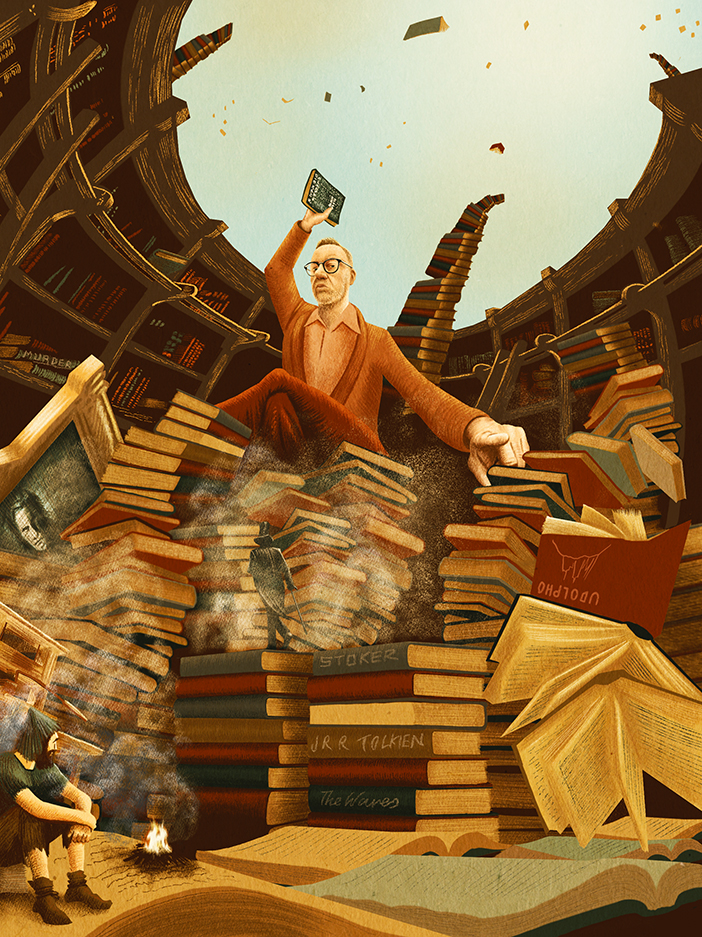
In these screen-scrolling times of ours, everyone is loudly proclaiming the benefits of reading. But what about the benefits of reading novels? Are novels more beneficial for you than other kinds of book? Is the intelligent man (it is invariably a man) who enjoys biography and history but never touches fiction really missing something vital? Do novels uniquely expand our sympathies or our imaginations? After almost 600 pages of his capacious A History of the Novel in Britain, Philip Hensher cannot resist hypothesising that, yes, novel reading really does make us better people. Reading about the murder of a teenager living near him in London who had himself been charged with carrying a machete, Hensher says, “I doubt that anyone in this story was a habitual reader of novels.” “If you had read more than one novel, with attention,” he supposes, you could not fatally hack or stab another human being; you would be too busy imagining what it would be like to be that other person.
George Eliot and Henry James would have concurred, but it is an unprovable theorem. Beyond his frequently announced pleasure in reading (most) fiction, Hensher understandably needs such a faith in the humanising power of novels to sustain him through this large history. He cannot pause to wonder if there have been psychopaths who enjoyed Eliot, or gangsters who relished Thomas Hardy. After all, the novel is the cultural form that lets you understand how another person thinks. When Daniel Defoe’s Robinson Crusoe – Hensher’s starting point – was published in 1719, neither author nor readers knew that it was a “novel”, as such a thing did not yet exist – yet this story of “strange, surprising adventures” (as the title page had it) already did what novels have done since: it involved the reader in the motives and desires of a particular individual.
Hensher treats Defoe as the first British novelist, rightly thinking that arguments on behalf of various proto-novels published before Robinson Crusoe are for the seminar room only. Defoe’s novels are “radically new”, because they show how individuals can transform themselves and their circumstances through “desire and will”. Novels let characters make both themselves and their destinies. Defoe’s fiction is also original because it is “realistic” in one particular way: it is full of circumstantial, factual detail. “The novel,” Hensher observes, “was created by the incorporation of documentary literary techniques.” Centuries later, the factuality of modish autofiction practises just what Defoe’s novels originally taught.
Hensher’s is a stunningly ambitious undertaking. I do not know of another single-author book that attempts such a sweep of literary history. No academic critic would dare. From the early 18th century, he takes us chronologically, in just seven mega-chapters, all the way to the end of the 20th century. He has decided to stop at 2000, believing that level-headed judgements about more recent fiction, “merrily buffeted by the whims and crazes and momentary excitements of its readers”, is impossible. The most important thing is that he has read a huge number of novels. More than 1,000 are listed in his bibliography. The project must have dominated his life for years.

What makes Hensher’s narrative a history rather than just a sequence of literary descriptions is his attention to the changing ways in which novels were printed, marketed and circulated. He is excellent on book history: on the importance of circulating libraries, or the cheap editions that took British fiction around the world, or the influence of magazine serialisation on forms of fiction in the late 19th century. Uninitiated readers will discover the strangling influence of Charles Mudie, whose vast private-lending library dominated the market in the Victorian era. Mudie required that novels be published in three volumes (the “triple-decker”) so that one volume could be lent at a time. Novelists had to fit their stories to this shape. He was also a censor, refusing to market novels (by George Gissing or George Meredith, say) that were not “moral”.
A novelist himself, Hensher knows that maximising earnings has always been the novelist’s preoccupation and he bothers with details about authors’ payments. So, for instance, we see George Henry Lewes’s negotiations on behalf of George Eliot, who was, of course, his life partner. Eliot was one of the first novelists to get a royalty, though Hensher points out that the arrangement was so unprecedented that “a term had not yet been settled on”. Her publisher, Blackwood, called it a “lordship”. (The OED records the first use of “royalty” for such a payment in 1856.)
All this is inevitably dependent on the labours of previous historians and biographers. What is original is Hensher’s advocacy of now neglected or entirely forgotten novels. He champions, for instance, the comic sporting fiction of the early Victorian RS Surtees. “Through hunting, Surtees examines… the tumultuous Victorian possibilities of social mobility.” He is “astonished” (but secretly gleeful) to note that Surtees is not even mentioned in the Oxford History of the Novel in English. He likes Thackeray’s Vanity Fair, but praises even more the same author’s “unforgettable” The Newcomes. He delights in the “mannered, even sometimes obscure prose style” of Meredith, “certainly among the most revolutionary of English novelists”. He vaunts (some of) the novels of Margaret Oliphant. He champions Arnold Bennett in a major way, suggesting that he is “more psychologically perceptive” than Virginia Woolf, who notoriously took his fiction to exemplify the worst novelistic habits of her age.
Hensher also likes to revalue novelists sidelined by those he thinks literary snobs. George Moore’s Esther Waters is hardly unknown, but here it is celebrated as “a work of genius”. Meanwhile, there are more entries for Anthony Trollope in the bibliography than for any other novelist. It is Trollope’s triumph that “his reputation is not artificially sustained by academic study, but by the interest of ordinary readers”. “He was John Major’s favourite novelist. A lot of academics can’t stand him.” If academics can’t stand him, he certainly must be wonderful. Yet the case that Hensher makes for Trollope is itself rather academic. He highlights the novelist’s formal ingenuity: a single day narrated four times from different point of view in Orley Farm; the audacious use of flashback in The Last Chronicle of Barset.
Hensher is often strong like this on formal developments. He shows that some of the “wildest experiments” that the novel ever conducted (in Clarissa as well as Tristram Shandy) were “near the beginning of its history”. He finds the origins of the “novel of unreliable narrators” in William Godwin’s Things as They Are (1794). He gives Jane Austen her proper credit for the revolutionary development of free indirect style, and sees where it leads (Henry James). He shows us the “startling experimental handling” of “sequential ordering” in early Muriel Spark.
Oddly, the examination of formal technique leads to a major telling off for George Eliot, who, with her faith in the humanising powers of fiction, you might expect to be his lodestar. She apparently makes a big “mistake” in Middlemarch by venturing into Casaubon’s consciousness, and mishandles switches of point of view throughout her novels. You might say this opinion is “contrarian”. Many of his readers, like me, will go on thinking that the moment when we are jolted into possible sympathy with Casaubon (“Dorothea – but why always Dorothea? Was her point of view the only possible one with regard to this marriage”) is one of the great coups of Victorian fiction.
Still, when Hensher argues for his judgements, the reader can consider without having to agree. A couple of paragraphs on why he “detests” Virginia Woolf’s The Waves are provocative but also thought-provoking. Rather often, however, we get a take-it-or-leave-it mode of literary assessment. Dickens is “the greatest writer in the English language”. Bleak House is “the greatest novel in the English language”. GK Chesterton’s The Man Who Was Thursday is “a great masterpiece”. Kingsley Amis’s Girl, 20 is “a masterpiece”. Many books (by Elizabeth Inchbald, Ivy Compton-Burnett or Nevil Shute) are “magnificent”. Some terms of approbation are all his own. Thomas Love Peacock’s Gryll Grange is “an adorable novel”; Elizabeth Gaskell’s Cranford “is certainly one of the most adorable of English novels”; Benjamin Farjeon’s Joshua Marvel is “rather adorable”.
Less frequent are the negative judgements, but these are too often without justification. Ann Radcliffe is “a simply terrible writer” and her Mysteries of Udolpho is “awful rubbish”. Wuthering Heights is “a novel of fairly blundering technique” (I think this is provably untrue). All Gissing’s fiction is distinguished by “mechanical monotony”. The Picture of Dorian Gray is “a work of lamentable feebleness”. Colin MacInnes is “a terrible novelist”. John Mortimer’s Paradise Postponed is “idiotic”. Bad luck if you have felt differently about any of these.
When he gets to his last chapter, surveying fiction from 1960 to 2000, the number of novels published is ever increasing and Hensher understandably finds it hard to provide much of a narrative. He puts the novelists into groups (working-class authors, “new arrivals” from the empire, experimental novelists, novelists of “violence and excess”) and captures their works in rapid precis. With so many books to cover, he simply runs out of space for quotation, let alone much literary analysis. It also becomes harder for him to find novelists who have been unfairly forgotten (his best effort is a lengthy section celebrating the oeuvre of Kingsley Amis).
Hensher has written a generous and appreciative literary history, where his own pleasure in fiction is always evident. He himself scorns “those guardians of the novel who distrust pleasure”. This presumably includes academics, who are given short shrift throughout the book (never mind that his sources for the publishing history of novels are books by academics). As we get near the present day, Hensher declares that fiction needs rescuing from “the gatekeepers” or “self-appointed patrons of the novel” (reviewers? Judges of literary prizes?), who value books for their socio-political content. Paradoxically, these same “gatekeepers” apparently also over-value historical fiction, of which he has a decidedly low opinion.
Yet some of his strongest feelings about novels will be shared by some of the left-liberal cultural arbiters whom he disdains. He believes in “the novel’s innate tendency to subversion” – to puncture pieties and question certainties. So it has been the most egalitarian of cultural forms. Near his conclusion, he notices how many out-of-print novels he has purchased from Abebooks have been deaccessioned copies from public libraries. He eloquently laments “mass deaccession, and the consequent collapse in the number of users of the vast, once treasure-filled network of public libraries”. The novel is, or can be, for everyone.
John Mullan is a professor of English literature at University College London
A History of the Novel in Britain
Philip Hensher
Pelican, 704pp, £25
Purchasing a book may earn the NS a commission from Bookshop.org, who support independent bookshops
[Further reading: The anomalous delight of More Or Less]
Content from our partners



Related

This article appears in the 10 Sep 2026 issue of the New Statesman, The World According To Ed
Join the debate
Subscribe here to comment