
The insult was architectural: one cell, three bodies, a shelf for each man, a bucket, cold seeping through masonry. On 2 March 1949, in Warsaw’s Mokotów Prison, Kazimierz Moczarski – a former officer of the Polish Home Army falsely charged as a collaborator by the communist regime – was pushed into a room with two Germans. One was Gustav Schielke, an ex-policeman and Nazi functionary. The other was SS-Gruppenführer Jürgen Stroop, liquidator of the Warsaw Ghetto.
“My shock at finding myself with Nazis,” Moczarski writes, “quickly transformed into a resolution: if I am now with war criminals, then let me get to know them, try to break down the threads of their life stories and personalities.” If he succeeded, he might have an answer to his question: what “historical, psychological, sociological mechanism” had led some Germans to join “a gang of mass murderers who governed the Reich”?
For 255 days, Moczarski listened. The verb is too pallid for the feat. He probed, needled, circled back, and challenged Stroop’s self-account. The result is Conversations with an Executioner, a censored version published in Poland in 1977 and now expertly translated by Sean Gasper Bye in the first full English edition.
Born in Warsaw in 1907, the son of teachers, Moczarski trained in law and journalism, and worked on labour protections at the Ministry of Social Welfare. He belonged to the democratic, secular left, with a lawyer’s respect for institutions and a distrust of revolutionary fervour. During the German occupation, this disposition found its clandestine form. In the Directorate of Underground Resistance he tracked collaborators and informers. He saw it as a means to protect persecuted citizens, including Jews, from predation by neighbours.

By spring 1945, Moczarski believed that resistance against the new Soviet-backed order was doomed, yet he remained out of loyalty. His reward was 11 years in prison. Arrested in August 1945, he was caught in the communist fiction that the Home Army had been quasi-fascist rather than anti-Nazi. He spent 14 months in a dark isolation cell. In a later petition, he listed 49 methods of torture he endured.
The book Moczarski made from his nine months with Stroop is built mainly from dialogue, though it never claims the innocence of stenography. He had no notebook in the cell. Prison, he said, had trained his memory into “phenomenal concentration”; he could compose on a page visible only to the mind, mark a place, return, revise. After his release he checked names, dates, ranks and locations against archival files and the historical record.
Stroop, as Moczarski draws him, is appalling partly because he is so available to description. Born in Detmold in 1895, the son of a police official, he joined the SS in 1932 and discovered in National Socialism a theology of advancement. Here was the little man enlarged by uniform. He liked horses, boots, baths, cologne and invoking the names of powerful superiors. He sang Wagnerian arias. Moczarski catches him miming carriage-driving in the cell, flourishing invisible reins, cracking an invisible whip, pink with recollected pleasure, until the guard bangs on the iron door.
Schielke, the third man, functions as counterweight: a German compromised by service yet irked by SS arrogance, a witness to the Nazification of everyday life. His presence prevents the cell from becoming a clean duel. Moczarski listens to both men’s poisoned vocabulary circulate in close quarters: rank, race, order, hardness, loyalty, duty – words that had passed from meeting halls into killing fields.
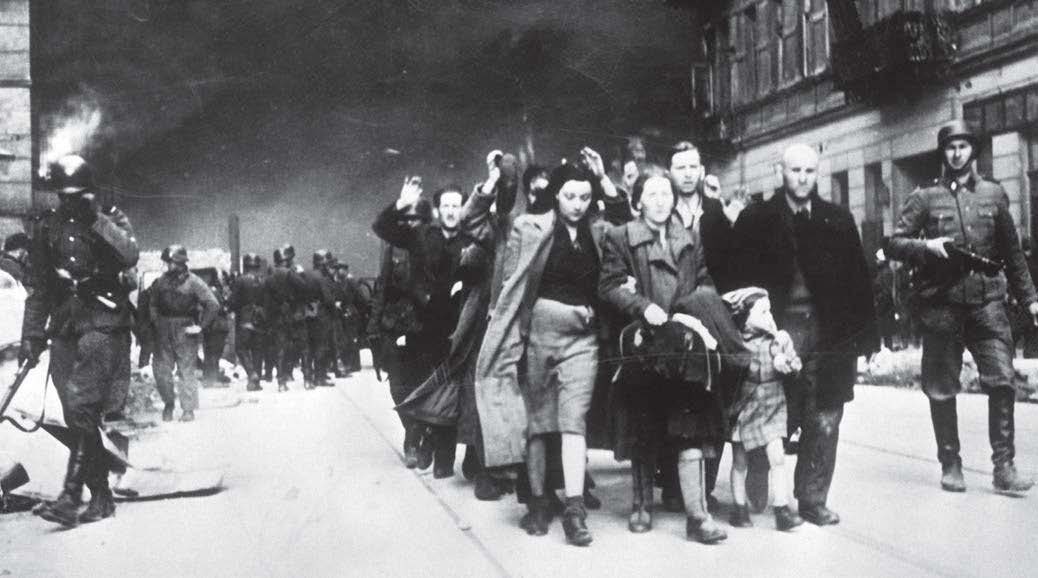
Before Stroop entered Warsaw, its Jews had already been crushed into the ghetto. Before the war, the city’s nearly 400,000 Jews formed Europe’s largest urban Jewish community; worldwide it was second only to New York. The ghetto, 840 acres of the old Jewish quarter, was enclosed with barbed wire and later sealed behind a brick wall ten feet high. Starvation and typhus killed thousands each month. Then the railway did its work. Beginning 22 July 1942, more than 5,000 Jews a day were deported to Treblinka. By September, 265,000 had been sent to the gas chambers.
Here Stroop’s appetite enters the evidence. Before the final operation began, he slipped into the ghetto on inspection. He then returned to his quarters, rubbed on cologne, ate Knödel and rare sirloin, drank Burgundy.
The operation to liquidate the ghetto began on 19 April 1943, the eve of Passover. Stroop had arrived in Warsaw two days earlier, secretly, under orders from Himmler to supervise the destruction. Before dawn, roughly 2,000 SS men and German troops moved towards the ghetto with tanks and rapid-fire artillery.
The Germans expected a police action. They met a small army of the condemned, entrenched in bunkers, attics, courtyards, roofs and sewers. About 700 Jewish fighters resisted with pistols, a few rifles, one machine gun, homemade bombs, grenades, Molotov cocktails. Stroop, to his amazement, discovered young women fighting with weapons in hand. He had planned to liquidate the ghetto in three days. The outgunned Jewish fighters held out for nearly a month.
Stroop’s solution was fire. After initial resistance rattled his forces, he decided “to burn down one house after another”. He recalls the Jews appearing on balconies, roofs, cornices, searching for escape. He remembers the scene in a sensory rush: “Fires, smoke, flames, embers blowing on the wind, dust, floating feathers, the stench of burnt material and bodies, the boom of heavy guns and grenades.” He had a grotesque word for men, women and children who leaped from burning upper floors after tossing down blankets and eiderdowns to break the fall: “paratroopers”. Moczarski records Stroop’s excitement as he pantomimes shooting ducks, pacing the cell and calling out “bang! bang!”. The killer performs again for an audience of two prisoners.
Block after block, the Germans drove people from hiding places with flamethrowers. On Holy Wednesday, Stroop attacked a quartermaster’s complex, where he found ferocious resistance. “With flames, heat and fumes we smoked the Jews out! Herr Moczarski, how they screamed as they were fried and smoked!”
The final act came on 16 May: Stroop blew up the Great Synagogue on Tłomackie Street. Moczarski records him standing in the cell near the radiators, head raised, flushed with happiness. “What a magnificent sight it was!” Stroop says. “A fantastic image, visually and theatrically!… A feast of colours. An unforgettable allegory of the triumph over Jewry.” The same day’s report announced: “The Jewish quarter of Warsaw is no more!”
Stroop then describes what was to replace the ghetto. “The former ghetto area,” he tells his cellmates, “was designated as a residential and recreation district. Villas, gardens, red roof tiles, green shutters, roses, swimming pools, tree-lined avenues, parks and gardens.” The blueprints included a Jürgen-Stroop-Allee.
Instead, at his Polish trial in 1951, Stroop’s own report became evidence against him; its self-congratulation had preserved the crime in his own hand. A US military court had already sentenced him to death for involvement in the murder of captured American airmen; after long negotiations he was transferred to Polish jurisdiction. Stroop was hanged at Mokotów Prison on 6 March 1952.
Moczarski’s afterlife as a free man was no triumphal release into vindication. Rehabilitated in 1956, he joined the Kurier Polski newspaper, but remained under surveillance. During the antisemitic purges that began in 1967, he opposed the hunt for Jewish colleagues and was removed as a department head. Conversations with an Executioner reached Polish readers slowly and appeared uncensored only after communism fell.
Bye has three sharply different voices to carry: Moczarski’s ironic narration, alive to absurdity; Schielke’s sour interjections; Stroop’s mingled pomposity and bureaucratese. His translation wisely preserves the roughness of Moczarski’s prose.
The temptation is to imagine in Stroop some satanic depth proportionate to his crimes. What Moczarski records is a man of compartments: family sentiment, career anxiety, murderous duty, each sealed from the others. The regime had supplied his conscience with a vocabulary: Order, Führer, Reich, hardness. “Anyone wishing to be a true man in those days,” Stroop declares, “meaning a strong one, had to act as I did. ‘Gelobt sei was hart macht!’” (“Praised be what hardens!”) This is the mind Moczarski fixes with such merciless composure: ambition made obedient, obedience made pleasurable, until murder sounded like administration and administration like virtue.
Conversations with an Executioner
Kazimierz Moczarski, trs by Sean Gasper Bye
Duckworth, 496pp, £25
Purchasing a book may earn the NS a commission from Bookshop.org, who support independent bookshops
[Further reading: The agony of Sebastian Faulks]
Content from our partners



Related

This article appears in the 24 Sep 2026 issue of the New Statesman, A Sense of Power
Join the debate
Subscribe here to comment