
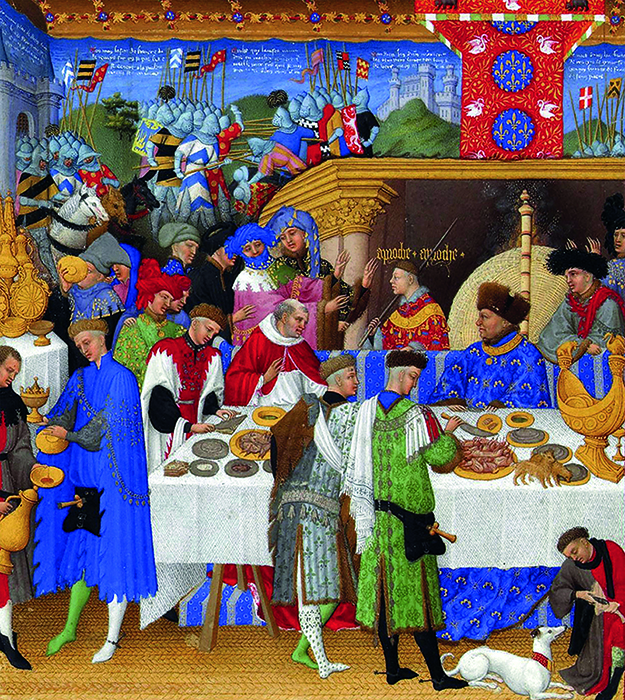
A curator stages a scene. In a medieval palace – now a heritage site – the curator is the one who brings the cold rooms to life: who selects and arranges the manuscript leaves scattered across a desk, the half-finished embroidery draped over the arm of a chair, the artificial food – fruit and meat and pastries and gleaming whole fish – spread out on a banqueting table. It is a strange job. To determine whether she’s been successful in her staging, she has devised a test. She places fresh herbs in the medieval kitchen, next to the plastic eggs and the plastic meat pies; she has an instinctive understanding of the power of the senses to evoke the presence of the past. “If the herbs betray that the replica food is an illusion,” the curator tells us, “it is a failure, and I start again.”
May We Feed the King is Rebecca Perry’s debut novel, now shortlisted for the Booker Prize. It weaves together two stories: the story of the curator, staging and arranging fake fruits and inkwells and discarded robes for an upcoming exhibition in a medieval palace; and the story of the King, a gentle, reluctant ruler who reigned briefly during a hazily sketched Middle Ages. Without names, without many details of character or place or chronology or plot, Perry’s novel has the feel of a medieval allegory. There is the curator, a woman recovering from an unidentified trauma, who feels compelled to reawaken the past through the careful arrangement of rooms; she works together with the archivist, another figure of no determined gender or character, to create a story from the partial archives of the deeper past: the ledgers, ballads, poems and tapestries, that the palace retains in spades.
The story of the King, too, is so spare as to feel allegorical, or maybe archetypal – more fairy tale than novel. He is an unwilling ruler, the third of three brothers, who never expected to rise to the throne. He likes to garden and to daydream. He abhors power, particularly the forms of power that underwrite medieval kingship: violence, expansion, force. He hates the hunt and can’t abide killing animals for sport. He is married to a Queen who is in love with another member of his court. None of these characters have names. The King’s reign is marked by stasis and indecision. He will not go to war. He will not execute traitors. He will not undertake the sorts of projects kings are expected to undertake, such as exploring new trade routes or punishing minor uprisings.
And so, very little happens in the novel: bowls of apples are arranged; ledgers unfurled and transcribed; the King cries softly in his council chamber. And yet, for all its stillness, Perry asks penetrating questions. Partly she wants us to see the parallels between the work of the curator and the work of the historical novelist. Both are concerned with how we judge realism; with how artistic evocations of the past are judged to be successful. Like the fresh herb test, Perry’s answer is that we can approach the deeper, stranger past through sensory description. She describes, for example, the “most beautiful ham slice” available in the artificial food catalogue used by the curator: “with a pollen-like breadcrumbed perimeter” and “slices of white lard curling almost imperceptibly at the edges, as if cut and left on the side to dehydrate”. Perry’s proposition – the curator’s proposition – is that it is this kind of sensory detail that brings the past most vividly to life. She pares away everything else – chronology, event, character, all but the barest elements of plot – to test that idea.

Perry goes further, too, asking sweeping questions about how we can know the past at all. In a scene at the end of the novel, the archivist and the curator hold a sort of open day in the palace, asking and fielding questions from members of the public who walk through the rooms, read the archival documents, and listen to stories about the King. Both characters emphasise just how partial our knowledge of the past is, even with the most complete records: that every document can be interpreted in multiple ways, that there is no ultimate meaning to be made – that we can never really know how the story ends. The curator tells the gathered visitors that recovering the history of the ambivalent King has been a “fuck you” to everyone who tries to manhandle ambiguity into order, to knock out the air” from his story.
The curator tells the audience about a collection of painted apples in a museum in Turin: 286 of them, precisely rendered replicas of every variety of apple grown in Italy in the 19th century. Maybe the apple artist was an obsessive botanist, maybe it was the fashion at the time to undertake such projects, maybe he just loved apples, or maybe, suggests the archivist, he wanted “to make us confront, one day, what we have lost”: that is, of course, how the apples tasted. For a novel that asks us to embrace ambiguity, this lesson was all on the surface – but maybe that is because I am a historian and not a novelist. It is axiomatic to historians that the relationship between history-writing and “what really happened” is as vexed and as fictive as an artist’s evocation of that same past, even if we are oriented by different questions of method.
More compelling are the questions Perry asks about stillness and inertia, and what they mean for the form of the novel itself. The King’s older brother dies on the throne; the King is crowned; he does nothing. He grieves his old life. His court wants him to punish petty criminals or fund faraway adventures or eat voraciously at his banqueting table or have sex with the Queen, but instead he walks in the garden and thinks of flowers he has once seen: “The flowers were pink – a pink like he’d never seen before – and, when rubbed, the foliage smelled of blackcurrant and mint. Please could someone locate it for him.” This is not the sort of authority a king is meant to wield, and his court grows restive. They know that power requires movement.
Does a novel require movement, too? That seems to be Perry’s question. Just how much stillness can a novel hold? At times, May We Feed the King reads almost like a collection of prose poems. The title of each short chapter bears so much of their meaning, not unlike the prose poetry of Anne Carson – a writer Perry has cited as an influence on her work. (Perry is the author of two poetry collections, too.) There is, for example, a very short chapter titled “Are Vessels Not for Carrying”, whose entire text reads: “The Queen notices that now, when people greet her, they look at her stomach before they look at her face, then raise their eyes, disappointed.”
Throughout the story of the King, Perry employs the device of the hole in the wall, the curtain accidentally left drawn. Someone looking in from the garden window, or through a crack in the door, would see some intimate scene: the King sitting at his desk, unable to put quill to paper; or bare-footed, masturbating on the edge of his bed. Like the curator’s precise work with fruit and bowls, the scale of the novel is the domestic, the interior. I thought again and again of stanzas – the form acts as the rooms of the poem. We are peering into a palace on the scale of the dollhouse, life inside its rooms is frozen. It is beautiful, and surreal, and asks us to confront precisely that boundary between the poem and the novel. Susan Stewart, in her book On Longing (1984), described the miniature in fiction as “the daydream of life inside life”, and that is just what Perry has conjured.
“To make us confront, one day, what we have lost,” as the archivist tells their audience, is partly Perry’s aim too. This is where I became less sure of the novel’s success. I loved its questions about form, the beauty of its miniatures and its atmosphere, which is like being inside someone else’s daydream. But the strangeness of the medieval past is oddly tamed here. The King is a bad king by the court’s standards, but he is a good, even worthy, modern man. He gardens, he cries, he doesn’t force monogamy on his wife. It is easy, maybe too easy, to empathise with him.
The King’s gentleness is contrasted with a kind of rough-hewn masculinity expected by his courtiers, one defined above all by a big appetite – for bloodshed, for food, for sex. An appetite fit for a king. But that is a kind of parody of medieval masculinity, which encompassed lots of other virtues and values, too, whether male friendship and camaraderie, loyalty, restraint and, yes, even crying. Perry’s vision of masculinity does not admit the same kind of complexity that is so successful in her questions about power and stillness. But we can’t confront what we have lost if what we have lost has been stripped back to its most unambiguous form.
Erin Maglaque is the author of Presence: A Hidden History of the Female Body (Jonathan Cape)
May We Feed the King
Rebecca Perry
Granta, 272pp, £14.99
Purchasing a book may earn the NS a commission from Bookshop.org, who support independent bookshops
[Further reading: The Goldsmiths Prize 2026 shortlist announced]
Content from our partners



Related


This article appears in the 01 Oct 2026 issue of the New Statesman, Sunshine and Rain
Join the debate
Subscribe here to comment