
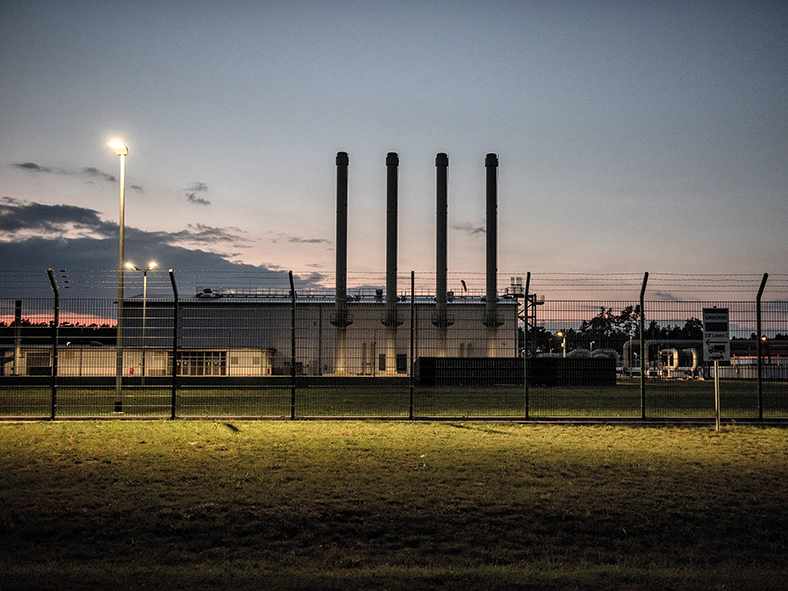
At 2.03am on 26 September 2022, a seismic monitoring station on the edge of the Arctic Circle detected a powerful tremor at the bottom of the Baltic Sea. The Nord Stream 2 pipeline, which was built to transport natural gas from Russia to Germany and ran along the seabed, registered a sudden loss of pressure. A Danish fighter jet flying over the site at dawn observed a vast underwater gas plume that stretched almost a kilometre wide, churning the dark blue surface white as hundreds of thousands of tonnes of pressurised methane surged up from below.
It was soon clear that this was a deliberate act of sabotage. Seven months after Russia’s full-scale invasion of Ukraine, someone had blown up the critical pipeline that connected the Russian gas industry to its most important European customer, even if sales of gas were suspended at the time. Early suspicions centred on the US. The then president, Joe Biden, was on record threatening to “bring an end” to the pipeline if Russia attacked Ukraine. (White House officials clarified that he had been talking about sanctions.) The former Polish foreign minister Radosław Sikorski, who has since returned to the role, helped fuel the speculation by posting a photograph of the aftermath on what was then Twitter with the caption, “Thank you, USA.” (He later told the New Statesman he had meant this as a joke, although maintained that the destruction of the pipeline was a “very good thing”.)
The other prime suspect was Moscow. Maritime tracking data showed Russian military and research vessels in the area shortly before the explosions. Theories emerged that the Kremlin had destroyed its own pipelines to drive up energy costs and stoke political divisions in Germany – perhaps even to extricate the Russian state-controlled giant Gazprom from its contract disputes – but these explanations were never wholly convincing.
In fact, as Bojan Pancevski reveals in The Nord Stream Conspiracy: The Inside Story of the Explosions That Shook the World, the culprits had already slipped back across the border into Ukraine, where they might have remained unknown were it not for a single German traffic camera that unwittingly recorded their escape. In part, the initial focus on the US and Russia was driven by the mistaken assumption that only the world’s most formidable military powers would have been able to muster the specialist underwater capabilities needed to plant explosives at such a precise location, 80 metres below the surface of the Baltic Sea. Ukraine barely had a navy at the time. It was not only foreign observers who believed this. One of the divers who helped to plant the bombs told Pancevski, who is the chief European political correspondent for the Wall Street Journal and has spent many years reporting from Ukraine, that he was convinced another power must have been involved. “Ukraine didn’t have the money or the resources,” he explains. “All we had was a handful of patriotic idiots willing to go to the bottom of the sea.”

Those “patriotic idiots” included civilian deep-sea divers who were recruited for the mission by its architects – a small group of Ukrainian intelligence and military officials Pancevski calls “the Startup” who insist they were working on their own initiative – after it transpired that even the country’s most elite special forces units were not trained to dive to the required 80m depth. One of the leading members of the Startup, known as “the General” (the figures are all anonymised), described the group as a “tiny little deep state,” which had no compunction about resorting to unconventional tactics to defend Ukraine. It falls in and out of favour with Volodymyr Zelensky’s administration in Kyiv as the war goes on. The Startup assemble a cast worthy of Ocean’s Eleven to carry out the attack, as Pancevski puts it: “A dirty dozen – soldiers, divers, born-again Christians and wanted men seeking redemption.”
After training for the mission in strict secrecy in deep, abandoned quarries in Ukraine, the final plan was to travel by road across the continent to Germany, with their explosives concealed in diving canisters, where the team of seven people – three soldiers and four civilians – would board a small, rented yacht and sail out to the location of the pipeline in the Baltic Sea. They are armed with only “makeshift bombs, standard diving equipment, copious amounts of booze and cigarettes, and the audacity to strike a blow against Russia, their imperial nemesis”. The pivotal figure turns out to be a diminutive former model, whom Pancevski calls Freya. Confronted by forbidding waves in the midst of a terrible storm, the men on the boat vote to call off the mission when Freya steps forward to insist that she will dive alone, galvanising – or perhaps shaming – the rest of the crew into pressing ahead. She is also a crucial part of their cover story. If stopped by the police on their way to the marina, the group are supposed to explain that they are making a diving-themed porn film. “This won’t be conspicuous at all in Germany or Sweden,” one of the commanders assures them.
Beyond the sheer audacity of the plot, which succeeds beyond all reasonable expectations (a simultaneous attempt by a second team to target the TurkStream pipeline in the Black Sea was thwarted after the crew was unable to reach the designated site), another key theme to emerge from this book is the murky nature of Ukraine’s wartime politics. Far from the flattering depictions that frequently convey a country united behind the heroic figure of Zelensky, Pancevski documents the improvised and fragmentary composition of the country’s defence, which spans warring clans and vicious power struggles within the political elite. During the chaotic early hours of the Russian assault in February 2022, the members of the Startup arm themselves with grenade launchers, heavy machine guns, and portable anti-aircraft missiles from the Ukrainian military intelligence agency’s armoury and drive out of Kyiv in their own cars to confront the approaching Russian tanks. One of the men brings the ceremonial pistol he was awarded for valour, breaking the gun out of its display case and later firing it at a Russian armoured column.
By April 2022, the Startup are brainstorming ideas to bring the war home to Russia. (The group is ultimately integrated into Ukraine’s Special Operations Force, but, like many Ukrainian units, its operations are still primarily financed by private funds.) They rule out the idea of focusing on high-level assassinations, perhaps even Putin himself, as too time-consuming and unlikely to succeed. Instead, they resolve to target the sources of income that sustain the Russian war machine.
“Everything boils down to the economy,” the General tells the group. “We need to attack their economy. Hit them where it hurts the most.” They settle on a list of economic targets that includes the Kerch Bridge, which links Russia and Crimea, Russian oil pipelines, ports and tankers, as well as the pipelines that supply Russian natural gas to Germany and Turkey.
The plan to attack the Nord Stream 2 pipeline has to be postponed that summer after Dutch intelligence learns of the plot and the CIA warns the Ukrainians not to proceed, concerned that a major attack on European energy infrastructure would trigger a backlash against Ukraine in Germany, one of its most important backers. But after a respectful pause, the Startup move ahead. “God loves everyone equally,” the General explains to Pancevski. “But he helps those who help themselves.”
It is not entirely clear how much Zelensky knew of the plot. Valery Zaluzhny, who was then head of Ukraine’s armed forces but was later removed from his post and dispatched overseas as ambassador to the UK, is said to have told the Ukrainian president about the operation at one point to “cover his own ass”. (Both Zelensky and Zaluzhny deny any involvement in the attack.) Other than Putin, the recurring villain of the book is Andriy Yermak, until recently Zelensky’s chief of staff, who is depicted as a Machiavellian figure, ruthlessly focused on accruing power and pursuing vendettas against his domestic rivals. These include one of the masterminds of the Nord Stream plot, who is thrown into prison on spurious charges for more than a year.
Zaluzhny “never trusted Zelensky’s presidential administration”, Pancevski writes, noting that he blamed the country’s political leadership for failing to prepare for the Russian invasion. “In particular, he thought the all-powerful chief of staff Yermak was a bad actor.” Yermak reportedly comes after Pancevski too, who he says appealed to Lachlan Murdoch in an unsuccessful effort to kill the Journal’s investigation into the Nord Stream bombing. (Yermak resigned in May after anti-corruption investigators raided his home and is currently awaiting trial on charges of money laundering, which he denies.)
If The Nord Stream Conspiracy was merely the story of the plot to blow up the pipeline, it would be over in 180 pages. But Pancevski also details the German police investigation into the attack, weaving together the domestic political fallout in Ukraine, and the broader geopolitical fallout across Europe, with the investigators’ years-long pursuit of the suspects. This includes the tedious work of sifting through endless traffic camera footage, which eventually yields a single, crucial photograph of one of the Ukrainian divers making his getaway.
Most of the suspects remain in Ukraine, which bans the extradition of its citizens. The German detectives are also repeatedly thwarted by their Polish counterparts – one suspect is located and finally arrested, but then released as the country’s political leadership makes it clear that, in their view, the perpetrators of the Nord Stream attack deserve praise, not prison time. A sole suspect, named as Serhii Kuznietsov, was arrested in Italy in August 2025 and extradited to Germany, where he is scheduled to stand trial later this year. Pancevski depicts the lead investigator personally accompanying him in the helicopter to the German detention centre having apparently developed a form of respect for his quarry after their long game of cat and mouse.
One might think that the Nord Stream conspirators would be national heroes in Ukraine. “The officers who recruited them had promised glory,” Pancevski explains. “They said they would be war heroes. They said Europe would be grateful.” Instead, they were being hunted by German detectives, unable to leave Ukraine without fear of arrest. There were no medals, no public accolades, nor even a defence of their actions. One soldier who took part in the mission returned to his unit and died on the front line near Pokrovsk in 2024. One of the generals who oversaw the operation was forcibly retired. Another of the leading figures spent 20 months in jail.
Perhaps the only member of the team to prosper in the aftermath is Freya, the female diver who insists the group complete their mission despite the stormy seas and surely deserves her own book. We are told that Freya has since enlisted in the Ukrainian special forces, where she is an instructor teaching commandos tactical diving and perhaps still taking part in active operations herself. Asked about a series of attacks on Russian shadow-fleet oil tankers in recent years that used magnetic mines attached underwater to their hulls, one of the Nord Stream plotters suggests she could well have been involved. “It’s her unit – and who else would be crazy enough?”
The Nord Stream Conspiracy: The Inside Story of the Explosions That Shook the World
Bojan Pancevski
Hutchinson Heinemann, 336pp, £25
Purchasing a book may earn the NS a commission from Bookshop.org, who support independent bookshops
[Further reading: Salman Rushdie on terrorism in the modern world]
Content from our partners



Related
This article appears in the 16 Sep 2026 issue of the New Statesman, Will AI kill us all?
Join the debate
Subscribe here to comment